Universal Shaft Coupling for PIR Sandwich Panel Line Angle Compensation and Power Transmission

In the modern construction industry, PIR (Polyisocyanurate) sandwich panels have become indispensable building materials due to their excellent thermal insulation, fire-retardant properties, and structural stability. These panels, composed of two outer facing layers and a PIR foam core, are widely used in external walls, roofs, cold storage facilities, and various prefabricated buildings, driving the continuous development and innovation of their production technology. The PIR sandwich panel production line is a complex integrated system that combines mechanical, electrical, hydraulic, and chemical reaction technologies, involving multiple continuous processes such as material uncoiling, roll forming, preheating, foaming, lamination, curing, and cutting. Each link requires precise and stable power transmission to ensure the consistency of product quality and the efficiency of the entire production process. Among the numerous components that make up the transmission system of the production line, the universal shaft coupling stands out as a core component, whose unique structural design and excellent performance in angle compensation and power transmission effectively address the key challenges faced by the transmission system of PIR sandwich panel production lines, ensuring the smooth and efficient operation of the entire production line.
To fully understand the role of universal shaft couplings in PIR sandwich panel production lines, it is first necessary to clarify the working characteristics of the production line and the core requirements for its transmission system. A modern PIR sandwich panel production line is a highly automated continuous production system that requires the coordinated operation of multiple subsystems, including the hydraulic decoiler system, roll forming system, preheating system, foaming system, double-belt lamination system, curing system, cutting system, cooling system, and stacking system. Each subsystem is driven by an independent power source, and the power needs to be transmitted to various executive components accurately and stably to ensure that the entire production line operates in a synchronized manner. The transmission system of the PIR sandwich panel production line faces several unique challenges that ordinary coupling components are difficult to address. Firstly, due to the limitations of the production process and the overall layout of the equipment, the installation positions of each subsystem are often not on the same axis, resulting in inevitable angular deviations between the driving shaft and the driven shaft. For example, the decoiler system and the roll forming system are usually arranged in different positions according to the production process, leading to a certain angle between their respective transmission shafts. Secondly, during the long-term continuous operation of the production line, the equipment will generate vibration and thermal expansion, which will cause changes in the relative position of the transmission shafts, requiring the transmission components to have a certain compensation capacity to avoid damage to the shafts and other components due to excessive stress. Thirdly, the production process of PIR sandwich panels has strict requirements on the stability and uniformity of power transmission. Especially in the foaming and lamination links, even slight fluctuations in power transmission will affect the uniformity of the PIR foam core and the bonding effect between the foam and the outer facing layers, thereby reducing the quality of the finished sandwich panels. In addition, the production environment of PIR sandwich panels may involve certain temperature changes and mechanical vibrations, which puts forward higher requirements on the durability and adaptability of the transmission components. It is against this background that universal shaft couplings have become the ideal choice for the transmission system of PIR sandwich panel production lines, relying on their excellent angle compensation capability and stable power transmission performance.
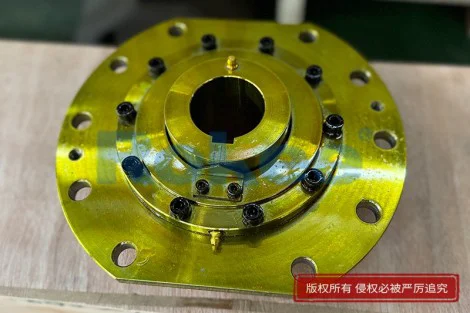
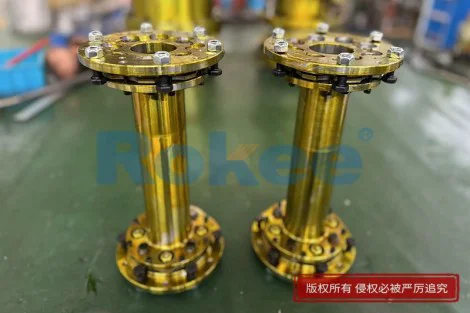
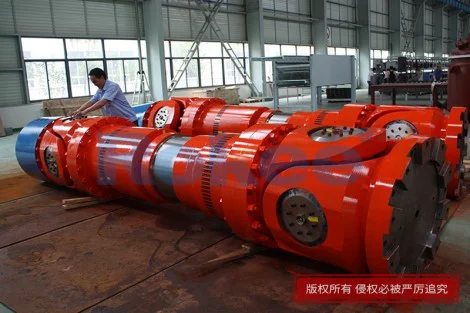
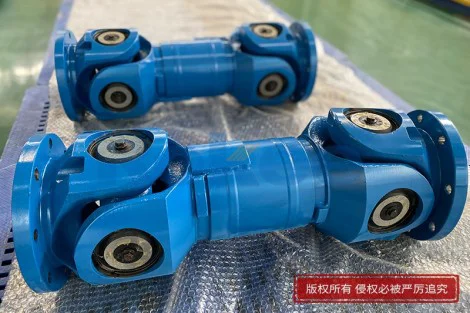
Universal shaft couplings, also known as universal joint couplings, are mechanical components used to connect two rigid shafts whose axes are inclined to each other, enabling the reliable transmission of rotary motion and torque between misaligned shafts. The basic working principle of universal shaft couplings is based on the theory of spatial linkage mechanisms. Taking the commonly used cross-axis universal shaft coupling as an example, it consists of a cross shaft, bearings, and fork head components. The cross shaft connects the fork heads of the two shafts, and the bearings ensure the flexible rotation of the cross shaft. When the driving shaft rotates, it drives the cross shaft to swing, and the cross shaft then transmits the swinging motion to the driven shaft, thereby realizing the transmission of torque and motion. When there is an angular deviation between the two shafts, the cross shaft will continuously adjust its angle during rotation, ensuring the continuous transmission of power. It should be noted that a single universal shaft coupling may experience speed fluctuations during transmission, where the output shaft speed may vary periodically. To solve this problem, in practical applications of PIR sandwich panel production lines, a double-joint universal shaft coupling is usually adopted. By reasonably arranging the spatial geometric relationship between the two universal joints, the synchronization of the driving and driven shafts is ensured, and the impact of speed fluctuations is eliminated, making the power transmission more stable and uniform, which is crucial for ensuring the quality of PIR sandwich panels.
The angle compensation capability of universal shaft couplings is one of their most prominent advantages, and it is precisely this capability that makes them perfectly adapted to the working characteristics of PIR sandwich panel production lines. According to industry practice, the allowable angular deviation between the two shafts connected by universal shaft couplings can usually reach 5° to 45°, depending on the structural type and design parameters of the coupling. In PIR sandwich panel production lines, this angle compensation capability can effectively address the angular misalignment between the transmission shafts of different subsystems caused by installation layout and equipment operation. For example, in the connection between the roll forming system and the foaming system, due to the different installation heights and positions of the two systems, there is often a certain angular deviation between their transmission shafts. The universal shaft coupling can compensate for this deviation through its own structural design, ensuring that the power is smoothly transmitted from the driving shaft to the driven shaft without generating excessive stress on the shafts and bearings. In addition, during the long-term operation of the production line, the thermal expansion of the equipment will cause changes in the relative position of the shafts, leading to changes in the angular deviation. The universal shaft coupling can dynamically adjust to these changes, maintaining stable power transmission and avoiding equipment failure caused by shaft misalignment. This dynamic angle compensation capability not only ensures the smooth operation of the production line but also extends the service life of the transmission system components.
In addition to excellent angle compensation capability, universal shaft couplings also have outstanding power transmission performance, which is essential for the efficient operation of PIR sandwich panel production lines. The power transmission efficiency of universal shaft couplings is usually between 95% and 99%, depending on the type of coupling, working conditions, and design optimization. Among them, the cross-axis universal shaft coupling has an efficiency of about 95% to 98%, which is affected by the deflection angle; the ball cage universal shaft coupling has an efficiency of more than 98%, which is suitable for high-precision transmission scenarios. In PIR sandwich panel production lines, the power required by each subsystem varies according to the process requirements. For example, the decoiler system and the roll forming system need to transmit large torque to drive the uncoiling and forming of the outer facing layers, while the foaming system and the cutting system require more stable and precise power transmission. Universal shaft couplings can meet these different power transmission requirements by selecting appropriate structural types and material specifications. Made of high-strength materials such as alloy steel and carbon steel, universal shaft couplings have high load-bearing capacity and can transmit large torque, which is suitable for the heavy-duty working environment of PIR sandwich panel production lines. After appropriate heat treatment, these materials have excellent wear resistance and fatigue life, ensuring that the universal shaft couplings can maintain stable performance during long-term continuous operation. In addition, the compact structure of universal shaft couplings makes them suitable for installation in spaces with limited space in the production line, without affecting the layout of other equipment, which further enhances their adaptability in PIR sandwich panel production lines.
The selection of universal shaft couplings for PIR sandwich panel line needs to be based on the specific working conditions and process requirements of the production line to ensure that the selected couplings can perfectly match the transmission system. When selecting, several key factors need to be comprehensively considered. Firstly, the torque and power requirements of the transmission system. It is necessary to calculate the actual torque according to the rated power and speed of the equipment, and the allowable torque of the selected universal shaft coupling should be greater than the actual working torque, usually with a safety factor of 1.2 to 2 times to avoid coupling damage due to overload. Secondly, the angular deviation between the shafts. According to the actual angular deviation between the transmission shafts of different subsystems in the production line, select a universal shaft coupling with appropriate angle compensation capacity to ensure that the coupling can effectively compensate for the deviation and maintain stable power transmission. Thirdly, the working environment. The production environment of PIR sandwich panel production lines may involve certain temperature changes and mechanical vibrations. Therefore, it is necessary to select universal shaft couplings with corresponding environmental adaptability. For example, in high-temperature environments, couplings made of high-temperature resistant materials should be selected to avoid material aging and performance degradation; in environments with high humidity or corrosive media, couplings made of corrosion-resistant materials or with surface anti-corrosion treatment should be selected. Fourthly, the installation space. According to the installation space of the transmission system in the production line, select a universal shaft coupling with an appropriate structural size to ensure that the coupling can be smoothly installed and does not interfere with other equipment components. In addition, the maintenance convenience of the coupling should also be considered. Selecting a coupling with simple structure and easy maintenance can reduce the maintenance workload and downtime of the production line, improving production efficiency.
Proper installation and regular maintenance of universal shaft couplings are crucial to ensuring their long-term stable operation and extending their service life, which is directly related to the continuous and efficient operation of PIR sandwich panel production lines. In terms of installation, first of all, it is necessary to ensure the correct alignment of the coupling and the shafts. Although universal shaft couplings have angle compensation capability, excessive misalignment will still increase the wear of the coupling and reduce the transmission efficiency. Therefore, during installation, laser alignment instruments or dial indicators should be used to check the alignment of the shafts, and the angular deviation should be controlled within the allowable range of the coupling. Secondly, the connection between the coupling and the shafts should be firm. The bolts and fasteners used for connection should be tightened according to the specified torque, and anti-loosening gaskets or thread glue should be used to prevent the bolts from loosening during operation. After the initial installation, the equipment should be run for a period of time, and then the bolts should be re-tightened to ensure the firmness of the connection. In addition, during installation, attention should be paid to protecting the surface of the coupling and the shafts to avoid scratches and damage, which may affect the performance of the components.
In terms of maintenance, regular lubrication is one of the key links. The sliding surfaces, cross shafts, and bearings of universal shaft couplings need to be lubricated regularly to reduce friction and wear, improve transmission efficiency, and extend service life. The type of lubricant should be selected according to the working conditions of the coupling. For example, lithium-based grease or molybdenum disulfide calcium-based grease is usually used. The lubrication cycle should be determined according to the working environment and operating time. Under normal working conditions, lubrication should be performed every 300 to 500 hours or every 3 months; under harsh working conditions such as high temperature, heavy load, or high dust, the lubrication cycle should be shortened to 100 to 200 hours or once a month. When lubricating, the old grease should be cleaned first, and then new grease should be injected through the grease nipple until the new grease overflows, ensuring that all lubrication points are fully lubricated. In addition, regular inspection of the coupling is also necessary. It is necessary to regularly check whether there are signs of wear, corrosion, or cracks on the cross shaft, bearings, fork heads, and other components of the coupling. If abnormal wear or damage is found, the components should be replaced in a timely manner to avoid further damage to the coupling and the transmission system. At the same time, the bolts and fasteners should be checked regularly to ensure that they are not loose. The dynamic balance of the coupling should also be checked regularly, especially for couplings used in high-speed transmission scenarios, to avoid excessive vibration caused by unbalanced rotation.
The application of universal shaft couplings in PIR sandwich panel production lines not only solves the key problems of angle compensation and power transmission in the transmission system but also brings significant economic and practical benefits to the production enterprise. By ensuring the stable and efficient operation of the transmission system, universal shaft couplings reduce the failure rate of the production line, reduce unplanned downtime, and improve production efficiency. At the same time, the stable power transmission and accurate angle compensation ensure the consistency of the quality of PIR sandwich panels, reduce the generation of defective products, and improve the market competitiveness of the products. In addition, the long service life and low maintenance cost of universal shaft couplings help reduce the production cost of enterprises and improve economic benefits. With the continuous development of PIR sandwich panel production technology, the requirements for the transmission system are becoming higher and higher. Universal shaft couplings, as a key component of the transmission system, are also constantly being improved and optimized. New materials and structural designs are continuously applied to universal shaft couplings, making them have better performance, higher efficiency, and stronger adaptability, which will further promote the development of PIR sandwich panel production technology and provide more reliable support for the efficient production of PIR sandwich panels.
In practical application cases, many PIR sandwich panel production enterprises have achieved good results by adopting universal shaft couplings. For example, in a large-scale PIR sandwich panel production line, the original transmission system used ordinary rigid couplings, which often had problems such as shaft misalignment, excessive vibration, and frequent equipment failures, resulting in low production efficiency and unstable product quality. After replacing with universal shaft couplings, the angular deviation between the shafts was effectively compensated, the vibration of the transmission system was significantly reduced, the failure rate of the equipment was greatly reduced, and the production efficiency was increased by more than 15%. At the same time, the quality of the PIR sandwich panels produced was more stable, the qualification rate of the products was significantly improved, and the enterprise achieved better economic benefits. This case fully demonstrates the important role of universal shaft couplings in PIR sandwich panel production lines and their significant advantages in solving angle compensation and power transmission problems.
In conclusion, universal shaft couplings play an irreplaceable role in the angle compensation and power transmission of PIR sandwich panel production lines. Their excellent angle compensation capability can effectively address the angular misalignment between the transmission shafts of different subsystems, ensuring the smooth transmission of power; their stable power transmission performance can meet the different power requirements of each link in the production line, ensuring the quality and efficiency of production; their compact structure and strong adaptability make them suitable for the complex working environment and installation layout of PIR sandwich panel production lines. Proper selection, installation, and maintenance of universal shaft couplings are crucial to ensuring their long-term stable operation and the continuous and efficient operation of the production line. With the continuous advancement of industrial technology, universal shaft couplings will be further optimized and improved, and their application in PIR sandwich panel production lines will become more extensive and in-depth, providing stronger support for the sustainable development of the PIR sandwich panel industry.