SWC Cardan Shaft Special Transmission Component for Sandwich Panel Line
In the modern construction and industrial manufacturing fields, sandwich panels have become an essential material due to their excellent thermal insulation, structural stability, flame retardancy, and environmental friendliness. These panels, composed of two outer facing materials and a core layer (such as polyurethane, rock wool, or foam), are widely used in external walls, roofs, cold storage facilities, prefabricated buildings, and other scenarios, driving the continuous development and upgrading of sandwich panel production technology. A sandwich panel production line is a complex integrated system that involves multiple sequential processes, including uncoiling of facing materials, roll forming, preheating, core material foaming or filling, lamination, curing, and cutting. Each process requires precise, stable, and efficient power transmission to ensure the consistency of product quality, the smooth operation of the production line, and the improvement of production efficiency. Among the numerous transmission components in the production line, the SWC cardan shaft stands out as a special and indispensable core component, whose unique structural design and excellent transmission performance perfectly adapt to the complex working conditions of sandwich panel production lines, providing reliable power support for the stable operation of the entire production system.
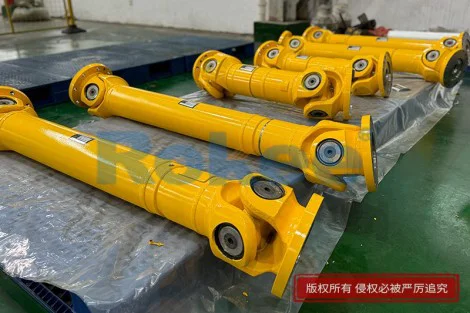
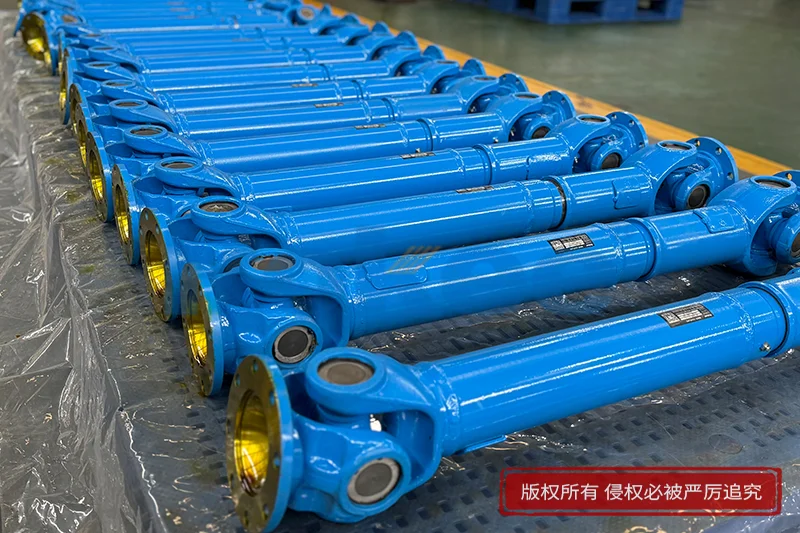
The SWC cardan shaft, also known as the SWC cross-shaft universal joint shaft, is a high-performance transmission component designed for heavy-duty, high-torque, and angular deviation transmission scenarios. Unlike ordinary transmission shafts, it adopts a scientific and reasonable structural design that can effectively transmit power between two shafts that are not on the same axis, compensate for angular deviations, axial displacements, and radial displacements between shafts, and absorb vibration and buffer impact loads during operation. These characteristics make it particularly suitable for sandwich panel production lines, where the layout of various equipment subsystems is often limited by the production process and site space, resulting in unavoidable axis misalignment between the driving device and the driven equipment. The SWC cardan shaft can effectively solve this problem, ensuring that power is transmitted stably and efficiently, thereby avoiding production interruptions or product quality defects caused by transmission failures.
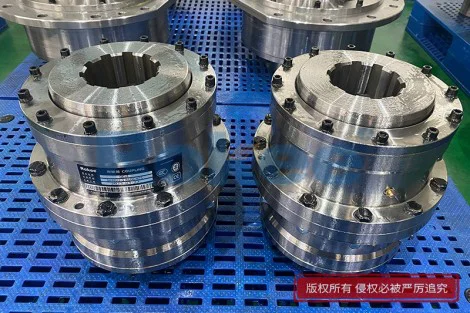
To better understand the role of the SWC cardan shaft in sandwich panel production lines, it is necessary to first elaborate on its structural composition and working principle. The core structure of the SWC cardan shaft mainly includes universal joint forks, cross shafts, needle bearings, spline shafts, spline sleeves, and sealing devices. The universal joint forks are usually made of high-strength alloy steel through integral forging, which abandons the traditional bolt connection method, reduces the number of connection points and parts, significantly improves structural rigidity and load-bearing capacity, and effectively reduces the risk of failures caused by bolt loosening or fracture. In the same external dimension, the load-bearing capacity of this integral forging structure is higher than that of traditional split structures, which can better adapt to the heavy-duty working environment of sandwich panel production lines.
The cross shaft is the core hub of power transmission in the SWC cardan shaft, usually made of high-quality alloy steel such as 20CrMnTi. After carburizing and quenching treatment, its surface hardness can reach a high level, while ensuring that the core part has good toughness, which can withstand large torque and impact loads without deformation or fracture. The roundness error of the bearing position of the cross shaft is strictly controlled within a very small range, ensuring precise cooperation with the needle bearings. The needle bearing system is an important component to ensure the smooth operation of the SWC cardan shaft. Each set of bearings contains dozens of precision needles, which are matched with bearing sleeves of special contours, resulting in an extremely low friction coefficient. This not only reduces energy loss during transmission but also reduces wear between parts, extending the service life of the component.
The spline shaft and spline sleeve are designed to cooperate with each other, endowing the SWC cardan shaft with telescopic compensation capacity. In the operation process of the sandwich panel production line, due to factors such as equipment vibration, thermal expansion, and installation errors, there may be a certain amount of axial displacement between the driving shaft and the driven shaft. The telescopic function of the spline pair can effectively compensate for this displacement, avoiding additional stress on the transmission component and ensuring stable power transmission. The sealing device of the SWC cardan shaft adopts a combination of multi-layer labyrinth seal and high-temperature resistant grease, which can effectively prevent grease leakage and prevent external dust, water vapor, and other pollutants from entering the bearing interior. This design can realize long-term maintenance-free operation, reduce the frequency of equipment maintenance, and improve the continuous operation capacity of the sandwich panel production line.
The working principle of the SWC cardan shaft is based on the universal transmission effect of the cross shaft. When there is an angular deviation between the driving shaft and the driven shaft, the cross shaft swings with the universal joint fork through its own rotation to compensate for the angular deviation, and at the same time, realizes the stable transmission of torque through precise cooperation with the needle bearings. The single-section SWC cardan shaft can compensate for an axis angle of 15° to 25°, and if a double cross-shaft series installation method is adopted, the angle compensation capacity can be increased to 40° to 45°, and the speed fluctuation caused by single-section transmission can be offset through a specific installation layout, ensuring that the rotational speed of the input and output shafts remains consistent. This excellent angle compensation capacity enables the SWC cardan shaft to adapt to the transmission scenario where the two shafts are not concentric or have relative swing in the sandwich panel production line, and can also absorb vibration and buffer impact loads during the operation of the equipment, reducing the vibration and noise of the transmission system, improving the working environment, and extending the service life of the entire production line equipment.
In the actual operation of the sandwich panel line, the SWC cardan shaft is widely used in various key transmission links, playing an irreplaceable role. For example, in the uncoiling and roll forming process of facing materials, the uncoiling machine and roll forming machine need stable power transmission to ensure that the facing materials are uncoiled at a uniform speed and formed according to the specified shape. Due to the layout limitations of the equipment, there is often an angular deviation between the motor and the transmission shaft of the uncoiling machine and roll forming machine. The SWC cardan shaft can effectively compensate for this deviation, ensuring that the power is transmitted stably, avoiding uneven uncoiling speed or uneven forming of the facing materials, which affects the subsequent lamination quality.
In the core material foaming and lamination process, which is a key link in the production of sandwich panels, the stability of power transmission directly affects the uniformity of the core material foaming and the bonding firmness between the core material and the facing materials. The foaming system and lamination system of the sandwich panel production line need to operate synchronously, and the power transmission between the two systems requires high precision. The SWC cardan shaft has high transmission efficiency, which can reach 98% to 99.8%, ensuring that the power is transmitted efficiently without excessive energy loss. At the same time, its stable transmission performance can avoid speed fluctuations, ensuring that the foaming agent is evenly distributed in the core layer and the lamination pressure is stable, thus improving the density uniformity and structural strength of the sandwich panels.
In the cutting process of sandwich panels, the cutting machine needs to operate at a constant speed to ensure that the cutting size of the panels is accurate and the cutting surface is flat. The power transmission between the motor and the cutting blade often faces the problem of axis misalignment due to the installation position of the cutting machine. The SWC cardan shaft can solve this problem well, ensuring that the cutting blade rotates at a constant speed, avoiding cutting size errors or uneven cutting surfaces caused by unstable power transmission, and improving the qualification rate of products.
The excellent performance of the SWC cardan shaft in the sandwich panel production line is not only reflected in its structural design and transmission effect but also in its strong adaptability to the working environment. Sandwich panel production lines usually operate continuously for a long time, and the working environment may have dust, humidity, and temperature changes. The SWC cardan shaft is made of high-quality materials and undergoes strict heat treatment and surface treatment, which has good corrosion resistance, wear resistance, and high-temperature resistance. It can operate stably in harsh working environments, not easily affected by external factors, and reduce the frequency of component replacement.
In addition, the SWC cardan shaft also has the characteristics of easy installation and maintenance, which is very suitable for the actual needs of sandwich panel production lines. The installation process of the SWC cardan shaft is relatively simple, and it can be installed and debugged according to the actual installation space and axis deviation of the production line. During the installation process, it is only necessary to strictly control the coaxiality error of the two shafts to avoid additional load on the cardan shaft due to excessive installation deviation. In terms of maintenance, due to the excellent sealing performance and wear resistance of the SWC cardan shaft, it only needs regular inspection of the lubricating oil status, sealing performance, and component wear during long-term operation. If necessary, supplementary lubricating oil or replacement of worn parts can be carried out, which reduces the maintenance cost and labor intensity of the production line.
It should be noted that the selection of the SWC cardan shaft for the sandwich panel production line needs to be based on the actual working conditions of the production line, such as the rated torque, rotational speed, working temperature, installation space, and axis deviation. Different models of SWC cardan shafts have different load-bearing capacities, angle compensation ranges, and telescopic amounts. Only by selecting the appropriate model can the best transmission effect be achieved, and the stable operation of the production line be ensured. For example, for sandwich panel production lines with large torque and high rotational speed, a model with a larger nominal torque and higher allowable rotational speed should be selected; for production lines with large axis deviation, a model with strong angle compensation capacity should be selected.
In the process of using the SWC cardan shaft, some operational taboos also need to be paid attention to. It is strictly prohibited to use a hammer to directly strike the cross shaft or universal joint fork, which may cause deformation or damage to the parts; it is not allowed to forcibly assemble the spline pair without aligning the phase marks, so as to avoid damage to the tooth surface; different specifications of bolts should not be mixed to ensure the connection strength. In special working environments, such as high temperature or high humidity, corresponding protective measures should be taken, such as selecting ceramic bearings and adding heat insulation covers in high-temperature environments, and adding stainless steel dust covers in humid environments to extend the service life of the SWC cardan shaft.
With the continuous development of sandwich panel production technology, the requirements for transmission components are becoming higher and higher. The SWC cardan shaft, as a special transmission component suitable for sandwich panel production lines, has been widely used and recognized due to its excellent performance, stable operation, and strong adaptability. It not only ensures the stable operation of the sandwich panel production line and improves production efficiency and product quality but also reduces the maintenance cost and equipment failure rate of the production line, bringing considerable economic benefits to enterprises. In the future, with the continuous advancement of mechanical processing technology and material science, the SWC cardan shaft will be further optimized and improved in terms of structure, performance, and service life, better adapting to the development needs of the sandwich panel production industry, and making greater contributions to the development of the construction and industrial manufacturing fields.
In summary, the SWC cardan shaft is an indispensable special transmission component in the sandwich panel production line. Its unique structural design, excellent transmission performance, strong adaptability, and easy installation and maintenance make it perfectly suitable for the complex working conditions of the sandwich panel production line. It provides reliable power support for each process of the production line, ensures the stable operation of the production line, improves production efficiency and product quality, and plays an important role in promoting the healthy and sustainable development of the sandwich panel production industry. For enterprises engaged in the production of sandwich panels, choosing a suitable SWC cardan shaft and doing a good job in its installation, use, and maintenance is of great significance for reducing production costs, improving market competitiveness, and achieving long-term stable development.