Barrel Coupling For Pump

Barrel couplings serve as indispensable mechanical components in modern pump systems, acting as the core connecting medium between pump drive units and load-bearing structures to achieve stable torque transmission and flexible mechanical compensation. Unlike conventional rigid couplings, this specialized coupling structure is uniquely optimized for the complex operating conditions of pump equipment, effectively addressing common operational issues such as shaft misalignment, mechanical vibration, and thermal displacement that frequently occur during long-term pump operation. Its ingenious barrel-shaped contact structure enables uniform load distribution during power transmission, significantly reducing local stress concentration on key mechanical parts. Widely applied in various industrial and civil pump scenarios, the barrel coupling balances transmission efficiency, operational stability and service durability. It not only ensures the continuous and efficient operation of pump equipment but also minimizes mechanical wear and failure risks, becoming a key guarantee for the long-term stable operation of fluid transmission systems.
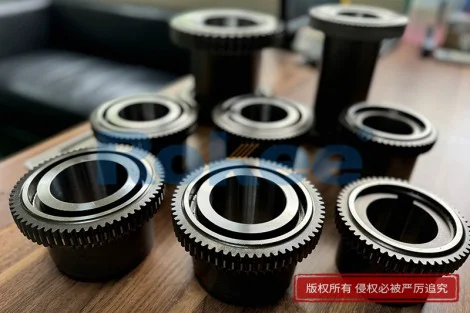
The core structural design of barrel couplings lays a solid foundation for their superior performance in pump system matching. Composed of precision-machined barrel-shaped tooth sleeves, matching hubs and auxiliary fastening components, the overall structure features high integration and compactness, which perfectly adapts to the limited installation space of most pump equipment. The curved barrel tooth profile is the most distinctive design highlight, differing greatly from traditional straight-tooth coupling structures. This special tooth shape can form a larger contact area during torque transmission, enabling gradual and even load transfer rather than instantaneous concentrated force bearing. When the pump starts, stops or operates with variable load, the flexible contact structure buffers instantaneous impact force effectively. Meanwhile, the overall structure adopts high-strength wear-resistant materials, which can resist mechanical abrasion and fatigue damage caused by long-term continuous operation of pumps. The simplified assembly structure also avoids redundant mechanical structures, reducing the probability of structural failure and making the coupling more adaptable to the continuous working state of pump equipment.
One of the most valuable functional advantages of barrel couplings in pump systems is their excellent misalignment compensation capability. During the installation and long-term operation of pump equipment, various misalignment problems are inevitable due to manual installation errors, equipment foundation settlement, thermal expansion and contraction of metal parts, and mechanical aging. These deviations include parallel offset, angular deflection and axial displacement between the driving shaft and driven shaft of the pump. Without effective compensation, such misalignment will cause severe shaft vibration, abnormal bearing wear and unstable torque transmission, greatly shortening the service life of pump core components. Barrel couplings can flexibly adapt to these tiny mechanical displacements through the flexible fit of barrel tooth structures, automatically adjusting the contact angle and stress distribution between teeth. This real-time compensation function eliminates additional mechanical stress caused by misalignment, ensures the coaxial stability of the pump transmission system, and maintains consistent and efficient power output throughout the equipment operation cycle.
Barrel couplings deliver outstanding performance in vibration damping and noise reduction, which is crucial for optimizing the operating environment of pump systems. Pump equipment inevitably generates mechanical vibration and running noise during high-speed operation, especially in high-power and high-flow industrial pump scenarios. Long-term severe vibration will not only loosen equipment connecting parts and affect operation accuracy but also cause structural fatigue damage to the entire fluid transmission system. The unique elastic contact mechanism of barrel couplings can absorb and dissipate most of the vibration energy generated during power transmission. The curved tooth surface fits tightly and buffers vibration frequency differences between the driving end and driven end, avoiding vibration resonance of the pump system. In addition, the uniform load transmission mode eliminates the friction and impact noise caused by local uneven force of traditional couplings. Stable and low-vibration operation not only improves the overall working efficiency of the pump but also reduces equipment operation noise, meeting the environmental operation requirements of various industrial production and civil engineering scenarios.
In terms of power transmission efficiency, barrel couplings show obvious advantages over many traditional coupling products in pump matching applications. The optimized barrel tooth contact design maximizes the effective stress area during torque transmission, realizing almost lossless power transmission between the pump power source and the working end. Traditional couplings often have problems such as insufficient contact area and uneven force, which lead to partial power loss during operation and reduce the overall operating efficiency of pump equipment. Barrel couplings can maintain stable transmission efficiency even under variable load and long-term continuous operation conditions. When the pump operates at high load or frequent start-stop cycles, the coupling structure can still evenly bear torque changes without local overload or stress concentration. This efficient transmission performance not only reduces invalid energy consumption of pump equipment but also ensures stable fluid transmission capacity, avoiding flow fluctuation and pressure instability caused by power transmission failure, thus improving the overall working quality of the fluid conveying system.
Durability and low maintenance characteristics make barrel couplings highly cost-effective in long-term pump system operation. Pump equipment usually needs to operate continuously for a long time, putting forward high requirements on the wear resistance, fatigue resistance and structural stability of matching coupling parts. Barrel couplings adopt refined processing technology and high-quality structural materials, with strong resistance to mechanical wear, impact load and thermal aging. The smooth curved tooth surface reduces friction loss during relative movement, avoiding rapid wear and tooth surface damage caused by long-term friction. Different from ordinary flexible couplings that are prone to elastic fatigue and structural deformation, the structural stability of barrel couplings can remain unchanged after thousands of start-stop cycles and long-term continuous operation. Meanwhile, the integrated and simplified structural design avoids easily damaged vulnerable parts, reducing the frequency of daily inspection and replacement. The low maintenance demand effectively shortens equipment downtime, improves the continuous operation rate of pump systems, and reduces the overall operation and maintenance cost of mechanical equipment.
The wide application adaptability of barrel couplings enables them to be compatible with diversified pump equipment and complex working conditions. Whether it is small and medium-sized civil water supply pumps, large industrial circulating pumps, or fluid delivery pumps used in special working environments, barrel couplings can achieve precise matching and stable operation. Their compact structural form adapts to narrow installation spaces of integrated pump equipment, while the high load-bearing performance meets the operation demands of high-power heavy-duty pump systems. In working environments with temperature changes, dust pollution and slight mechanical impact, barrel couplings can still maintain stable working performance without failure caused by environmental interference. Moreover, the flexible structural design can adapt to different shaft diameter specifications and installation forms of pump equipment, with strong universality. This excellent adaptability makes barrel couplings the preferred matching part of most pump system transformation and new equipment supporting projects, and also promotes their wide promotion in various fluid transmission fields.
With the continuous upgrading of pump system intelligent operation and high-efficiency energy-saving requirements, the application value of barrel couplings in fluid transmission equipment is becoming increasingly prominent. Modern pump equipment is developing towards high precision, high efficiency and long-life cycle, which puts forward higher standards for the stability, accuracy and durability of supporting transmission components. Barrel couplings, with their superior misalignment compensation, efficient transmission, vibration reduction and long-life performance, can fully meet the iterative upgrading needs of pump systems. In actual industrial operation, they effectively reduce the failure rate of pump transmission systems, extend the overall service life of equipment, and create stable operational benefits for fluid transmission work. In the future, with the continuous optimization of structural design and material technology, barrel couplings will further improve their comprehensive performance, adapt to more extreme working conditions and high-precision pump operation scenarios, and provide more reliable basic support for the efficient and stable operation of various fluid transmission systems.