Flexible Tyre Coupling
In the field of mechanical power transmission, the stability and durability of shaft connection components directly determine the overall operating efficiency and service life of mechanical systems. Among various flexible transmission components, flexible tyre coupling stands out as a highly practical and versatile connecting unit, widely adopted in general industrial machinery, fluid transmission equipment, power generation devices and various rotating mechanical systems. Different from rigid couplings that rely on hard connection to transmit torque and ordinary flexible couplings with limited deformation tolerance, this type of coupling utilizes a special elastomeric tyre structure as the core force-bearing and buffer component, realizing efficient torque transmission while possessing excellent adaptive adjustment and energy absorption capabilities. Its unique structural design and material characteristics enable it to adapt to complex and changeable operating environments and variable load working conditions, solving many common vibration, impact and misalignment problems in mechanical transmission processes.
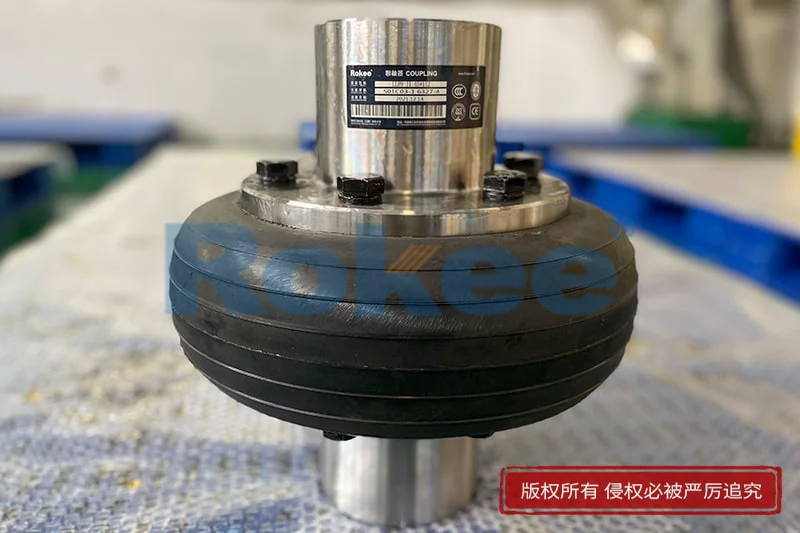
The basic structural composition of flexible tyre coupling is simple and scientific, mainly consisting of an elastic rubber tyre body and two symmetric connecting flanges. The elastic tyre component is the core part of the coupling, which is usually made of high-elasticity composite rubber materials with internal fiber reinforcement structures. This integrated rubber structure avoids the structural defects of split connecting components, ensuring uniform force bearing and stable deformation during operation. The two flanges are installed on the driving shaft and driven shaft respectively, and are closely connected with the rubber tyre body through fastening structures. This assembly method forms a flexible connection system between the two shafts, completely different from the rigid locking connection of traditional couplings. When the equipment operates, the torsional shear deformation of the rubber tyre body becomes the core working form, which not only completes the continuous transmission of rotational torque, but also reserves sufficient flexible buffer space for the relative displacement between the two connected shafts.
One of the most prominent functional advantages of flexible tyre coupling is its excellent multi-dimensional misalignment compensation ability. In actual mechanical installation and long-term operation, it is difficult to achieve absolute coaxiality between the driving shaft and the driven shaft. Processing errors of mechanical parts, installation deviations, thermal deformation during equipment operation, and slight foundation settlement will lead to three types of misalignment states: axial displacement, radial parallel displacement and angular deviation. Most traditional couplings can only compensate for a single type of misalignment with a small tolerance range, and excessive deviation will cause additional mechanical stress, severe component wear and even shaft deformation. In contrast, flexible tyre coupling can simultaneously adapt to three-dimensional misalignment changes with a large allowable compensation range. The high elasticity and structural ductility of the rubber tyre body can offset the relative displacement between shafts in all directions, avoiding rigid friction and extrusion between shaft components. This adaptive compensation effect effectively eliminates additional load generated by shaft misalignment, protects bearings, shafts and other precision transmission parts, and greatly reduces the failure rate of mechanical transmission systems.
Superior vibration damping and shock absorption performance is another core feature that makes flexible tyre coupling irreplaceable in industrial transmission. Most industrial mechanical equipment will generate periodic rotational vibration during continuous operation, and frequent start-stop, sudden load increase or decrease, and impact load working conditions will produce instantaneous strong mechanical shock. These vibrations and impacts will be transmitted along the transmission shaft, causing resonance of the whole equipment, increasing operating noise, accelerating fatigue wear of parts, and even loosening connecting structures and damaging precision components in severe cases. The elastomeric material of the tyre coupling has good damping and energy dissipation characteristics. When vibration and impact energy are transmitted to the coupling, the rubber tyre body will produce reversible elastic deformation to absorb and consume most of the impact and vibration energy. It can effectively isolate the mutual transmission of vibration between the driving end and the driven end, suppress mechanical resonance, and reduce equipment operating noise. For mechanical equipment with frequent variable load operation, this buffer and damping effect can stabilize the operating state of the equipment, avoid instantaneous torque impact damage to the transmission system, and ensure continuous and stable power output.
In terms of operating performance and environmental adaptability, flexible tyre coupling has many practical advantages that meet the needs of industrial production. First of all, it achieves backlash-free torque transmission. The integrated flexible structure and tight assembly fit ensure that there is no idle stroke during torque transmission, and the power response is sensitive and accurate. This characteristic is particularly important for equipment that requires precise power transmission and stable speed regulation, avoiding torque loss and transmission delay caused by structural gaps. Secondly, the coupling has excellent electrical insulation performance. The rubber elastomer material can effectively isolate current conduction between the two connected shafts, prevent galvanic corrosion and static accumulation in the transmission system, and protect mechanical components and supporting electrical control systems from electrical damage. In addition, optimized rubber formula materials enable the coupling to resist the erosion of conventional industrial media such as lubricating oil, common chemicals and moisture, and have certain anti-aging and anti-ultraviolet capabilities, adapting to harsh working environments such as open-air operation, humid workshops and oil-rich working conditions.
The installation, disassembly and daily maintenance of flexible tyre coupling have obvious cost and efficiency advantages. Its standardized structural design allows radial assembly and disassembly without moving or adjusting the connected driving and driven equipment. During installation, workers only need to fix the flanges on the corresponding shafts and complete the butt joint and fastening of the rubber tyre body, without complex debugging and precision calibration processes. Compared with other flexible couplings that require high-precision alignment and professional installation tools, its installation difficulty is significantly reduced, and the construction cycle is shortened. In daily operation, the coupling requires no lubrication and regular oiling maintenance, eliminating the daily maintenance work of refueling, oil inspection and sealing replacement required by gear couplings and chain couplings. The simple structure with few vulnerable parts also reduces the probability of structural failure. Daily inspection only needs to check the surface state of the rubber tyre body and the fastening degree of connecting parts, which greatly reduces the manpower and time cost of equipment operation and maintenance, and improves the overall operating efficiency of production equipment.
Flexible tyre coupling also shows good operating stability and fatigue resistance in long-term service. Although it is a flexible connecting component, the reinforced fiber structure inside the rubber tyre body effectively enhances the overall structural strength and torsional rigidity, avoiding excessive deformation and torque loss during high-load operation. Under long-term continuous operation and frequent alternating load conditions, the material can maintain stable elastic performance, without permanent deformation, elastic fatigue or rapid aging failure. Its reasonable stress distribution structure makes the force borne by each part of the tyre body uniform, avoiding local stress concentration and premature damage. This reliable long-term service performance ensures the continuous and stable operation of mechanical equipment, reduces frequent shutdown maintenance caused by coupling failure, and improves the continuity of industrial production.
It is also necessary to objectively recognize the performance limitations of flexible tyre coupling to realize scientific selection and standardized application. Compared with rigid couplings and heavy-duty gear couplings, its ultimate bearing capacity is relatively limited, and it is not suitable for ultra-high torque and ultra-high load working conditions. In addition, when the relative torsion angle between the two shafts is too large, the rubber tyre body will produce obvious torsional distortion, resulting in slight changes in axial size, and generating small additional axial force on the connected shaft parts. Meanwhile, the overall outer dimension of the coupling is relatively large, which requires a certain installation space in the mechanical structure. These characteristics determine that it is more suitable for medium and light load transmission scenarios with high requirements for vibration reduction, misalignment compensation and stable operation, rather than extreme heavy-load and ultra-precision micro-displacement transmission equipment.
Based on its comprehensive performance advantages, flexible tyre coupling has been widely used in various industrial fields. In fluid transmission equipment such as water pumps and fans, it can offset the vibration generated by high-speed rotation and the slight shaft misalignment caused by long-term operation, ensuring the stable operation of fluid transmission systems and reducing pipeline vibration and noise. In power equipment such as compressors and generators, it buffers the periodic impact load generated by equipment operation, protects precision power components, and improves the stability of power output. In general manufacturing machinery, transportation equipment and agricultural machinery, it adapts to frequent start-stop and variable load working conditions, reduces equipment failure rates, and extends the overall service life of mechanical systems. With the continuous upgrading of industrial mechanical equipment towards high efficiency, low noise and high stability, the application value and application scope of flexible tyre coupling are constantly expanding, becoming an indispensable basic connecting component in modern mechanical transmission systems.
In conclusion, flexible tyre coupling balances flexibility and stability in structural design, and integrates misalignment compensation, vibration damping, shock absorption, easy maintenance and environmental adaptability in functional performance. Although it has certain limitations in load-bearing capacity and structural volume, its comprehensive advantages in adapting to complex working conditions and improving equipment operating stability make it occupy an important position in the field of mechanical transmission. With the continuous optimization of elastomer material formulas and structural design technology, the performance of flexible tyre coupling will be further improved, with higher load-bearing capacity, better aging resistance and longer service life, providing more reliable basic support for the efficient and stable operation of various industrial mechanical equipment.