Cardan Driveshaft Optimizes PUF Board Production Line Transmission Efficiency Upgrade
In the modern manufacturing industry, the efficiency and stability of production lines directly determine the competitiveness of enterprises, especially in the field of PUF board production. PUF boards, known for their excellent thermal insulation, sound insulation, and structural strength, are widely used in construction, refrigeration, and aerospace fields. However, the production process of PUF boards involves multiple links, including raw material mixing, foaming, lamination, cutting, and packaging, each of which relies on a stable and efficient transmission system to ensure continuous operation. The transmission system is the "nerve" of the PUF board production line, and any instability or inefficiency in transmission will lead to reduced production efficiency, increased energy consumption, and even defects in product quality. In recent years, with the continuous upgrading of industrial production technology, the cardan driveshaft, as a flexible transmission component with unique structural advantages, has been widely applied in PUF board production lines, effectively solving the bottlenecks of traditional transmission systems and promoting the comprehensive upgrade of transmission efficiency.
To understand how the cardan driveshaft optimizes the transmission efficiency of PUF board production lines, it is first necessary to clarify the core challenges faced by the transmission system in the production process of PUF boards. Unlike general mechanical production lines, the PUF board production line has special requirements for the transmission system due to the particularity of its production process. First, the installation and layout of each subsystem in the production line, such as the mixing equipment, foaming machine, lamination roller, and cutting machine, are often not on the same axis due to the limitations of the production process and the overall structure of the equipment, resulting in angular deviations between the driving shaft and the driven shaft. This misalignment is inevitable in actual production, and traditional rigid transmission components cannot effectively compensate for this deviation, leading to uneven power transmission, increased mechanical wear, and even equipment failure. Second, during the long-term continuous operation of the production line, the equipment will generate a certain amount of vibration and thermal expansion due to high-load operation and changes in ambient temperature. These factors will cause changes in the relative position of the transmission shafts, requiring the transmission components to have a certain degree of compensation capacity to adapt to these dynamic changes. Third, the production process of PUF boards has strict requirements for the stability and uniformity of power transmission. Especially in the foaming and lamination links, even slight fluctuations in transmission speed or torque will affect the density of the PUF foam core and the bonding effect between the core and the facing materials, thereby reducing product quality and increasing the rate of defective products. Fourth, with the diversification of market demand, PUF board production lines need to adapt to the production of products of different specifications and thicknesses, which involves adjusting the speed and torque of each subsystem. The traditional transmission system has poor flexibility and adaptability, making it difficult to quickly respond to production adjustments, thus affecting production efficiency.
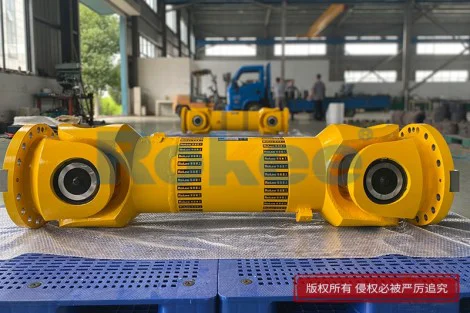
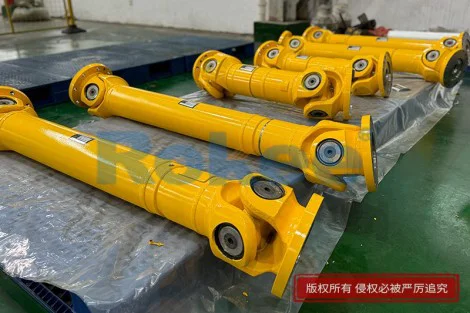
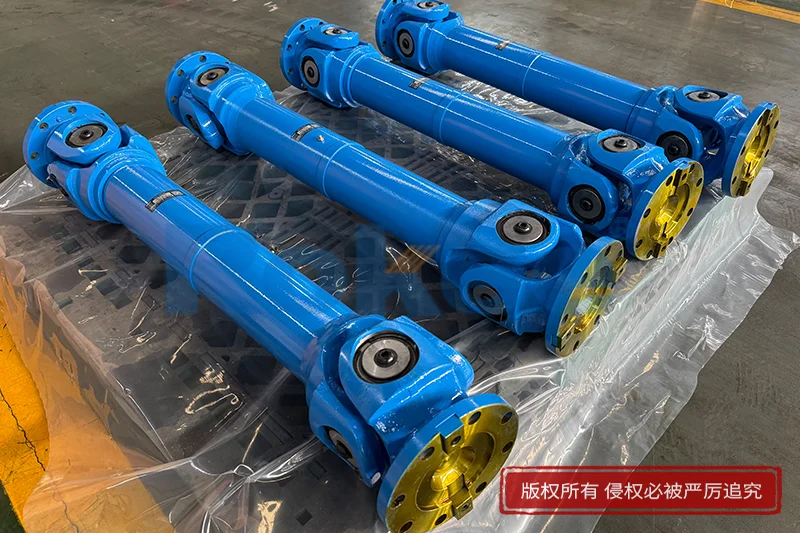
The cardan driveshaft, also known as a universal joint shaft, is a mechanical component designed to transmit rotational motion and torque between two rigid shafts with inclined axes. Its basic structure consists of a pair of hinges arranged close to each other, perpendicular to each other, and connected by a cross shaft, also known as the spider. This unique structural design gives the cardan driveshaft excellent flexibility and compensation capacity, which can perfectly solve the above-mentioned challenges of the PUF board production line transmission system. Unlike rigid couplings that require precise coaxial alignment of the two shafts, the cardan driveshaft can realize stable power transmission even when there is an angular deviation between the shafts, which greatly reduces the installation accuracy requirements of the production line equipment, simplifies the installation process, and reduces the installation and adjustment time. In the PUF board production line, the angular deviation between the driving shaft and the driven shaft of each equipment is often between 5° and 45°, and the cardan driveshaft can easily compensate for this deviation through its cross shaft and hinge structure, ensuring that the power is transmitted smoothly and uniformly, avoiding the problems of uneven transmission and mechanical wear caused by misalignment.
In addition to its excellent misalignment compensation capacity, the cardan driveshaft also has the advantage of stable torque transmission, which is crucial for the PUF board production process. The foaming link of PUF boards requires the mixing equipment to rotate at a stable speed to ensure that the raw materials are fully mixed and the foaming agent can react evenly. The lamination link requires the lamination roller to maintain a constant torque to ensure that the PUF foam core and the facing materials are closely bonded without bubbles or gaps. The traditional transmission system often has torque fluctuations due to factors such as shaft misalignment and mechanical wear, which affect the stability of the production process. The cardan driveshaft, through its precision-manufactured cross joints, bearing caps, and splined sections, can effectively reduce torque loss and ensure that the torque is transmitted stably and uniformly. Even under high-load and high-speed operation conditions, the cardan driveshaft can maintain consistent rotational speed and torque transfer, providing a stable power guarantee for each link of the PUF board production line. At the same time, the cardan driveshaft has a strong load-bearing capacity, which can adapt to the high-load operation requirements of the PUF board production line. The mixing equipment and lamination roller in the production line often need to bear large loads during operation, and the cardan driveshaft, made of high-strength alloy steel and processed through precision machining and heat treatment, can withstand these loads stably, avoiding damage to the transmission component due to overload, thus ensuring the continuous operation of the production line.
The application of cardan driveshafts also effectively reduces energy consumption in PUF board production lines, further optimizing transmission efficiency. In traditional transmission systems, due to the lack of misalignment compensation capacity, a large amount of energy is wasted in overcoming friction and vibration caused by shaft misalignment. At the same time, torque fluctuations will also lead to increased energy consumption of the motor, as the motor needs to adjust its output power frequently to adapt to the changes in the transmission system. The cardan driveshaft, by compensating for shaft misalignment and reducing torque loss, can make the power transmitted more efficiently, reducing the energy waste caused by friction and vibration. In addition, the cardan driveshaft has a simple structure and low mechanical wear, which reduces the energy consumption caused by mechanical friction. According to practical application data, after replacing the traditional transmission component with a cardan driveshaft, the energy consumption of the PUF board production line can be reduced by 8% to 15%, which not only reduces the production cost of enterprises but also conforms to the concept of energy conservation and environmental protection in modern industrial production.
Another important advantage of the cardan driveshaft in optimizing the transmission efficiency of PUF board production lines is its good flexibility and adaptability, which can meet the needs of diversified production. With the continuous development of the market, the demand for PUF boards of different specifications, thicknesses, and performance is increasing, which requires the production line to be able to adjust the production process and parameters quickly. The traditional transmission system has a fixed structure and poor adjustability, and it takes a lot of time and manpower to adjust the speed and torque of each subsystem, which affects production efficiency. The cardan driveshaft can be flexibly adjusted according to the production needs, and its modular and detachable structure facilitates the adjustment and replacement of components. For example, when the production line needs to switch to the production of PUF boards of different thicknesses, the speed and torque of the lamination roller and cutting machine can be adjusted by changing the specifications of the cardan driveshaft or adjusting the angle of the universal joint, which greatly shortens the adjustment time of the production line and improves the flexibility and adaptability of the production line. In addition, the cardan driveshaft can be customized according to the specific needs of the PUF board production line, including length, torque capacity, and connection mode, ensuring that it can perfectly match the existing equipment of the production line and achieve the best transmission effect.
The durability and low maintenance requirements of the cardan driveshaft also provide a strong guarantee for the long-term stable operation of the PUF board production line. The PUF board production line usually operates continuously for 24 hours, which puts high requirements on the service life and reliability of the transmission components. Traditional transmission components are prone to wear, deformation, and other problems after long-term high-load operation, requiring frequent maintenance and replacement, which not only increases the maintenance cost but also affects the continuous operation of the production line. The cardan driveshaft is made of high-grade materials, typically heat-treated alloy steel, which has excellent wear resistance, corrosion resistance, and fatigue resistance. At the same time, modern cardan driveshafts often feature enhanced materials and protective coatings to resist wear, corrosion, and environmental factors, ensuring extended service life. In addition, the cardan driveshaft has a simple structure and few wearing parts, and regular lubrication and inspection can ensure its long-term stable operation. The maintenance cycle of the cardan driveshaft is usually 2 to 3 times longer than that of traditional transmission components, which greatly reduces the maintenance cost and downtime of the production line, further improving the overall production efficiency.
In practical application, the optimization effect of the cardan driveshaft on the transmission efficiency of the PUF board production line has been fully verified. A number of PUF board manufacturers have carried out technical transformation on their production lines, replacing the traditional rigid transmission components with cardan driveshafts. After the transformation, the transmission stability of the production line has been significantly improved, the frequency of equipment failure has been reduced by more than 30%, and the production efficiency has been increased by 15% to 20%. At the same time, the product qualification rate has been improved by 5% to 8% due to the stable power transmission, and the energy consumption per unit product has been reduced by 8% to 15%. For example, in a large PUF board production base, after the cardan driveshaft was adopted in the foaming and lamination links, the problem of uneven foam density caused by torque fluctuations was completely solved, the bonding quality of the PUF board was significantly improved, and the production capacity of the production line was increased by 18% within three months. In addition, the cardan driveshaft also reduces the noise and vibration of the production line, improving the working environment of the workshop and reducing the impact of equipment vibration on the surrounding environment.
It should be noted that the application of cardan driveshafts in PUF board production lines also requires scientific selection and installation to ensure the best optimization effect. When selecting a cardan driveshaft, it is necessary to comprehensively consider the load, speed, angular deviation, and other parameters of the production line to select the appropriate specification and type of cardan driveshaft. For example, in the high-speed operation links such as cutting machines, ball cage cardan driveshafts with smooth transmission and high speed should be selected; in the heavy-load operation links such as mixing equipment, cross-axis cardan driveshafts with strong load-bearing capacity should be selected. In the installation process, it is necessary to ensure the correct installation angle and position of the cardan driveshaft, and carry out regular inspection and adjustment to avoid the impact of installation errors on the transmission effect. In addition, regular lubrication and maintenance of the cardan driveshaft are also essential. Choosing the appropriate lubricating oil and lubrication cycle can effectively reduce mechanical wear and extend the service life of the cardan driveshaft.
With the continuous advancement of industrialization and the increasing demand for high-efficiency, energy-saving, and high-quality production, the cardan driveshaft, as a key component to optimize the transmission efficiency of PUF board production lines, will play an increasingly important role. In the future, with the development of material science and mechanical processing technology, the performance of cardan driveshafts will be further improved. For example, the application of new high-strength and lightweight materials will reduce the weight of the cardan driveshaft while improving its load-bearing capacity; the adoption of intelligent monitoring technology will realize real-time monitoring of the operation status of the cardan driveshaft, timely find potential faults, and ensure the safe and stable operation of the production line. At the same time, the integration of cardan driveshafts with intelligent production systems will further improve the automation level and production efficiency of PUF board production lines, promoting the transformation and upgrading of the PUF board manufacturing industry towards intelligence, high efficiency, and energy conservation.
In conclusion, the cardan driveshaft, with its unique structural advantages of misalignment compensation, stable torque transmission, good flexibility, and high durability, effectively solves the bottlenecks of traditional transmission systems in PUF board production lines. It not only improves the transmission efficiency and stability of the production line, reduces energy consumption and maintenance costs, but also improves the product quality and production capacity, providing strong technical support for the sustainable development of PUF board manufacturers. In the context of the continuous upgrading of industrial production technology, the application of cardan driveshafts will become more and more extensive, and it will continue to promote the upgrading of transmission efficiency of PUF board production lines, helping the PUF board manufacturing industry to achieve higher quality and more efficient development.