Crown Gear Coupling Ensures Continuous And Stable Operation Of PU Sandwich Panel Production Line
In the modern construction and industrial material manufacturing industry, polyurethane (PU) sandwich panels have become an indispensable core material due to their excellent thermal insulation, sound insulation, light weight, and high structural strength. These panels are widely used in industrial plants, logistics warehouses, integrated houses, external wall insulation projects, and central air conditioning ducts, providing reliable support for energy conservation, environmental protection, and structural stability of buildings. The continuous and stable operation of the PU sandwich panel production line is the key to ensuring the quality consistency, production efficiency, and market supply of the panels. Among the numerous mechanical components that make up the production line, the crown gear coupling, as a core power transmission part, plays an irreplaceable role in connecting various functional modules, transmitting torque stably, and compensating for shaft misalignment, directly determining the operational reliability and service life of the entire production line. Without a high-performance crown gear coupling, even the most advanced production equipment may face frequent shutdowns, unstable product quality, and increased maintenance costs, ultimately affecting the economic benefits of manufacturers and the healthy development of the industry.
To understand the critical role of crown gear couplings in PU sandwich panel production lines, it is first necessary to clarify the working principle and operational characteristics of the production line itself. A complete PU sandwich panel production line is a complex integrated system composed of multiple sequential and coordinated functional units, including uncoiling systems, steel plate feeding and pretreatment systems, reinforcement unit, forming machine systems, high-pressure foaming and mixing systems, double crawler lamination and curing systems, cutting systems, and automatic conveying and packaging systems. Each of these units operates in a continuous and coordinated manner, with power transmission between them requiring high precision, stability, and responsiveness. The production process starts with the uncoiling of surface materials, which are usually galvanized steel, galvalume, or aluminum sheets with excellent durability and corrosion resistance. These coiled materials are uncoiled smoothly under the control of tension devices to avoid deviation and wrinkles, then leveled and preheated to ensure good adhesion with the PU foam core. Subsequently, the high-pressure foaming system accurately mixes polyol, isocyanate, foaming agent, catalyst, and other raw materials in a specific proportion, and evenly sprays the mixture onto the bottom surface material. The upper surface material and the foamed core are then sent to the double crawler lamination conveyor together, where the PU foam undergoes chemical reaction and curing between the upper and lower conveyor chain plates to form a three-layer composite structure. Finally, the cured composite panel is cut into finished products of specified length by the cutting system and then conveyed to the packaging unit for final processing. Throughout this entire process, each functional unit must maintain synchronous operation, and any interruption or instability in power transmission will lead to production stagnation or product defects, such as uneven foam filling, inconsistent panel thickness, surface wrinkles, or cutting errors.
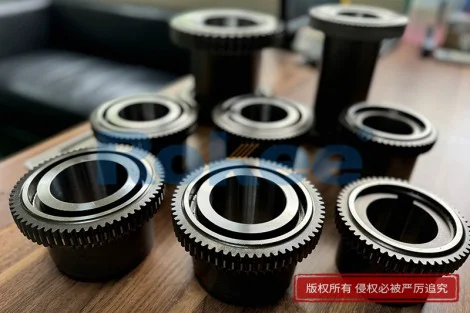
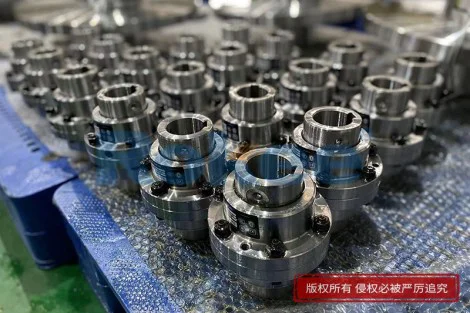
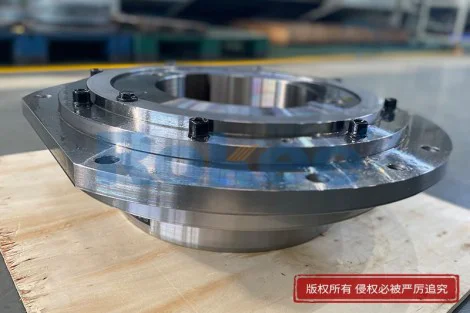
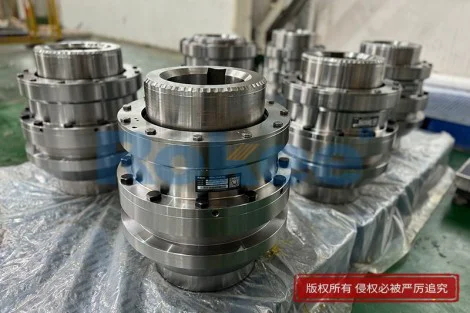
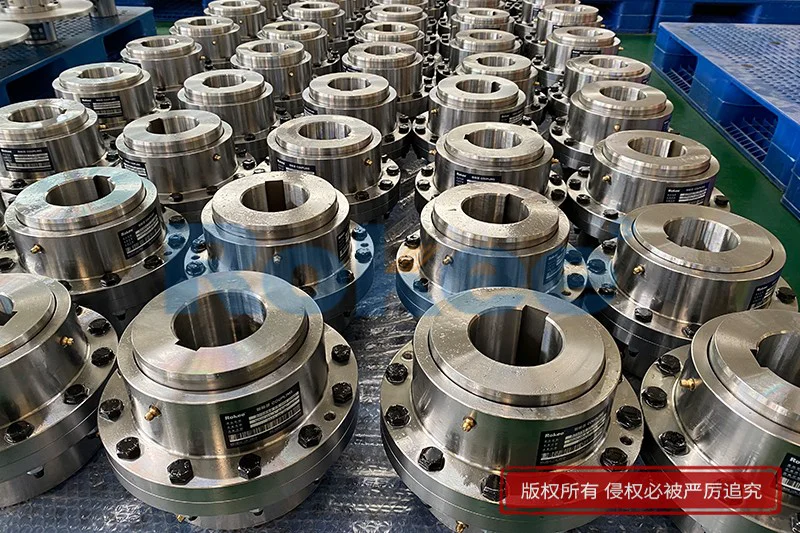
The crown gear coupling is precisely designed to meet the high requirements of power transmission in such continuous production lines. As a type of advanced mechanical coupling, it is composed of two hubs with crowned gear teeth and two flanges with internal straight teeth, connected by high-strength bolts to form a stable transmission structure. The core design feature of the crown gear coupling lies in the spherical crown shape of the outer gear teeth, whose center of the sphere coincides with the axis of the gear. This unique tooth profile design fundamentally distinguishes it from traditional straight-tooth couplings and endows it with excellent performance advantages that are highly compatible with the operational needs of PU sandwich panel production lines. Unlike straight-tooth couplings, which have line contact between teeth and are prone to stress concentration when there is shaft misalignment, the crowned tooth profile realizes surface contact between the meshing teeth, which not only increases the contact area but also makes the load distribution more uniform, effectively reducing the wear of tooth surfaces and extending the service life of the coupling.
One of the most critical advantages of crown gear couplings in PU sandwich panel production line is their excellent misalignment compensation capability. In the actual operation of the production line, due to factors such as equipment installation errors, thermal expansion and contraction during long-term operation, foundation settlement, and slight deformation of the frame, it is difficult to maintain absolute coaxiality between the shafts of different functional units (such as the motor and reducer, reducer and conveyor, or foaming machine and mixing head). If a coupling with poor misalignment compensation capability is used, this slight shaft misalignment will lead to increased friction between the coupling teeth, increased noise, excessive temperature rise, and even tooth breakage or shaft damage over time, resulting in unplanned production shutdowns. The crown gear coupling, however, can effectively compensate for angular, radial, and axial misalignments between shafts through its spherical crown tooth profile. Generally, its single-side angular compensation capability can reach more than 1.5°, and the comprehensive radial and axial compensation amounts are far higher than those of straight-tooth couplings of the same specification. This means that even if there is a slight deviation between the shafts of each functional unit in the production line, the crown gear coupling can still transmit torque smoothly, ensuring that the uncoiling, feeding, foaming, curing, and cutting units operate synchronously without affecting the production rhythm. For example, in the double crawler lamination conveyor system, which is crucial for the curing of PU sandwich panels, the crown gear coupling connects the drive motor and the conveyor roller. Due to the long length of the conveyor and the influence of thermal expansion during operation, the shafts of the motor and the roller are prone to slight angular misalignment. The crown gear coupling can effectively absorb this misalignment, ensuring that the conveyor runs at a constant speed, avoiding uneven pressure on the panel during the lamination process, and thus ensuring the uniformity of the panel thickness and the firmness of the foam core bonding.
Another key advantage of crown gear couplings that adapts to the needs of PU sandwich panel production lines is their high torque transmission capacity and compact structure. The production line, especially the double crawler lamination conveyor and the cutting system, requires large torque during operation to drive heavy-duty components such as conveyor chains, rollers, and cutting blades, while the installation space of mechanical components in the production line is often limited. The crown gear coupling, with its surface contact tooth profile design, can transmit larger torque in the same external dimensions compared to traditional couplings. This is because the surface contact between the crowned teeth increases the number of meshing teeth at the same time, making the load distribution more uniform and improving the torque density of the coupling. In addition, the crown gear coupling is usually made of high-strength forged steel, which undergoes strict heat treatment processes such as deep carburizing and quenching, making the tooth surface reach high hardness (HRC 58-62) while maintaining good toughness of the tooth core. This not only enhances the wear resistance and impact resistance of the coupling but also enables it to withstand the alternating torque and impact load generated during the start-up and operation of the production line. For instance, during the start-up of the high-pressure foaming system, the motor will generate an instantaneous peak torque. The crown gear coupling can effectively absorb and buffer this peak torque through its excellent structural design, avoiding damage to the motor, reducer, and other key components, and ensuring the stable start-up and operation of the foaming system. At the same time, the compact structure of the crown gear coupling saves valuable installation space for the production line, allowing for more reasonable layout of other functional units and improving the overall integration level of the production line.
The stable lubrication performance and long service life of crown gear couplings also provide important guarantee for the continuous operation of PU sandwich panel production lines. The production of PU sandwich panels usually requires 24-hour continuous operation to meet the large market demand, which puts forward high requirements for the service life and maintenance cycle of mechanical components. Frequent maintenance and replacement of couplings will not only increase the labor intensity of maintenance personnel but also interrupt the production process, resulting in economic losses. The crown gear coupling is equipped with a special sealing structure and grease injection ports, which can effectively prevent dust, foam raw materials, and other impurities from entering the meshing surface of the teeth, ensuring the cleanliness of the transmission part. At the same time, the special tooth profile design creates favorable conditions for the storage and flow of lubricating grease, reducing friction and wear between the teeth. Generally, the lubrication cycle of the crown gear coupling can reach 4000-8000 operating hours, which is much longer than that of traditional straight-tooth couplings (2000 operating hours). In addition, the wear of the crown gear coupling is gradual and predictable. Through regular oil sample detection and maintenance, the service life of the coupling can be further extended, usually reaching 1.5-2 times that of straight-tooth couplings. This means that manufacturers can reduce the frequency of coupling replacement and maintenance, reduce maintenance costs, and ensure the continuous and stable operation of the production line.
In addition to the above advantages, the crown gear coupling also has good vibration and shock absorption performance, which is of great significance for improving the operational stability of the PU sandwich panel production line. During the operation of the production line, the motor, reducer, foaming machine, and other equipment will generate a certain amount of vibration. If these vibrations are not effectively absorbed and buffered, they will be transmitted to the entire mechanical system, leading to loose connections between components, increased noise, and even affecting the precision of the production process. For example, the vibration generated by the motor will be transmitted to the conveyor system through the coupling, which may cause the surface material to deviate during the conveying process, resulting in uneven bonding between the surface material and the PU foam core. The crown gear coupling, through its flexible meshing characteristics, can effectively absorb and buffer the vibration and impact generated during the operation of the equipment, reduce the vibration intensity of the entire transmission system, and protect the key components such as the motor, reducer, and conveyor from vibration damage. Practical application data shows that in the production line using crown gear couplings, the temperature rise of the motor bearing can be reduced by 5-8℃, and the vibration intensity of the reducer gear can also be significantly improved, which not only extends the service life of the equipment but also ensures the stability of the production process and the quality of the products.
The application of crown gear couplings in PU sandwich panel production lines is not only reflected in the transmission connection between key functional units but also runs through the entire production process, providing comprehensive power transmission guarantee for the stable operation of the production line. In the uncoiling system, the crown gear coupling connects the uncoiling motor and the uncoiling roller, ensuring that the surface material is uncoiled at a constant speed, avoiding the problems of material stretching or wrinkling caused by unstable speed. In the feeding and pretreatment system, the coupling drives the conveying roller to operate stably, ensuring that the surface material is fed into the next process smoothly and accurately, laying a good foundation for the subsequent foaming and lamination. In the high-pressure foaming system, the crown gear coupling transmits power to the mixing head and the metering pump, ensuring the accurate proportioning and uniform mixing of raw materials, which is crucial for the quality of the PU foam core. In the double crawler lamination and curing system, the coupling drives the crawler conveyor to operate at a constant speed, ensuring that the PU foam is fully cured under stable pressure and temperature, avoiding the problems of uneven foam density or poor bonding caused by unstable conveyor speed. In the cutting system, the crown gear coupling ensures that the cutting blade rotates at a constant speed and with high precision, ensuring that the length of the finished panel is accurate and the cutting surface is smooth, reducing the waste of materials and improving the qualification rate of products.
It is worth noting that to give full play to the role of crown gear couplings in ensuring the continuous and stable operation of PU sandwich panel production lines, correct installation, use, and maintenance are also essential. During installation, it is necessary to carefully clean all parts of the coupling, ensure the accurate alignment of the shafts using a dial indicator, and tighten the connecting bolts according to the specified torque. Although the crown gear coupling has excellent misalignment compensation capability, good initial alignment can maximize its service life and performance. During operation, it is necessary to regularly check the lubrication status of the coupling, refill lubricating grease every 1000 operating hours, and replace the lubricating grease every 5000 operating hours to ensure that the meshing surface is in a good lubrication state. At the same time, it is necessary to regularly inspect the wear of the tooth surface, the tightness of the bolts, and the integrity of the sealing structure. If any abnormal situation is found, it should be handled in a timely manner to avoid further damage to the coupling and the production line. In addition, the selection of crown gear couplings should also be based on the actual operating parameters of the production line, such as torque, speed, shaft diameter, and misalignment, to ensure that the coupling is fully compatible with the production line, so as to achieve the best transmission effect.
With the continuous development of the construction industry and the increasing demand for energy-saving and environmental protection building materials, the PU sandwich panel production line is developing towards higher automation, higher efficiency, and higher quality. This also puts forward higher requirements for the performance of core mechanical components such as crown gear couplings. In the future, with the continuous progress of material science and mechanical processing technology, crown gear couplings will be further optimized in terms of material selection, structural design, and manufacturing process. For example, the use of new high-strength and wear-resistant materials can further improve the torque transmission capacity and service life of the coupling; the optimization of the tooth profile design through three-dimensional simulation technology can further improve the misalignment compensation capability and vibration absorption performance of the coupling; the application of intelligent monitoring technology can realize real-time monitoring of the operating status of the coupling, timely predict potential faults, and provide a more reliable guarantee for the continuous and stable operation of the production line.
In conclusion, the crown gear coupling, as a core power transmission component, plays an irreplaceable role in ensuring the continuous and stable operation of the PU sandwich panel production line. Its excellent misalignment compensation capability, high torque transmission capacity, compact structure, stable lubrication performance, and good vibration absorption performance are highly compatible with the operational characteristics and requirements of the PU sandwich panel production line. It effectively connects various functional units of the production line, ensures synchronous and stable operation of each process, reduces the frequency of production shutdowns, improves production efficiency, ensures product quality consistency, and reduces maintenance costs. For manufacturers of PU sandwich panels, choosing high-performance crown gear couplings and carrying out correct installation, use, and maintenance is an important measure to improve the competitiveness of enterprises and ensure the healthy and sustainable development of production. In the context of the continuous upgrading of the production line, the crown gear coupling will continue to play a more important role, providing strong support for the development of the PU sandwich panel industry.