Flange Tyre Coupling

Flange tyre coupling is a widely adopted flexible transmission component in modern mechanical power systems, designed to connect driving and driven shafts while delivering stable torque transmission with exceptional adaptive performance. Composed of metal flange hubs and an elastic rubber tyre core, this coupling integrates the structural rigidity of flange connections and the flexible damping characteristics of tyre elastomers, making it distinct from rigid couplings and other flexible coupling types. Its core functional advantages lie in multi-directional misalignment compensation, efficient vibration damping, and outstanding shock load absorption, which effectively resolve common operational problems in mechanical transmission such as shaft installation deviation, equipment structural deformation, and intermittent load impact. With a simple and robust integral structure, it requires no complex lubrication systems and supports convenient assembly and disassembly. It is universally applicable to various medium and low-speed mechanical transmission scenarios, including material conveying equipment, fluid power machinery, and general industrial transmission devices, serving as a reliable guarantee for stable and long-term operation of mechanical systems.
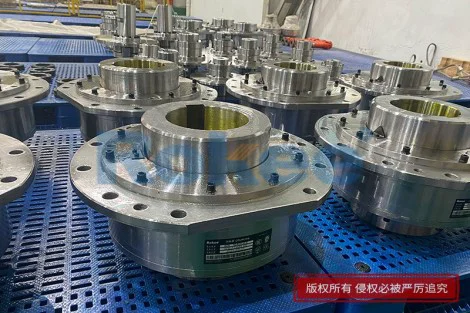
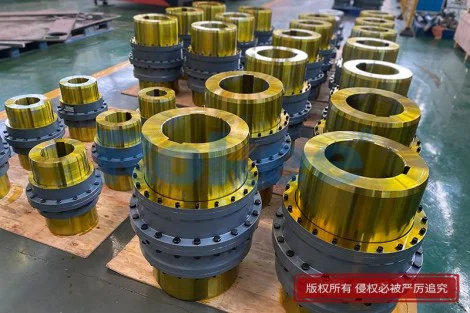
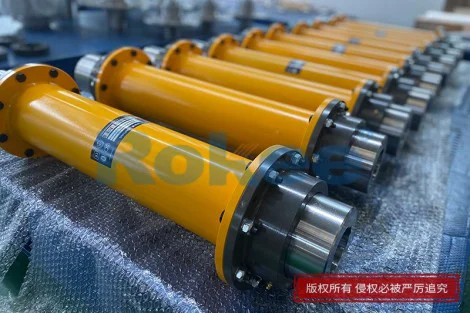
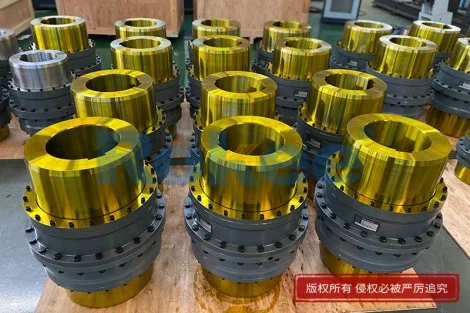
The basic structural composition of flange tyre coupling defines its unique mechanical performance and operational stability, with every component designed to coordinate torque transmission and flexible protection. The core components include two symmetrical metal flange hubs and a high-elasticity rubber tyre body clamped between them. The flange hubs are precision machined with uniform bolt holes, enabling firm and concentric connection with the main and auxiliary transmission shafts, and their integral metal structure provides sufficient structural strength to bear long-term torque loads without deformation or loosening. The intermediate rubber tyre element is the key functional part, usually made of high-quality elastomer materials with excellent tensile, shear and fatigue resistance. Different from traditional split flexible parts, the integrated tyre structure forms a closed elastic buffer zone between the two flanges. During equipment operation, torque is transmitted through the friction and bonding force between the flange end faces and the tyre surface, while the elastic deformation of the rubber tyre absorbs abnormal mechanical stress. There are no vulnerable small parts such as springs or gears inside the coupling, which greatly reduces structural failure risks and simplifies the overall mechanical layout of the transmission system.
The working principle of flange tyre coupling is based on the elastic torsional deformation of the rubber tyre and friction torque transmission, realizing efficient and buffered power delivery. When the driving shaft starts to operate, the connected driving flange rotates synchronously, and the rotational torque is transferred to the rubber tyre through contact friction, driving the driven flange and the connected driven shaft to rotate simultaneously. In the steady operation state, the tyre produces slight and uniform torsional shear deformation, which ensures continuous and stable torque output without power loss. Once the mechanical system encounters unstable operating conditions such as sudden start, emergency stop or load mutation, the elastic tyre will undergo adaptive large deformation to buffer instantaneous shock torque. This deformation process effectively dissipates impact energy and prevents sharp torque fluctuations from being directly transmitted to the driven equipment. Meanwhile, the elastic tyre can automatically compensate for tiny displacement deviations generated during equipment operation, including angular deviation, parallel offset and axial displacement between the two shafts. This flexible working mode avoids rigid friction and stress concentration between shafts, fundamentally reducing mechanical wear and transmission failure caused by shaft misalignment.
One of the most prominent performance strengths of flange tire coupling is its superior multi-dimensional misalignment tolerance, which solves the installation and operation pain points of traditional rigid transmission structures. In actual industrial production, it is impossible to achieve absolute coaxial alignment between driving and driven shafts due to mechanical processing errors, manual installation deviations, and slight structural deformation of equipment frames after long-term operation. Rigid couplings cannot adapt to such deviations, which will cause severe bearing wear, shaft vibration and even equipment jamming. In contrast, the elastic tyre structure of flange tyre coupling can tolerate a certain range of angular, parallel and axial misalignment simultaneously. Its soft elastic connection mode does not produce additional constraint stress on the transmission shaft system, and can continuously adjust the transmission state according to real-time shaft displacement changes. This adaptive compensation performance not only reduces the precision requirements for equipment installation and debugging, improving on-site assembly efficiency, but also offsets the structural displacement caused by equipment aging and operational vibration. It maintains stable transmission accuracy throughout the long service cycle of mechanical equipment and effectively extends the service life of supporting bearings and shafts.
Excellent vibration damping and shock absorption performance makes flange tyre coupling indispensable in high-stability mechanical transmission scenarios. Most industrial mechanical equipment will generate periodic vibration during continuous operation, and sudden load changes will produce instantaneous shock loads. These vibrations and impacts will be transmitted along the shaft system, causing equipment resonance, loose connecting parts, increased operating noise, and even fatigue damage to mechanical components over time. The elastomer material of the tyre core has natural high damping characteristics, which can effectively absorb and isolate torsional vibration and radial vibration generated in the transmission process. When shock loads occur, the rubber tyre can quickly store and release impact energy through elastic deformation, converting instantaneous violent mechanical impact into gentle elastic fluctuation. Compared with metal elastic couplings, it has a more significant vibration reduction effect and can suppress low-frequency and high-frequency vibration simultaneously. This performance optimizes the operating environment of the entire transmission system, reduces equipment operating noise, avoids component fatigue failure caused by long-term vibration, and improves the overall operational stability and safety of mechanical equipment.
Flange tyre coupling features extremely low maintenance costs and reliable long-term operational performance, bringing significant economic benefits to industrial equipment operation. Benefiting from its simple integral structure and high wear-resistant elastomer materials, this coupling requires no regular lubrication, oil replacement or complicated parameter debugging during daily operation, completely eliminating the routine maintenance work required by gear couplings and chain couplings. The rubber tyre has strong anti-aging, anti-wear and anti-fatigue properties, and can maintain stable elastic performance under continuous cyclic operation and conventional temperature changes. The metal flange hub has high structural rigidity and corrosion resistance, with no deformation or damage under normal load conditions. In the long-term operation process, the coupling only needs regular visual inspection to check for obvious tyre aging, cracking or bolt loosening, and the inspection process is simple and efficient. When individual parts reach the service life, the replacement operation is convenient and fast without disassembling a large number of equipment components. The low maintenance frequency and simple replacement process greatly reduce equipment downtime and manual maintenance costs, making it suitable for continuous and uninterrupted industrial production scenarios.
The application scope of flange tyre coupling covers multiple industrial fields, adapting to diverse mechanical transmission working conditions with its comprehensive performance advantages. It is widely used in general industrial machinery such as conveyors, mixers, and fans, where stable torque transmission and vibration reduction are required to ensure continuous and efficient equipment operation. In fluid machinery equipment including water pumps and compressors, it can buffer the pulsating load generated by medium transmission, avoid equipment vibration caused by fluid pressure fluctuation, and protect the sealing structure and internal precision parts of fluid equipment. It also performs well in light industrial and construction machinery, adapting to the complex working conditions of frequent start-stop and variable load operation. Additionally, its flexible transmission characteristic can effectively isolate mechanical vibration between the power source and the working machine, preventing vibration interference between adjacent equipment. Whether in indoor stable production environments or outdoor working conditions with slight temperature and vibration changes, it can maintain stable working performance, showing strong environmental adaptability and working condition compatibility.
With the continuous upgrading of modern industrial mechanical equipment towards high efficiency and stability, the application value of flange tyre coupling is constantly highlighted, and its performance advantages are further recognized in industrial transmission systems. Its perfect combination of rigid connection stability and flexible transmission buffering performance fills the performance gap between rigid couplings and ordinary flexible couplings, balancing transmission efficiency and equipment protection. Compared with other flexible couplings, it has simpler structure, lower failure rate and stronger comprehensive adaptability, which can meet the transmission needs of most medium and low-speed mechanical equipment. In the future, with the continuous optimization of elastomer material technology, the high-temperature resistance, wear resistance and fatigue resistance of flange tyre coupling will be further improved, enabling it to adapt to more extreme working conditions. As a mature and reliable mechanical transmission component, it will continue to play an important role in industrial production, providing stable and durable connection solutions for various mechanical power transmission systems.