Double Cardan Driveshaft

The double cardan driveshaft is a sophisticated power transmission component engineered to address the inherent limitations of single universal joint driveshafts in mechanical power delivery systems. As an upgraded iteration of traditional cardan transmission structures, it integrates two universal joints and an intermediate connecting component to achieve near-constant angular velocity power transmission, overcoming the speed fluctuation, vibration, and torque instability that plague single-joint designs under angled operating conditions. Widely applied in mechanical transmission scenarios requiring large deflection angles and smooth power output, this component balances structural simplicity with operational stability, making it a core part of power transmission systems for mobile and industrial mechanical equipment. Its unique phase cancellation mechanism eliminates rotational irregularities, ensuring consistent torque transfer even with continuous changes in shaft alignment, thus improving overall mechanical operation efficiency and reducing component wear caused by unbalanced rotation.
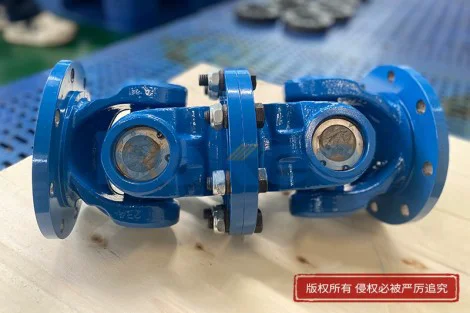
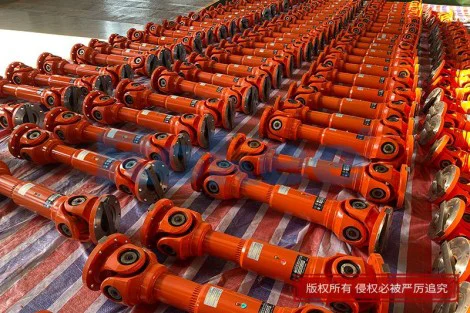
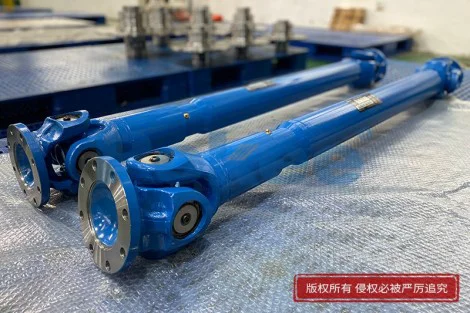
The fundamental structural composition of the double cardan driveshaft differentiates it profoundly from conventional single cardan driveshaft units, laying a solid foundation for its superior transmission performance. The entire assembly primarily consists of two symmetrically arranged universal joints, a precision-machined intermediate shaft or centering yoke, and reinforced end yoke components. Each universal joint features a classic cross-spider structure, with the cross-shaped central component serving as the core rotational connection that links the paired yoke parts on both sides. The two universal joints are installed in a precise 90-degree phase offset configuration through the intermediate connector, which is the key structural design that enables velocity fluctuation cancellation. All structural parts are manufactured with high rigidity and dimensional accuracy, with mating surfaces finely processed to minimize mechanical clearance during rotation. Unlike single cardan shafts that rely on a single joint to bear all deflection and rotation loads, the dual-joint structure distributes operational stress evenly, effectively avoiding localized stress concentration and structural deformation during long-term high-load operation, and providing stable structural support for complex angle transmission.
The working principle of the double cardan driveshaft centers on the mechanical phase cancellation effect that corrects the rotational defects of single universal joints. A single cardan joint inevitably produces periodic angular velocity fluctuations when operating at a deflection angle, where the input shaft maintains a constant speed while the output shaft accelerates and decelerates repeatedly within each rotation cycle. This irregular rotation generates torsional vibration, torque loss, and mechanical resonance in the transmission system. The double cardan structure perfectly offsets this flaw by utilizing two identical universal joints with opposite phase characteristics. When the first universal joint creates a deceleration deviation during power transmission, the second joint simultaneously produces a corresponding acceleration deviation of equal magnitude, and the two opposite velocity fluctuations neutralize each other completely. As a result, the final output shaft achieves a nearly constant angular velocity and stable torque output regardless of the continuous deflection changes between the input and output ends. This pure mechanical correction principle requires no auxiliary electronic control systems, ensuring high reliability and adaptability in harsh mechanical operating environments.
One of the most prominent functional advantages of the double cardan driveshaft is its excellent adaptability to large-angle deflection working conditions, which greatly expands the application scope of mechanical power transmission. Traditional single cardan driveshafts can only operate stably within a small deflection angle range, and excessive angles will amplify velocity fluctuations and vibration, even causing transmission jamming and component damage. In contrast, the double cardan structure can maintain efficient and stable power transmission under significantly larger shaft deflection angles, adapting to the dynamic position changes of power components during mechanical operation. In equipment where the relative position of power output and input ends changes frequently due to movement, vibration, or structural deformation, this driveshaft can continuously adjust its working angle without sacrificing transmission stability. Additionally, its balanced rotation characteristics effectively suppress mechanical vibration and noise generated during power transmission, reducing the impact of transmission system vibration on the overall mechanical structure, improving operational comfort, and lowering the risk of structural fatigue damage caused by long-term vibration excitation.
The operational stability and durability of the double cardan driveshaft make it a reliable long-term solution for high-intensity mechanical transmission scenarios. The dual-joint stress distribution structure disperses the instantaneous impact load generated during mechanical start-up, acceleration, and load mutation, avoiding the concentrated impact damage that single joints often suffer. The cross-spider and yoke contact parts adopt optimized motion matching design, which reduces sliding friction and rotational wear between components during continuous operation. Under continuous high-speed rotation and variable load conditions, the component wear rate is significantly lower than that of traditional transmission structures, effectively extending the service life of the entire transmission assembly. Moreover, the double cardan driveshaft exhibits strong resistance to mechanical deformation and environmental interference. It can maintain precise phase matching and stable transmission performance in complex working environments with vibration, slight structural displacement, and temperature changes, avoiding transmission failure caused by structural misalignment and ensuring continuous and stable operation of mechanical equipment in long-cycle and high-intensity working states.
The installation and matching characteristics of the double cardan driveshaft determine its efficient adaptability to diverse mechanical system layouts. Although its structural composition is slightly more complex than that of a single cardan driveshaft, its modular design simplifies overall installation and assembly processes. The standardized matching interface allows it to be flexibly integrated into various mechanical power transmission systems without complex structural modification of the original equipment. The core installation requirement lies in ensuring the precise phase alignment of the two universal joints, which is the key to exerting the velocity cancellation effect. Reasonable installation spacing and angle reservation can further optimize its operational performance, enabling it to adapt to compact mechanical space layouts while reserving sufficient deflection stroke for dynamic operation. In addition, the driveshaft features good dynamic balance performance after professional calibration, which effectively avoids rotational eccentricity and secondary vibration during high-speed operation. Its flexible matching capability enables it to be compatible with multiple power transmission modes and mechanical structural forms, meeting the diversified layout requirements of modern mechanical equipment.
In practical industrial and mechanical applications, the double cardan driveshaft has become an indispensable core component in multiple professional fields due to its comprehensive performance advantages. It is widely used in mobile mechanical equipment that requires flexible angle adjustment and stable power transmission, where frequent chassis displacement and angle changes occur during operation. It also plays a key role in industrial transmission equipment with high requirements for torque stability and low vibration operation, effectively improving the operational precision and stability of mechanical systems. Compared with constant velocity joints of other structural types, it retains the advantages of simple mechanical structure, low failure rate, and convenient maintenance, while overcoming the transmission instability defects of traditional cardan shafts. With the continuous upgrading of modern mechanical equipment towards high efficiency, high stability and high adaptability, the application value of double cardan driveshafts continues to rise, and its structural design principles also provide important reference for the optimization and iteration of medium and low-speed power transmission components.
The future development and optimization direction of double cardan driveshafts mainly focuses on structural lightweight, friction reduction and efficiency improvement, and adaptive performance upgrading. With the progress of material processing technology, high-strength and low-density materials are gradually applied to its production, which can reduce the self-weight of the component while ensuring structural rigidity, thereby reducing the inertial load during rotation and further improving transmission efficiency. Optimized surface treatment and structural polishing processes can minimize internal friction between moving parts, reduce energy loss during power transmission, and slow down component wear. In addition, combined with modern mechanical dynamic simulation technology, the structural phase matching and stress distribution of the driveshaft can be further optimized to enhance its adaptability to extreme working conditions such as ultra-large deflection angles and sudden load changes. These continuous optimizations will further expand the application boundary of double cardan driveshafts and maintain its core competitive advantage in the field of mechanical power transmission.