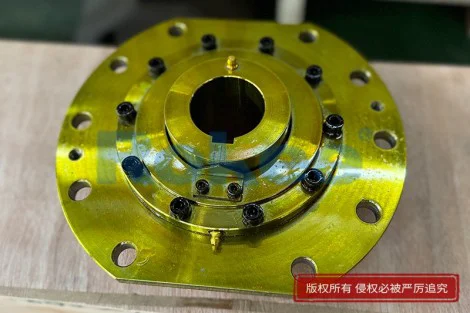
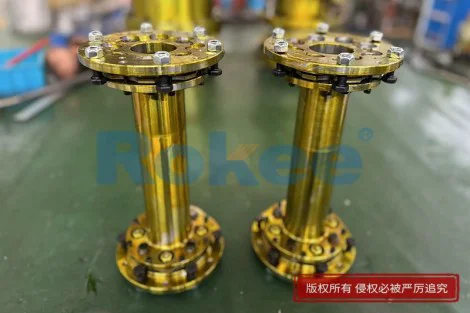
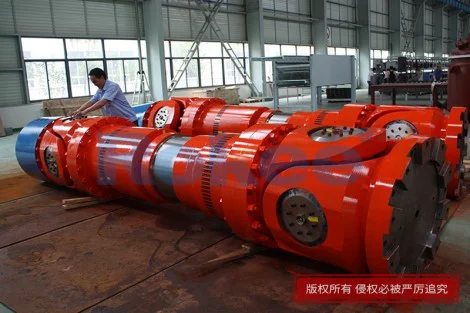
Industrial Cardan Driveshaft
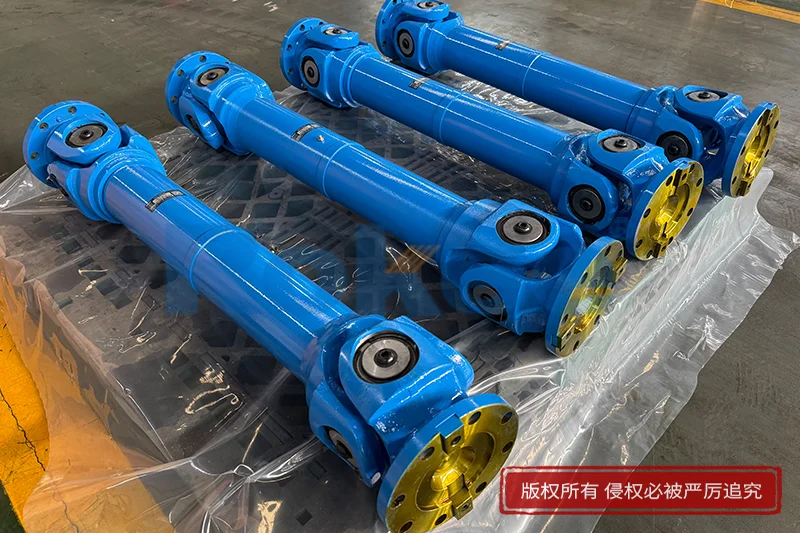
Industrial cardan driveshafts are essential mechanical transmission components widely adopted in modern industrial machinery, serving as a flexible bridge for torque and rotational power transfer between misaligned rotating shafts. Unlike rigid transmission parts that rely on precise axis alignment, these specialized driveshafts integrate universal joint structures and telescopic mechanisms to adapt to angular, axial, and radial deviations during equipment operation. They effectively resolve common transmission challenges caused by installation offsets, operational vibration, thermal deformation, and mechanical displacement in complex industrial working environments. Renowned for their robust load-bearing capacity, stable transmission performance, and outstanding structural flexibility, industrial cardan driveshafts can endure continuous high-torque operation and variable working conditions. They lay a solid foundation for the normal and efficient operation of various heavy-duty and automated mechanical systems, becoming an indispensable core part in industrial power transmission fields.
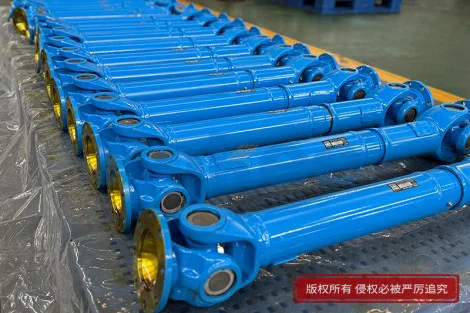
The structural composition of industrial cardan driveshafts is scientifically designed and highly integrated, with every core component tailored to ensure reliable power transmission and flexible deformation adaptation. The primary components include precision universal joint assemblies, rigid shaft bodies, yoke structures, spline telescopic units, and fastening connection accessories. The universal joint, as the most critical functional part, adopts a cross-shaft hinge structure that enables multi-directional rotational freedom, allowing the driveshaft to maintain continuous power output under significant angular deflection. The shaft body is usually forged from high-strength heat-treated steel materials, featuring high rigidity, wear resistance, and fatigue resistance to withstand long-term alternating loads and impact forces in industrial scenarios. The spline telescopic structure installed in the middle section can freely adjust the overall length of the driveshaft, perfectly compensating for axial displacement generated by equipment operation, vibration, or thermal expansion. All matching accessories such as bearings and locking parts are precision processed to reduce rotational friction and avoid structural loosening, ensuring the overall stability and durability of the driveshaft in long-term industrial service.
The working principle of industrial cardan driveshafts is based on the mechanical linkage characteristics of hinge transmission and flexible displacement compensation, realizing stable and efficient power transmission under non-ideal alignment conditions. When the power source drives the input end of the driveshaft to rotate, torque is first transmitted to the universal joint assembly through the connecting flange. The cross-shaft structure inside the universal joint converts the fixed-axis rotation of the driving end into flexible rotational motion, which can adapt to the angle difference between the driving shaft and the driven shaft. During the rotation process, the spline telescopic structure synchronously stretches and contracts according to the real-time displacement of the equipment, eliminating axial extrusion and tension stress that may damage the transmission system. Even when the operating angle and shaft distance change dynamically due to equipment vibration or load variation, the coordinated movement of universal joints and telescopic structures can maintain consistent torque transmission efficiency without obvious power loss or rotational jitter. This unique working mechanism fundamentally solves the transmission limitations of rigid shafts, which are prone to stuck operation or component damage under misalignment conditions.
Industrial cardan driveshafts possess unparalleled performance advantages compared with traditional rigid transmission shafts and ordinary coupling components, making them highly adaptable to complex industrial working conditions. First and foremost, they deliver excellent displacement compensation capability, simultaneously coping with angular, axial, and radial deviations that are inevitable in equipment installation and operation, greatly reducing the assembly precision requirements of mechanical systems. Secondly, these driveshafts feature ultra-high load-bearing performance, capable of stably transmitting large torque and adapting to heavy-load, continuous-duty industrial operation modes without deformation or failure. In addition, their structural flexibility effectively buffers mechanical vibration and impact loads generated during equipment start-up, shutdown, and variable-load operation, protecting the entire transmission system and extending the service life of matching mechanical parts. Moreover, the modular structural design enables convenient disassembly, assembly, and replacement of components, reducing equipment maintenance difficulty and downtime loss. Their stable transmission accuracy and low power loss also help improve the overall operating efficiency of industrial mechanical equipment.
The application scenarios of industrial cardan driveshafts cover almost all heavy-duty and mechanical transmission fields that require flexible power transfer, showing strong industrial versatility. In engineering machinery, they are widely applied in large rotating and walking equipment to transmit power between power units and execution components, adapting to the frequent displacement and angle changes of mechanical parts during operation. In metallurgical and mining industries, these driveshafts serve high-load continuous production equipment, stably outputting torque in harsh environments with dust, vibration, and variable loads to ensure uninterrupted production. In automated industrial production lines, they connect various transmission mechanisms of assembly and processing equipment, compensating for tiny displacement deviations generated by high-speed operation and ensuring the precise operation of automated processes. Additionally, they are commonly used in logistics transportation machinery, agricultural industrial equipment, and large fan and pump systems, providing reliable power transmission support for different types of industrial mechanical operation.
Material selection and manufacturing processes are critical factors that determine the service performance and service life of industrial cardan driveshafts, with strict technical requirements throughout production. High-quality carbon alloy steel is the mainstream raw material for manufacturing driveshaft bodies and core structural parts, which undergoes multiple forging processes to refine the internal metal structure, improving material density, rigidity, and fatigue resistance. After forging, all key components are subjected to professional heat treatment processes, including quenching and tempering, to enhance surface wear resistance and internal toughness, effectively avoiding fracture and wear failure under long-term alternating loads. The universal joint cross shaft and bearing parts adopt precision grinding processing to ensure matching accuracy and rotational flexibility, minimizing friction resistance during operation. The spline structure is processed by precision milling to guarantee smooth telescopic movement and uniform force bearing. Strict dimensional inspection and dynamic balance testing are conducted after assembly to eliminate rotational eccentricity and vibration, ensuring that each finished driveshaft can maintain stable operation at different rotational speeds.
Scientific daily maintenance and standardized operation are essential to maintain the long-term stable performance of industrial cardan driveshafts and reduce operational failures. In daily industrial operation, regular inspection of the driveshaft’s operating state is required, focusing on checking for abnormal vibration, noise, and rotational jitter during equipment operation, which are typical signs of structural wear or loose assembly. Lubrication maintenance is a key link in daily upkeep; universal joint bearings and spline telescopic parts need regular lubricant filling to reduce dry friction and component wear, while avoiding excessive lubricant accumulation that may adsorb dust and cause abrasion. It is necessary to regularly check the tightness of connecting fasteners to prevent component displacement caused by loose bolts under long-term vibration. Meanwhile, avoid long-term overload operation of the driveshaft beyond its bearing range, as excessive torque will cause structural deformation and fatigue damage. Timely cleaning of surface dust and debris can prevent foreign matter from entering the matching gaps of moving parts, ensuring flexible and stable operation of the transmission structure.
With the continuous upgrading of modern industrial manufacturing technology, the development trend of industrial cardan driveshafts is moving toward high precision, high durability, lightweight, and intelligent adaptation. Modern industrial production puts forward higher requirements for transmission component performance, driving the continuous optimization of driveshaft structural design and material technology. New high-strength alloy materials and composite surface treatment processes are gradually applied to production, further improving the wear resistance, corrosion resistance, and fatigue life of driveshafts while reducing overall structural weight. Structural design is constantly optimized to achieve more accurate displacement compensation and lower power loss, adapting to high-speed and high-precision industrial equipment operation needs. In addition, with the development of intelligent industrial equipment, cardan driveshafts are gradually combined with monitoring technologies to realize real-time perception of operating status, wear degree, and load changes, providing data support for predictive maintenance. These technological upgrades enable industrial cardan driveshafts to better adapt to the diversified and high-standard development needs of modern industrial transmission systems.