Cardan Driveshaft For Steel Mill
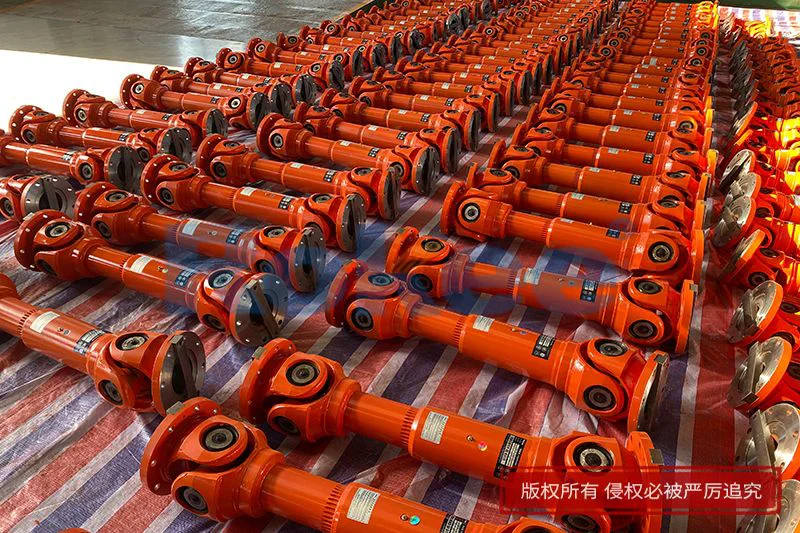
Cardan driveshafts stand as indispensable core transmission components in the full-range operation of steel mill production lines, undertaking the critical task of power transmission between driving and driven equipment in harsh metallurgical working environments. Unlike conventional rigid transmission shafts that rely on precise axis alignment, this specialized drive component features a flexible universal joint structure, enabling stable torque transmission while effectively compensating for angular, axial and radial misalignments generated during steel mill equipment operation. Steel manufacturing processes including hot rolling, cold rolling, steel plate forming and strip processing involve continuous high-load operation, frequent mechanical vibration and subtle equipment displacement, all of which pose rigorous demands on transmission system stability. Cardan driveshafts perfectly adapt to such complex working conditions, efficiently connecting rolling mills, gearboxes and power devices to ensure consistent and reliable power output. They reduce transmission failure risks caused by equipment displacement and vibration, maintain the continuous operation of steel production procedures, and indirectly improve the uniformity of steel product processing quality while lowering unexpected equipment downtime losses, serving as a key guarantee for the high-efficiency and stable operation of modern steel mills.
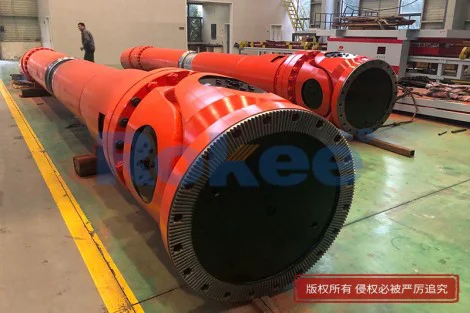
The structural design of cardan driveshafts tailored for steel mill scenarios is highly specialized and optimized for heavy-duty industrial operation, abandoning the simple structural mode of ordinary transmission shafts. The complete assembly mainly consists of universal joint assemblies, intermediate shaft tubes, telescopic spline structures and reinforced connecting flanges, with each component designed to adapt to the extreme working conditions of steel production. The core universal joint part adopts a cross-shaped spider structure matched with high-precision bearing assemblies, which forms a flexible hinge connection between two fork-shaped yokes. This structure is the key to realizing multi-directional displacement compensation, allowing the driveshaft to maintain stable rotation and torque output when the connected equipment produces angle deviation. The intermediate shaft tube is forged from high-strength alloy steel with integrated molding technology, featuring excellent structural rigidity and torsional resistance to withstand the instantaneous high torque generated during steel rolling operations. The built-in telescopic spline structure can freely adjust the overall length of the driveshaft, automatically compensating for axial displacement caused by equipment thermal expansion, mechanical wear and assembly errors in long-term operation. Meanwhile, the thickened flange connection structure enhances the assembly firmness between the driveshaft and equipment, effectively resisting shear force and impact load in high-intensity working environments and avoiding loose connection and power transmission interruption.
The working principle of steel mill cardan driveshafts is based on spatial linkage mechanical motion conversion, realizing efficient and stable power transmission under misaligned operating states. In the actual production process of steel mills, the driving end equipment such as motors and gearboxes often cannot maintain absolute coaxiality with the driven rolling mill equipment due to installation errors, equipment aging, thermal deformation and vibration displacement. Rigid transmission components will generate huge additional stress under such conditions, leading to component deformation, abrasion and even fracture failure. In contrast, the universal joint structure of the cardan driveshaft can convert the rotational motion of the driving shaft into flexible spatial motion through the cross spider and bearing coordination. When the two connected shafts produce angular deviation, the cross spider can rotate freely in the yoke bearings to adapt to the angle change, ensuring that the rotational torque can be continuously and evenly transmitted to the driven end without obvious power loss. The double universal joint matching design further optimizes the motion transmission effect, effectively balancing the angular velocity fluctuation existing in single universal joint transmission and making the output rotation more uniform and stable. This unique working mechanism enables the cardan driveshaft to always maintain efficient transmission performance in the dynamic and changing working environment of steel mills, avoiding transmission jitter and torque attenuation caused by equipment position changes.
Cardan driveshafts for steel mills possess outstanding comprehensive performance characteristics that distinguish them from ordinary industrial transmission components, fully meeting the high-intensity operation requirements of metallurgical production. First of all, they have ultra-high torque bearing capacity, which can cope with the instantaneous peak torque generated by steel rolling, steel pressing and other heavy-load processes, and maintain stable power transmission without slipping or torsion deformation. Secondly, the multi-dimensional displacement compensation performance is far superior to traditional couplings, which can simultaneously adapt to angular deflection, axial stretching and radial offset of equipment, and eliminate mechanical stress concentration caused by misalignment. In terms of environmental adaptability, the optimized structural design and surface treatment process enable the driveshaft to resist high-temperature radiation, dust erosion and mechanical impact in steel mill workshops. The internal bearing components are equipped with dust-proof and wear-resistant protective structures, which can prevent metal dust and oxide scale from entering the friction pair and reduce component wear. In addition, the transmission efficiency of the cardan driveshaft remains stable in long-term continuous operation. The precise matching of internal components minimizes friction resistance, ensuring that most of the power output by the power equipment is transmitted to the rolling mill equipment, avoiding energy waste and helping steel mills reduce production energy consumption in long-cycle operation.
The applicability of cardan driveshafts covers almost all core production links of steel mills, becoming a universal transmission solution for metallurgical heavy-duty equipment. In the hot rolling production line responsible for processing high-temperature steel billets, the equipment will produce obvious thermal expansion and vibration during high-speed rolling. The cardan driveshaft can adapt to the real-time position change of rolling rollers through flexible compensation performance, ensuring the synchronization of each group of rolling equipment and avoiding steel plate rolling deviation and thickness inconsistency caused by asynchronous power transmission. In the cold rolling process with higher requirements for processing precision, the stable and uniform torque output of the driveshaft effectively suppresses transmission vibration, reduces the surface ripple and processing defects of cold-rolled steel strips, and significantly improves the surface finish and dimensional accuracy of finished steel products. In addition, it is also widely used in steel plate leveling, shearing, winding and auxiliary transmission links of steel mill supporting equipment. Whether it is high-speed continuous operation equipment or low-speed heavy-load processing equipment, the cardan driveshaft can complete adaptive matching. Its modular structural design also facilitates flexible assembly and disassembly, enabling it to adapt to different equipment layouts and transmission distance requirements of various steel mill production lines, with extremely high scene compatibility.
Scientific daily maintenance and standardized operation are crucial to extending the service life and maintaining stable performance of steel mill cardan driveshafts. In the high-load and dusty working environment of steel mills, the driveshaft is prone to wear, lubrication failure and loose connecting parts after long-term operation, so regular routine inspection is essential. Operators need to regularly check the tightness of flange connecting parts to prevent bolt loosening caused by long-term vibration, which may lead to transmission jitter. It is necessary to regularly replenish and replace high-temperature resistant lubricating grease for the universal joint bearings and spline structures to avoid dry friction and accelerated component wear caused by lubricant failure under high-temperature working conditions. Meanwhile, the surface of the driveshaft should be cleaned regularly to remove accumulated steel dust, oxide scale and oil stains, preventing corrosive substances from eroding the shaft body and protective structure. In addition, the operating state of the driveshaft should be monitored during equipment operation. Once abnormal vibration, noise or torque transmission lag is found, the equipment should be shut down in time for inspection and maintenance to avoid small faults evolving into major component damage. Reasonable maintenance can effectively reduce the failure rate of the driveshaft, extend its service cycle, and reduce the frequency of equipment shutdown maintenance and component replacement costs for steel mills.
Compared with other traditional transmission components applied in steel mills, cardan driveshafts have irreplaceable comprehensive advantages in structural performance and operational economy. Traditional rigid couplings have extremely strict requirements on equipment coaxiality, and are prone to deformation and fracture under the frequent vibration and displacement conditions of steel mills, resulting in frequent equipment failures and affecting production continuity. Ordinary flexible couplings have limited torque bearing capacity and poor compensation performance, and cannot adapt to the heavy-load and high-vibration working environment of steel rolling equipment. In contrast, cardan driveshafts integrate high torque resistance, multi-directional compensation, vibration resistance and high-temperature resistance, and can maintain long-term stable operation in complex working conditions. Their flexible transmission characteristic can effectively buffer the instantaneous impact load generated during steel rolling, protect gears, motors and other precision components of the transmission system, and reduce the overall wear and failure rate of the equipment system. In addition, although the initial matching precision of cardan driveshafts is high, their modular structure brings convenient maintenance and replacement, with lower later operation and maintenance costs. For modern steel mills pursuing high-efficiency, low-consumption and stable production, cardan driveshafts can effectively improve the operating efficiency of the production line, reduce downtime losses, and create stable economic benefits for production operations.