Diaphragm Coupling Manufacturer

Diaphragm couplings are high-performance flexible transmission components widely adopted in modern mechanical transmission systems, serving as a critical connecting medium between driving and driven equipment. Unlike traditional rigid and elastic couplings that rely on mechanical contact or rubber deformation, these couplings utilize the reversible elastic deformation of metal diaphragms to achieve stable torque transmission and automatic compensation for various shaft misalignments. They effectively resolve common operational problems in rotating machinery, including vibration amplification, bearing wear, and transmission efficiency attenuation caused by axial, angular, and radial shaft deviations. Boasting core strengths such as lubrication-free operation, high structural stability, and excellent fatigue resistance, diaphragm couplings adapt to high-speed, high-precision, and long-cycle industrial operating scenarios. They have become an indispensable component in precision manufacturing, energy power, chemical engineering, and general mechanical equipment upgrading, continuously optimizing the stability and service life of mechanical transmission systems.
The working mechanism of diaphragm couplings centers on the elastic deformation characteristics of precision-processed metal diaphragm components, which underpins their reliable and efficient torque transmission performance. During equipment operation, torque is evenly transmitted from the driving shaft hub to the flexible diaphragm group, and then stably transferred to the driven shaft hub through the radial stress conduction of the diaphragms. When installation errors, equipment operation vibration, or thermal expansion and contraction cause relative displacement between the two connected shafts, the thin metal diaphragms produce micro elastic deformation to absorb and offset axial stretching, angular deflection, and radial offset. This flexible compensation mode avoids rigid extrusion and friction between shaft ends, eliminating additional mechanical stress on equipment bearings and transmission components. Since the entire transmission process relies on metal elastic deformation without sliding or rolling friction, the coupling maintains consistent transmission accuracy even during long-term continuous operation, effectively preventing torque loss and transmission lag that plague traditional coupling structures. The uniform stress distribution on the diaphragm surface also ensures balanced force bearing in all working states, laying a solid foundation for stable long-term operation.
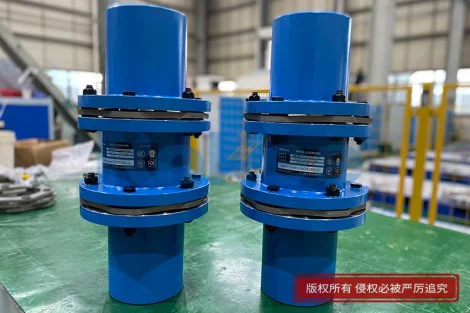
Structural diversity is a prominent feature of diaphragm couplings, enabling customized adaptation to differentiated industrial working conditions and transmission demands. The mainstream structural types are single-diaphragm and double-diaphragm configurations, each with unique application advantages and scenario orientations. Single-diaphragm couplings feature a compact and lightweight structure with fewer assembly parts, making them suitable for equipment with limited installation space and minor shaft misalignment. They deliver sensitive deformation response and stable torque transmission in low-to-medium load and medium-speed operating environments, meeting the basic precision transmission needs of general mechanical equipment. Double-diaphragm couplings adopt a combined structure with two sets of diaphragm groups and intermediate rigid components, which significantly enhances misalignment compensation capability, especially for larger angular and axial deviations. This structure disperses operational stress more evenly, reducing fatigue loss of individual diaphragms and improving overall structural durability. In addition, manufacturers optimize diaphragm thickness, quantity, and arrangement mode according to actual torque demands, realizing flexible matching from small-power precision transmission to high-power heavy-load transmission, covering diversified industrial application scenarios.
Diaphragm couplings stand out among various flexible transmission components due to their superior comprehensive performance advantages, solving multiple pain points of traditional coupling products. First and foremost, they achieve completely lubrication-free operation, abandoning the regular oiling and maintenance required by gear and chain couplings, which greatly reduces daily equipment maintenance costs and avoids equipment pollution and operational failures caused by lubricant aging and leakage. Second, the all-metal structural design endows the couplings with excellent high-temperature resistance, low-temperature resistance, and corrosion resistance, enabling stable operation in harsh environments such as high-temperature heating, low-temperature refrigeration, and chemical corrosive atmospheres where rubber elastic couplings cannot work normally. Moreover, the elastic deformation transmission mode produces minimal vibration and noise during high-speed rotation, effectively suppressing resonance of the transmission system and improving the overall operational smoothness of mechanical equipment. Additionally, the integral metal structure features high rigidity and stable deformation performance, ensuring no deformation failure or precision attenuation during long-term cyclic operation, with far longer service life than traditional flexible couplings.
The wide application scope of diaphragm couplings covers almost all fields involving precision mechanical transmission, becoming a core component for industrial equipment performance optimization. In the energy and power industry, they are widely applied in high-speed rotating equipment such as turbines, compressors, and generator sets, providing stable torque transmission and vibration suppression for high-power and high-speed operating systems, ensuring the safe and efficient operation of power equipment. In the chemical and petrochemical industry, their corrosion resistance and maintenance-free characteristics make them suitable for fluid transmission equipment including chemical pumps and stirring devices, adapting to complex and harsh production environments. In precision manufacturing fields such as machine tools and automation equipment, the high transmission accuracy and tiny misalignment compensation capability of diaphragm couplings guarantee the precise operation of processing equipment, effectively improving product processing accuracy and production qualification rate. Meanwhile, they also play an important role in metallurgical machinery, mining equipment, marine power systems, and ventilation and water supply equipment, fully meeting the high-reliability operation demands of various industrial scenarios.
Manufacturing precision and material selection are the core factors determining the service performance and service life of diaphragm couplings, and professional manufacturers strictly control every production link. In terms of material selection, high-strength alloy metal materials with excellent fatigue resistance, high toughness, and stable mechanical properties are preferentially adopted. These materials can withstand repeated elastic deformation and cyclic torque impact without fatigue cracking or structural failure, adapting to long-term continuous industrial operation. In the processing stage, advanced precision cutting and grinding technologies are used to process diaphragms and matching parts, ensuring uniform diaphragm thickness, smooth surface finish, and precise assembly size. The symmetrical structural design and precise dimensional control ensure consistent stress bearing and deformation of each diaphragm during operation, avoiding local stress concentration that leads to premature damage. Meanwhile, professional manufacturers conduct strict performance screening and quality inspection on finished products, verifying the torque transmission stability, misalignment compensation accuracy, and fatigue resistance of each batch of products, so as to ensure that the delivered couplings can maintain stable performance in complex working environments.
Reasonable installation and standardized application are crucial to giving full play to the superior performance of diaphragm couplings and extending their service cycle. Although diaphragm couplings have strong misalignment compensation capability, excessive shaft deviation beyond the adaptive range will still cause increased diaphragm stress and accelerated fatigue loss during operation. Therefore, precise shaft alignment calibration is required during installation to minimize initial axial, angular, and radial deviations, creating a good basic operating condition for the coupling. In the assembly process, the fastening force of connecting bolts needs to be evenly controlled to avoid unbalanced stress caused by inconsistent fastening degree, which may affect transmission stability and cause local diaphragm damage. During daily equipment operation, diaphragm couplings require almost no manual maintenance due to their lubrication-free design, but regular routine inspection of structural integrity and connection firmness is still needed to eliminate potential safety hazards in advance. For equipment working in high-frequency vibration and harsh environments, regular operational state monitoring can effectively judge the working performance of the coupling, realizing early warning and replacement of aging components and ensuring the long-term stable and safe operation of the entire mechanical transmission system.
With the continuous upgrading of modern industrial manufacturing towards high precision, high efficiency, and high reliability, diaphragm couplings are ushering in broader application prospects and continuous technological iteration. Industrial equipment is gradually developing towards high-speed operation, intelligent control, and extreme working condition adaptation, putting forward higher requirements for the transmission accuracy, stability, and durability of connecting components. Professional diaphragm coupling manufacturers keep optimizing product structure design and material formula, continuously improving the misalignment compensation ability, high-speed adaptability, and fatigue resistance of products to meet the evolving industrial market demands. Meanwhile, with the popularization of intelligent manufacturing and automated production lines, the matching performance of diaphragm couplings with intelligent equipment has been further improved, supporting the stable operation of high-precision automated production systems. As a key basic component of mechanical transmission, diaphragm couplings will continue to drive the performance upgrading of various mechanical equipment and become an important support for the high-quality development of modern industrial transmission technology.