Tyre Coupling For Pumps

Tyre couplings have emerged as one of the most reliable and practical flexible transmission components specially optimized for pump operating systems, serving as a critical connecting medium between pump bodies and driving motors. Unlike rigid coupling structures that lack adaptive flexibility, this elastomeric coupling relies on a high-elasticity tyre-shaped rubber element to complete torque transmission, while integrating multiple core functions including misalignment compensation, vibration damping and shock absorption. Pump equipment often faces complex operating conditions in actual operation, such as shaft position deviation caused by installation errors, vibration resonance generated by high-speed rotation, and instantaneous impact load during startup and shutdown. These unstable factors easily cause shaft wear, bearing damage and reduced operating efficiency if not buffered effectively. Tyre couplings perfectly solve these pain points with their unique torsionally soft structural characteristics, adapting to various mild deviations and dynamic load changes of pump units. Widely applicable to various types of industrial and civil pump equipment, they can effectively stabilize the operating state of pump systems, extend the service life of mechanical components, and reduce unnecessary equipment failure losses in long-term continuous operation scenarios.
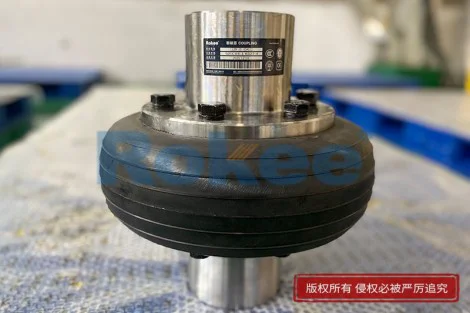
The basic structural composition of tire couplings for pumps is simple and scientific, laying a solid foundation for their stable and efficient operation in fluid transmission equipment. The entire coupling mainly consists of two precision-processed metal hubs and a split flexible rubber tyre element, with no complex auxiliary transmission structures or easily worn precision parts. The two metal hubs are respectively fixed on the motor shaft and the pump shaft, undertaking the task of fixing position and conducting torque. The intermediate tyre-shaped elastomer is the core functional component, usually made of high-quality rubber materials with layered cord reinforcement inside, which enhances the overall structural toughness and torque bearing capacity while maintaining excellent elasticity. This split external mounting design enables the flexible element to be directly assembled and disassembled from the outer side of the hubs without moving the connected pump and motor equipment or readjusting the shaft alignment state. Compared with traditional coupling structures that require overall disassembly for maintenance, this structural advantage greatly simplifies the operation process. In the daily operation of pump systems, the cooperative matching of metal hubs and rubber tyre elements ensures stable power transmission, and the integrated structural design avoids loose connection and torque loss caused by long-term operation, maintaining consistent transmission efficiency for a long time.
Superior misalignment compensation capability is the core advantage that makes tyre couplings uniquely suitable for pump system matching. During the installation and long-term operation of pump equipment, it is difficult to achieve absolute coaxial alignment between the motor shaft and the pump shaft due to manual installation deviations, equipment base settlement, thermal expansion and contraction of metal parts during operation, and mechanical aging deformation. Slight parallel, angular and axial misalignments are inevitable in actual working conditions, and rigid couplings will generate huge alternating stress at the shaft connection due to these deviations, accelerating the wear of shafts, bearings and seals, and even causing equipment vibration and noise. Tyre couplings rely on the high elasticity and structural ductility of the rubber tyre element to adapt to three-dimensional misalignment changes simultaneously. It can automatically offset parallel offset of the shaft center, balance angular deflection during rotation, and absorb axial telescopic displacement caused by temperature changes. This passive adaptive compensation effect eliminates additional mechanical stress generated by shaft misalignment, ensures that the pump and motor operate in a stable stress state, and effectively avoids equipment failure problems caused by long-term eccentric operation of the pump unit.
Excellent vibration damping and shock absorption performance enables tyre couplings to effectively protect pump equipment and optimize the operating environment. Pump units will produce continuous mechanical vibration during high-speed operation, and instantaneous torque impact will be formed at the moment of startup, shutdown and load mutation. These vibrations and impacts will be transmitted along the shaft to the entire transmission system, causing resonance of the equipment base, loosening of connecting parts, fatigue damage of precision components, and increasing operating noise. The elastomeric tyre structure of the coupling has natural vibration isolation and buffering properties, which can absorb and dissipate most of the torsional vibration and mechanical shock energy generated during pump operation. The soft torsion characteristic of the rubber element can smooth out instantaneous torque spikes, avoid rigid impact between the motor and the pump, and reduce the load pressure on the pump shaft and motor bearings. In addition, the vibration damping effect can also reduce the vibration transmission of the pump unit to the surrounding pipeline system, avoid pipeline looseness and medium leakage caused by long-term vibration, maintain the stability of the entire fluid transmission system, and greatly improve the overall operating comfort and safety of pump equipment.
Tyre couplings for pumps have outstanding durability and environmental adaptability, meeting the long-term continuous operation needs of various pump working scenarios. The reinforced rubber tyre element is specially processed to resist aging, abrasion and mild corrosion, and can maintain stable elastic performance and structural integrity in conventional industrial and civil working environments. Different from ordinary rubber parts that are prone to aging and deformation, the cord-reinforced internal structure effectively improves the tear resistance and compression resistance of the coupling, avoiding permanent deformation and functional failure under long-term cyclic load. The metal hub parts adopt anti-rust and anti-corrosion treatment processes, which can resist mild moisture and dust erosion in the working environment of pump rooms and fluid workshops. Whether it is continuous operation in indoor constant-temperature environments or intermittent operation in open and humid environments, the coupling can maintain stable working performance. Moreover, the structural design without sliding friction pairs avoids mechanical wear during operation, so there is no need for regular lubrication and oil replacement maintenance, fundamentally reducing the aging and failure risks caused by insufficient lubrication or lubricant deterioration, and adapting to the long-term unattended operation mode of most pump units.
The convenient maintenance feature of tyre couplings greatly reduces the operating and maintenance cost of pump systems and improves equipment operation efficiency. In the traditional pump transmission matching scheme, most flexible couplings require professional tools and complicated disassembly steps for replacement and maintenance, and often need to move the motor or pump equipment to adjust the shaft position, resulting in long equipment downtime and high maintenance labor costs. The split snap-out design of tyre couplings completely changes this maintenance mode. When the rubber tyre element reaches the service life or has minor wear and aging problems, maintenance personnel only need to disassemble the outer retaining structure to take out and replace the flexible element quickly, without moving any main equipment of the pump unit or recalibrating the shaft alignment accuracy. The whole maintenance process is simple and efficient, and the equipment downtime is shortened to the greatest extent. For industrial production scenarios that require continuous operation of pump equipment, this advantage can effectively avoid production interruption losses caused by equipment maintenance. Meanwhile, the long service life of the coupling core components and maintenance-free operating characteristics in daily use greatly reduce the frequency of equipment inspection and maintenance workload.
Tyre couplings show extremely high application versatility in different types of pump equipment and working conditions, becoming a universal preferred accessory for pump transmission systems. They can be perfectly matched with various common pump types including centrifugal pumps, circulating pumps, booster pumps and sewage pumps, covering fluid transmission needs from civil water supply and drainage to industrial production processes. For small and medium-sized pump units with stable load operation, the coupling can provide stable torque transmission and basic vibration damping protection; for medium and large industrial pump equipment with frequent load changes and harsh working conditions, its excellent shock absorption and misalignment resistance can cope with complex dynamic working conditions. In the fluid transmission system, the flexible transmission characteristic of tyre couplings can also buffer the hydraulic impact generated by sudden changes of fluid pressure in the pipeline, reducing the reaction force of fluid impact on the pump body. This multi-dimensional protection ability makes the coupling not only a simple power transmission component, but also an important protective device for the pump system, effectively improving the overall operational stability and anti-interference ability of the fluid transmission equipment.
With the continuous upgrading of industrial fluid transmission technology, the application value of tyre couplings in pump systems is becoming increasingly prominent, and they have gradually become an indispensable key component of high-efficiency and low-failure pump equipment. Compared with gear couplings, chain couplings and other rigid or semi-rigid transmission parts, tyre couplings have obvious comprehensive advantages in vibration reduction, misalignment adaptation, maintenance convenience and operation stability, which can well meet the high reliability and low loss operation requirements of modern pump equipment. In the long-term operation process of pump units, it can effectively reduce component wear and failure rate, extend the overhaul cycle of equipment, and reduce the overall operation cost of the system. As the design and material technology of elastomeric couplings continue to improve, the performance of tyre couplings will be further optimized, adapting to more extreme working conditions and more precise pump transmission scenarios, providing more stable and reliable basic guarantee for the efficient operation of various fluid transmission systems.