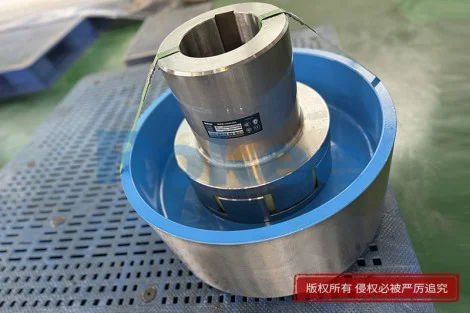
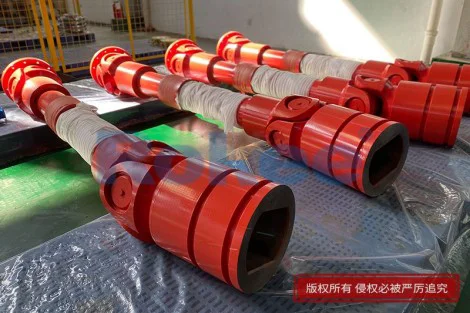
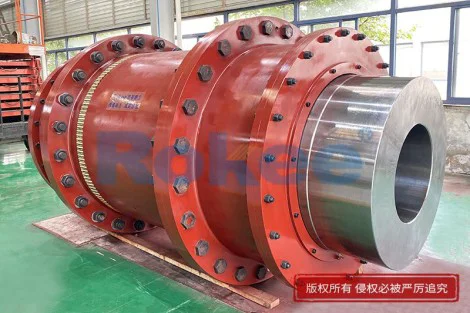
Special Cardan Shaft for PU Sandwich Panel Line Full Specifications and Customizable
In the modern construction and industrial manufacturing fields, polyurethane (PU) sandwich panels have become an indispensable material due to their excellent thermal insulation, flame retardancy, structural stability, and environmental friendliness. These panels, composed of two outer facing materials and a rigid PU foam core, are widely used in external walls, roofs, cold storage facilities, prefabricated buildings, and industrial workshops, driving the continuous development and upgrading of PU sandwich panel production lines. A PU sandwich panel production line is a complex integrated system that involves multiple sequential processes, including uncoiling of facing materials, roll forming, preheating, PU foaming, lamination, curing, and cutting. Each process requires precise and stable power transmission to ensure the consistency of product quality and the efficiency of the entire production line. Among the numerous components that constitute the transmission system of the production line, the special cardan shaft stands out as a core component, whose unique structural design and excellent performance directly determine the stable operation and production efficiency of the entire PU sandwich panel production line. Designed specifically for the working characteristics of PU sandwich panel production lines, this type of cardan shaft can adapt to the special working conditions of the production line, such as variable angles, continuous high-load operation, and multi-equipment coordination, while providing customizable solutions to meet the diverse needs of different production lines.
The special cardan shaft for PU sandwich panel line is developed based on the in-depth analysis of the working principles and operational characteristics of PU sandwich panel production lines. Unlike ordinary cardan shafts used in general industrial equipment, this special cardan shaft must meet the strict requirements of the production line in terms of transmission accuracy, load-bearing capacity, angle compensation, and service life. PU sandwich panel production lines usually operate continuously for a long time, with the transmission system needing to transfer power stably between multiple devices with different installation positions and angles, such as uncoiling machines, roll forming machines, foaming machines, double-belt lamination machines, and cutting machines. This requires the cardan shaft to have excellent angle compensation capacity, which can effectively resolve the angular deviations and axial displacements between the driving shaft and the driven shaft caused by the layout of the production line and equipment operation. At the same time, during the production process, the production line will generate a certain amount of vibration and thermal expansion, which puts higher requirements on the structural rigidity and fatigue resistance of the cardan shaft. Only a cardan shaft with reasonable structural design and high-quality materials can ensure long-term stable operation without failure, avoiding production interruptions caused by component damage.
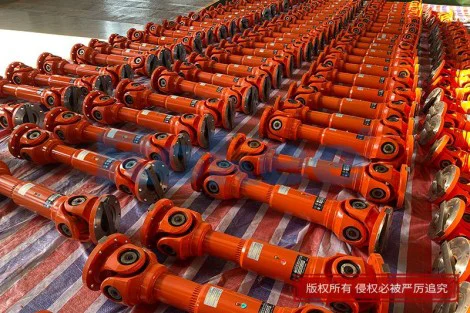
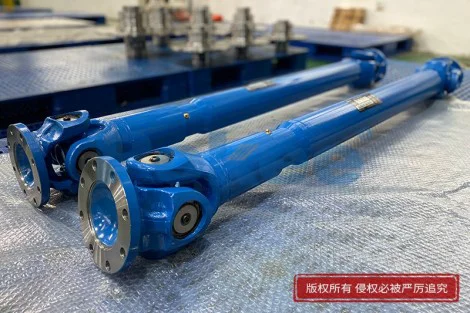
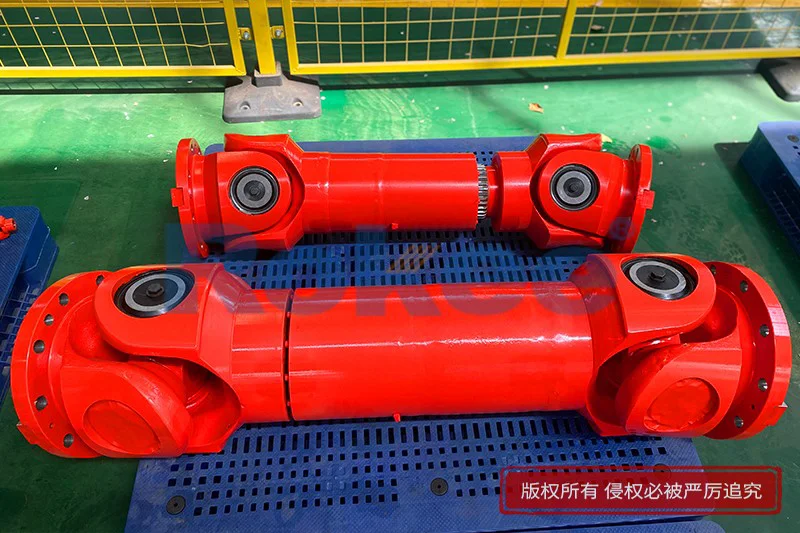
The full specifications of the special cardan shaft for PU sandwich panel lines cover multiple dimensions such as structural parameters, material specifications, performance indicators, and installation dimensions, which can fully adapt to the diverse needs of different types of PU sandwich panel production lines, including continuous and discontinuous production lines. In terms of structural parameters, the cardan shaft is mainly composed of universal joint assemblies, spline telescopic mechanisms, and transmission shaft tubes, which are scientifically matched to achieve efficient power transmission and flexible angle adjustment. The universal joint assembly, as the "joint" of power transmission, usually adopts a cross-shaft structure, consisting of cross shafts, needle bearings, and bearing cups. This structure allows the connected two shafts to rotate flexibly within a certain angle range, with an angular compensation capacity of 5° to 25°, which can well adapt to the angular deviations between different equipment in the PU sandwich panel production line. The spline telescopic mechanism is composed of internal spline sleeves and external spline shafts, adopting involute spline or rectangular spline design. This design not only ensures the effective transmission of torque but also allows axial relative sliding, which can flexibly compensate for the installation distance error between the two shafts and the axial displacement generated during operation, avoiding structural damage caused by thermal expansion and vibration. The transmission shaft tube, as the carrier of power transmission, is usually made of thick-walled seamless steel pipe or high-strength alloy steel pipe, with uniform wall thickness and high dimensional accuracy. For extra-long size cardan shafts, an intermediate support mechanism is added to avoid resonance and excessive bending during high-speed rotation, ensuring the stability of power transmission.
In terms of material specifications, the selection of materials for the special cardan shaft fully considers the working environment and load requirements of the PU sandwich panel production line, ensuring excellent performance and long service life. The main components such as the cross shaft, universal joint fork, and transmission shaft tube are usually made of medium carbon steel or alloy structural steel. Medium carbon steel, represented by 45# steel, has excellent strength, toughness, and machinability. After quenching and tempering treatment, its surface hardness can reach HRC 28-32, and the core toughness is maintained, which can meet the transmission needs of general load and medium speed production lines, with moderate cost and high cost performance. Alloy structural steel, such as 40Cr and 20CrMnTi, has better strength and hardenability than medium carbon steel. After heat treatment, its wear resistance and fatigue resistance are significantly improved, which is suitable for high-load and high-speed PU sandwich panel production lines, such as continuous production lines with a production speed of more than 5 meters per minute. In some special working environments, such as production lines in humid or corrosive areas, stainless steel materials are used to manufacture key components of the cardan shaft, which can effectively resist corrosion and rust, ensuring the stable operation of the cardan shaft in harsh environments. In addition, the surface of the cardan shaft is treated with anti-rust and anti-corrosion processes, such as galvanizing or spray painting, which further improves its corrosion resistance and extends its service life.
The performance indicators of the special cardan shaft for PU sandwich panel lines are strictly designed according to the actual working conditions of the production line, covering torque range, transmission efficiency, rotational accuracy, and service life. In terms of torque range, the cardan shaft can be designed and manufactured according to the power requirements of different production lines, with a torque range of 150 N·m to 1,000,000 N·m. For small and medium-sized PU sandwich panel production lines with low load and low speed, a cardan shaft with a small torque range can be selected to control costs; for large-scale continuous production lines with high load and high speed, a cardan shaft with a large torque range and high strength is required to ensure stable power transmission. The transmission efficiency of the cardan shaft is as high as 98% or more, which can minimize power loss during the transmission process, improve the energy utilization rate of the production line, and reduce energy consumption. In terms of rotational accuracy, the cardan shaft undergoes precise dynamic balance testing during the manufacturing process, with a dynamic balance grade of G6.3 or higher, which can effectively reduce vibration during high-speed rotation, avoid noise generation, and ensure the smooth operation of the production line. The service life of the cardan shaft is more than 10,000 hours under normal use and regular maintenance, which can meet the long-term continuous operation needs of the PU sandwich panel production line, reducing the frequency of component replacement and maintenance costs.
Installation dimensions are another important part of the full specifications of the special cardan shaft, which are designed according to the installation space and connection requirements of different PU sandwich panel production lines. The flange diameter of the cardan shaft ranges from 58 mm to 1200 mm, which can be matched with different types of flanges, such as DIN 58-225 and SAE 1100-1800, to meet the connection needs of different equipment. The length of the cardan shaft can be adjusted according to the distance between the driving device and the driven device, with a length range of 50 mm to 3000 mm. For production lines with limited installation space, a short-type cardan shaft with a compact structure can be selected, which can provide a certain length compensation while ensuring torque transmission. For production lines that require long-distance power transmission, a long-type cardan shaft with an intermediate support can be selected to ensure the stability and accuracy of power transmission. In addition, the cardan shaft is equipped with standardized connection components, which is convenient for installation and disassembly, reducing the difficulty of maintenance and replacement.
Customizability is one of the most prominent advantages of the special cardan shaft for PU sandwich panel lines, which can provide personalized solutions according to the specific needs of different users and production lines. The diversity of PU sandwich panel production lines leads to differences in their working conditions, load requirements, installation spaces, and connection methods, so the standard cardan shaft cannot fully meet all needs. The customizable service of the special cardan shaft covers multiple aspects, including structural design, material selection, performance parameters, and installation dimensions. In terms of structural design, according to the layout of the production line and the angle deviation between equipment, the structure of the universal joint assembly and the spline telescopic mechanism can be customized to improve the angle compensation capacity and transmission stability of the cardan shaft. For example, for production lines with large angular deviations between equipment, a double cardan shaft structure can be adopted to further improve the angle compensation capacity and reduce vibration. In terms of material selection, according to the working environment and load requirements of the production line, suitable materials can be selected to balance performance and cost. For example, for production lines in general environments, medium carbon steel can be selected to control costs; for production lines with high load and high speed, alloy structural steel can be selected to improve performance; for production lines in corrosive environments, stainless steel can be selected to ensure service life.
In terms of performance parameters, the torque range, transmission efficiency, and rotational accuracy of the cardan shaft can be customized according to the power requirements and production efficiency of the production line. For example, for production lines that require high-precision PU sandwich panels, the rotational accuracy of the cardan shaft can be improved to G4.0 or higher to ensure the stability of the production process and the consistency of product quality. In terms of installation dimensions, according to the installation space and connection requirements of the production line, the flange diameter, shaft length, and connection method of the cardan shaft can be customized to ensure a perfect match with the existing equipment of the production line, avoiding the need for modification of the production line and reducing installation costs. In addition, the surface treatment method of the cardan shaft can also be customized according to user needs, such as choosing different anti-rust and anti-corrosion treatments to adapt to different working environments.
The application of the special cardan shaft in PU sandwich panel production lines can effectively improve the stability and efficiency of the production line, reduce maintenance costs, and ensure product quality. In the uncoiling process of the production line, the cardan shaft transmits power to the uncoiling machine, ensuring the stable unwinding of the facing material and avoiding deviations caused by uneven power transmission. In the roll forming process, the cardan shaft ensures the uniform rotation of the forming rolls, making the shape of the facing material consistent and improving the flatness and dimensional accuracy of the panel. In the foaming and lamination process, the cardan shaft coordinates the operation of the foaming machine and the double-belt lamination machine, ensuring the uniform distribution of PU foam and the firm bonding between the foam core and the facing material, avoiding problems such as uneven foam density and poor bonding. In the cutting process, the cardan shaft drives the cutting machine to operate stably, ensuring the cutting accuracy of the panel and reducing the waste of materials.
Compared with ordinary cardan shafts, the special cardan shaft for PU sandwich panel lines has obvious advantages in adaptability, performance, and service life. Ordinary cardan shafts are designed for general industrial scenarios, with poor adaptability to the special working conditions of PU sandwich panel production lines, and are prone to problems such as vibration, wear, and failure during long-term operation, which affects the normal operation of the production line. The special cardan shaft is designed for the specific needs of PU sandwich panel production lines, with reasonable structural design, high-quality materials, and precise performance parameters, which can adapt to the long-term continuous operation, variable angle, and high-load working conditions of the production line. At the same time, the customizable service makes it more flexible and can meet the diverse needs of different production lines, providing strong support for the efficient and stable operation of PU sandwich panel production lines.
The maintenance and maintenance of the special cardan shaft for PU sandwich panel lines are relatively simple, which can further reduce the operation and maintenance costs of the production line. During normal use, regular lubrication and inspection are required to ensure the smooth operation of the cardan shaft. The cross shaft bearing and spline telescopic mechanism of the cardan shaft should be lubricated every two months, and the lubricating oil should be replaced in time when it turns black or contains metal chips to avoid internal wear. At the same time, regular inspection of the cardan shaft is required, including checking for abnormal noise, axial movement of the universal joint assembly, radial runout, and loose connecting bolts, and timely handling of problems found to avoid further damage to the cardan shaft. In addition, during installation, it is necessary to ensure that the fork ears at both ends are in the same plane to ensure the correct "phase" of the universal joint, and for multi-section cardan shafts, the working angles of adjacent universal joints should be as close as possible and in opposite directions to reduce secondary vibration.
With the continuous development of the PU sandwich panel industry, the requirements for the performance and quality of production line equipment are constantly improving, and the special cardan shaft, as a core component of the production line transmission system, will also face new development opportunities and challenges. In the future, with the application of new materials, new processes, and new technologies, the special cardan shaft for PU sandwich panel lines will be further optimized in structural design, material performance, and customization capabilities. For example, the application of high-strength lightweight materials will reduce the weight of the cardan shaft, improve transmission efficiency, and reduce energy consumption; the adoption of advanced processing technologies such as finite element analysis will optimize the structural design of the cardan shaft, improve its load-bearing capacity and fatigue resistance; the development of intelligent monitoring technology will realize real-time monitoring of the operation status of the cardan shaft, predict potential failures in advance, and improve the reliability and service life of the cardan shaft.
In conclusion, the special cardan shaft for PU sandwich panel lines is a key component that ensures the efficient and stable operation of PU sandwich panel production lines. Its full specifications cover structural parameters, material specifications, performance indicators, and installation dimensions, which can adapt to the diverse needs of different production lines. The customizable service provides personalized solutions for users, further improving the adaptability and flexibility of the cardan shaft. With excellent performance, long service life, and simple maintenance, the special cardan shaft has become an indispensable core component in the PU sandwich panel production line, providing strong support for the development of the PU sandwich panel industry. Whether it is a small and medium-sized discontinuous production line or a large-scale continuous production line, the special cardan shaft can meet its power transmission needs, helping users improve production efficiency, reduce costs, and enhance product quality.