Elastic Tire Coupling

In the complex and dynamic field of mechanical power transmission, the stability, flexibility, and durability of connecting components directly determine the overall operational efficiency and service life of mechanical systems. Among various flexible transmission components, elastic tire couplings stand out as a highly practical and adaptable solution, widely deployed in diverse industrial mechanical equipment that requires stable torque transmission, vibration attenuation, and displacement compensation. As a core flexible coupling device, it integrates unique elastomer structural characteristics and mechanical transmission principles, effectively solving common operational problems in shaft connection systems such as shaft misalignment, operational vibration, impact load fluctuation, and thermal deformation displacement, providing reliable basic support for the continuous and stable operation of mechanical equipment in complex working environments.
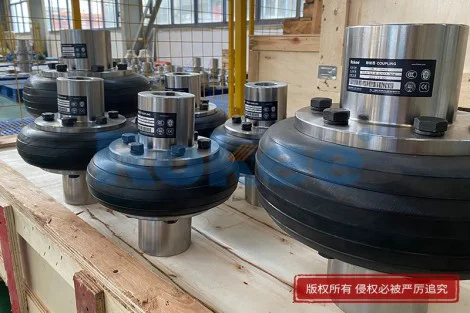
The basic composition of an elastic tire coupling is simple and scientific, mainly consisting of a flexible rubber tire-shaped elastic body and two matching metal half-coupling flanges. The rubber elastic element, serving as the core functional component of the entire coupling, adopts an integrated tire-like structure, which is tightly combined with the metal flange through mature vulcanization and assembly processes. This integrated structural design abandons the fragmented elastic component layout of traditional couplings, forming an integral force-bearing and buffering structure that can simultaneously undertake torque transmission, elastic deformation, and energy absorption functions. The metal flanges, usually made of high-strength metal materials with good rigidity and wear resistance, are responsible for connecting the driving and driven shafts of mechanical equipment, stably transmitting the power output from the power source to the executing mechanism, while cooperating with the rubber tire body to complete flexible adjustment during equipment operation.
The working principle of elastic tire couplings is based on the elastic deformation characteristics of polymer rubber materials and the friction transmission mechanism between structural contact surfaces. During the operation of mechanical equipment, the driving shaft drives the metal flange on one side to rotate, and torque is stably transmitted to the rubber tire body through the friction force and fastening structure between the flange and the tire body. Subsequently, the rubber elastic body transmits the torque to the metal flange on the other side, thereby realizing the synchronous rotation and power transmission of the driving and driven shafts. In this process, the excellent elastic deformation capacity of the rubber tire body plays a decisive role. When relative displacement occurs between the two connected shafts due to installation errors, equipment operation vibration, foundation settlement, or thermal expansion and contraction of components, the tire-shaped rubber structure can produce multi-directional elastic deformation to adapt to such changes. This flexible adaptation fundamentally avoids rigid extrusion and friction between shafts and transmission components, eliminating mechanical stress concentration caused by shaft misalignment and greatly reducing component wear and operational failure risks.
One of the most prominent performance advantages of elastic tire couplings is their superior multi-dimensional displacement compensation capability. Different from ordinary flexible couplings that can only adapt to single or limited displacement deviation, this type of coupling can effectively compensate for angular misalignment, radial parallel displacement, and axial displacement between two shafts simultaneously. In actual industrial production, it is difficult to achieve absolute coaxiality of two shafts during equipment installation, and long-term operational vibration and environmental temperature changes will further expand shaft displacement errors. The tire structure with good ductility can produce gentle elastic deformation within a reasonable range to adapt to these multi-dimensional deviations, ensuring that the power transmission process remains smooth and continuous without additional mechanical resistance. This comprehensive displacement compensation performance makes it far more adaptable than many traditional coupling products in complex installation and operating conditions, and it can still maintain stable transmission performance in equipment systems with large allowable shaft displacement errors.
In addition to outstanding displacement compensation ability, elastic tire couplings have excellent vibration damping and shock absorption performance, which is a key reason for their wide application in impact and vibration-intensive working scenarios. The rubber tire elastic body has good damping and energy absorption characteristics. When mechanical equipment is started, stopped, or operates under variable load conditions, instantaneous impact load and torsional vibration will be generated inside the transmission system. These unstable mechanical energies will be effectively absorbed and buffered by the rubber tire body through elastic deformation and internal material damping, converting instantaneous impact kinetic energy into gentle elastic potential energy and releasing it slowly. This process significantly reduces the vibration amplitude of the entire mechanical transmission system, weakens mechanical noise generated by vibration friction, and avoids fatigue damage to precision components caused by long-term high-frequency vibration. For equipment with frequent start-stop, forward and reverse rotation, and sudden load changes, this vibration buffering effect can effectively protect gears, bearings, shafts, and other core components, extending the overall service life of the equipment.
The structural design of elastic tire couplings also endows them with unique operational adaptability and environmental tolerance. The integrated rubber tire body has good structural integrity and will not produce loose or fragmented deformation during long-term operation. It can stably work in harsh working environments such as high dust, humidity, and slight corrosion, and is not easily affected by fine particulate impurities in the air. Unlike gear couplings and other rigid transmission components that require regular lubrication and oil seal maintenance, elastic tire couplings realize zero lubrication operation in the whole service process. There is no need to add lubricating oil or grease, nor is there a risk of oil leakage and pollution, which greatly reduces the daily maintenance workload of equipment and avoids production downtime caused by lubrication failure. This maintenance-free characteristic is particularly suitable for industrial production lines with continuous operation requirements and on-site working environments where maintenance operations are inconvenient.
The installation and replacement convenience of elastic tire couplings further improves their practical application value in industrial production. The overall structural layout is compact and reasonable, with a simple assembly relationship between components. During installation, workers do not need to carry out complex shaft alignment operations or disassemble a large number of equipment components. The rubber tire element can be quickly installed and fixed between the two metal flanges through standard fasteners. When the elastic component reaches the end of its service life and needs to be replaced, the old tire body can be removed and a new one installed without moving the driving and driven equipment or readjusting the shaft position, which greatly shortens equipment maintenance and replacement time, reduces production downtime losses, and improves the overall operational efficiency of the production system. For industrial scenarios requiring frequent equipment debugging and component replacement, this efficient assembly and disassembly feature brings obvious economic benefits.
Elastic tire couplings exhibit stable and reliable working performance under variable load and alternating operation conditions. Their torsional stiffness is relatively low and uniform, and the torque transmission process is gentle and stable without sudden torque fluctuation. When the equipment is subjected to alternating load impact or irregular power output, the elastic buffer structure can always maintain the continuity of power transmission, avoid transmission interruption or component jamming caused by load mutation, and ensure the stable operation of mechanical equipment. At the same time, the rubber material used for the tire body has good aging resistance and fatigue resistance after special processing. It can withstand long-term repeated elastic deformation and frequent vibration impact, and will not easily experience hardening, cracking, or deformation failure, maintaining stable mechanical performance throughout the long service cycle.
In terms of industrial application scenarios, elastic tire couplings cover a wide range of mechanical equipment in multiple industries. In mining and heavy industry, they are applied to impact-intensive equipment such as crushers and ball mills. These devices often bear strong impact loads and continuous vibration during operation, and the vibration damping and buffer performance of tire couplings can effectively resist mechanical impact and protect the transmission system from damage. In the papermaking and printing industry, large-diameter roller transmission equipment is prone to axial and radial displacement caused by thermal expansion during long-term high-temperature operation, and the multi-dimensional displacement compensation capability of elastic tire couplings can perfectly adapt to such deformation changes, ensuring the stable operation of roller transmission. In the energy and power industry, long-axis transmission systems such as large fans and water pumps are affected by foundation settlement and environmental vibration for a long time, and tire couplings can effectively compensate for accumulated shaft displacement errors and maintain the stability of long-distance power transmission.
In addition, elastic tire couplings also show good adaptability in ship transportation, chemical production, building materials processing, and general mechanical manufacturing fields. In ship propulsion systems, they can adapt to the vibration and displacement changes of ship equipment during navigation and resist the impact of humid and salt-spray environment on transmission components. In chemical production equipment operating for a long time, their maintenance-free and anti-pollution characteristics can adapt to complex chemical working environments and reduce equipment failure rates. In building materials processing machinery with high dust and high load operation, their durable and vibration-resistant performance ensures the continuous and efficient operation of production equipment.
Despite the many excellent performance advantages, elastic tire couplings also have certain application limitations that need to be reasonably considered in actual selection and use. Compared with compact rigid couplings, the overall radial size of elastic tire couplings is slightly larger, which requires a certain installation space in the equipment design. In addition, although the rubber tire body has good comprehensive performance, its high-temperature resistance is limited compared with metal components, so it is not suitable for long-term operation in ultra-high temperature working environments. Meanwhile, in ultra-high-speed and ultra-precision transmission scenarios with extremely strict torque transmission accuracy requirements, the slight elastic deformation of the rubber body may have a minor impact on transmission precision, making it more suitable for medium and low-speed, high-stability, and high-vibration working scenarios rather than extreme precision transmission equipment.
The correct selection and standardized use of elastic tire couplings are key to giving full play to their performance advantages. In the model selection stage, it is necessary to comprehensively evaluate multiple factors such as the equipment's operating speed, transmission torque magnitude, working environment temperature, vibration intensity, and shaft displacement range. It is essential to match the coupling with appropriate elastic hardness and structural specifications according to actual working conditions to avoid performance mismatch caused by improper selection. During the installation process, it is necessary to ensure uniform fastening of fasteners and correct assembly position of components to avoid local stress concentration caused by uneven assembly, which may lead to premature wear of the rubber tire body. In daily equipment operation, although the coupling requires no regular maintenance, regular visual inspection of the rubber body for aging, cracking, or abnormal deformation is still needed. Timely replacement of aging components can effectively avoid sudden equipment failures and ensure long-term stable operation of the transmission system.
From the perspective of mechanical transmission system optimization, the application of elastic tire couplings effectively improves the overall operational reliability of mechanical equipment and reduces the comprehensive operating cost of industrial production. Its integrated flexible transmission structure realizes the organic combination of power transmission, vibration reduction, and displacement compensation, solving many pain points of traditional rigid and semi-flexible couplings in practical applications. The excellent environmental adaptability, zero-maintenance performance, and convenient replacement characteristics not only reduce equipment maintenance labor costs and time costs but also reduce the failure rate of transmission components, extend the service cycle of mechanical equipment, and create stable production benefits for industrial enterprises.
With the continuous upgrading of industrial mechanical equipment towards high efficiency, stability, and intelligence, the market demand for high-performance flexible transmission components is also increasing. As a mature and reliable flexible coupling product, elastic tire couplings will continue to exert their unique performance advantages in more industrial scenarios. Through the continuous optimization of rubber material formula and structural design, their high-temperature resistance, wear resistance, and fatigue resistance will be further improved, and their application scope will be continuously expanded. In the future industrial mechanical transmission field, elastic tire couplings will still occupy an important position, providing solid and reliable basic component support for the stable and efficient operation of various mechanical equipment systems.