Universal Joint Coupling Helps PIR Sandwich Panel Production Line Double Production Capacity

The continuous advancement of modern building energy-saving technology has driven the rapid expansion of market demand for PIR sandwich panels. As a core lightweight and thermal insulation building material, PIR sandwich panels are widely applied in industrial plant construction, cold chain storage facilities, commercial buildings and other fields due to their excellent thermal insulation performance, structural stability and weather resistance. With the continuous upgrading of construction efficiency standards and energy-saving requirements, the manufacturing industry has put forward higher demands for the production efficiency, operational stability and product consistency of PIR sandwich panel production lines. For a long time, many medium and large-scale panel production lines have been restricted by traditional transmission system defects, including unstable power transmission, easy equipment jitter, frequent shutdown maintenance and limited operating speed, which have become key bottlenecks restricting the release of production capacity. The application of universal joint coupling has thoroughly optimized the transmission structure of PIR sandwich panel production lines, effectively solved various pain points in traditional transmission operation, realized stable high-speed continuous production of the entire line, and finally achieved a significant doubling of comprehensive production capacity while ensuring product processing quality.
PIR sandwich panel manufacturing is a typical continuous and integrated industrial production process, which integrates raw material feeding, foam compounding, continuous pressing, surface trimming, fixed-length cutting and finished product conveying into one automated production line. The whole production process requires precise coordination of multiple sets of transmission equipment, and the synchronization accuracy and operational stability of each transmission node directly determine the overall operating efficiency of the production line. In the traditional production line transmission design, rigid connection structures are mostly adopted between driving shafts and driven shafts of various transmission components. This rigid connection mode can only adapt to ideal linear shaft alignment conditions, but in actual long-term industrial operation, production equipment will inevitably produce tiny axial displacement, angular deviation and structural vibration due to mechanical wear, equipment load changes and long-term high-frequency operation. These subtle deviations cannot be compensated by rigid transmission structures, which will lead to uneven torque transmission, periodic equipment jitter and unstable operating speed of the production line. In the low-speed production mode in the past, such defects could be covered up to a certain extent, but once the production line speed is increased to pursue higher output, the transmission errors will be amplified instantly, resulting in unqualified panel thickness uniformity, irregular cutting sizes, and even frequent equipment stalling and emergency shutdowns, seriously restricting the improvement of production efficiency.
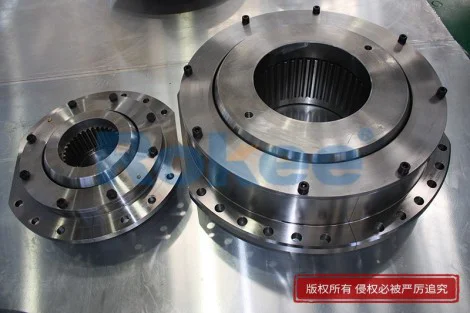
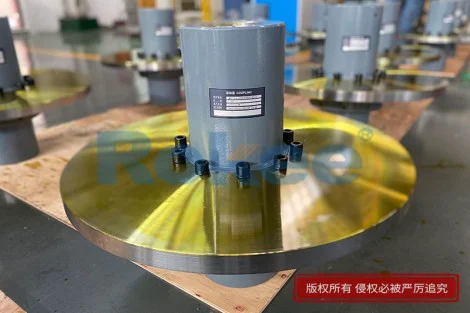
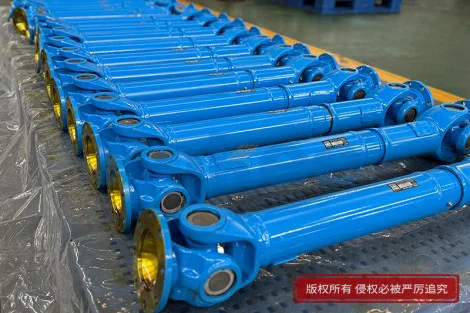
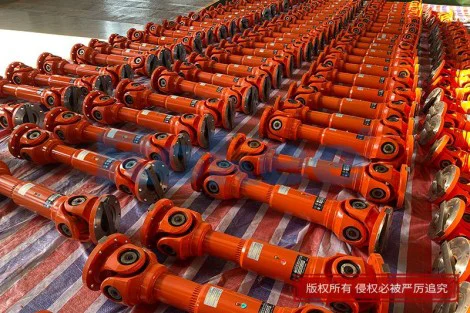
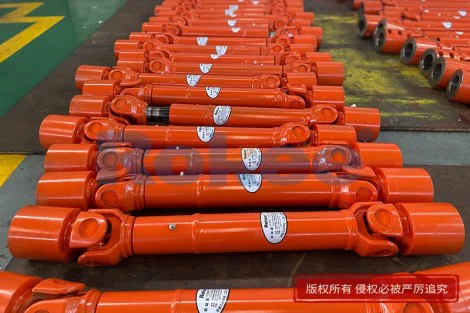
The fundamental advantage of universal joint coupling lies in its unique flexible spatial transmission capability and efficient misalignment compensation performance, which completely breaks through the structural limitations of traditional rigid transmission parts. Based on the spatial linkage transmission principle, the core structure of the universal joint coupling is composed of fork-shaped yokes, a central cross shaft and matching flexible bearing components. The two groups of yokes are respectively connected with the driving end and driven end of the production line transmission shaft system. Through the flexible pivoting and adaptive deflection of the cross shaft structure, it can maintain continuous and stable torque and rotational power transmission under the working conditions of angular deviation and micro axial displacement between the main and driven shafts. Different from rigid couplings that are prone to stress concentration and transmission failure when facing shaft displacement, the universal joint coupling can actively adapt to the dynamic offset of the equipment shaft system during operation, eliminate transmission dead angles and power loss caused by structural misalignment, and ensure that the power output of the power unit can be efficiently and completely transmitted to each production execution component.
In the actual operation of PIR sandwich panel production line, the optimization effect of universal joint coupling on production efficiency runs through the whole production link. In the raw material feeding and conveying stage, the production line needs to continuously and stably transport metal base plates and thermal insulation core materials at a uniform speed. The traditional rigid transmission system is prone to intermittent speed fluctuation due to slight shaft misalignment, resulting in uneven feeding spacing and inconsistent material tension. This not only affects the subsequent composite pressing effect of the panel, but also forces the production line to reduce the operating speed to avoid material deviation and stacking, which greatly limits the feeding efficiency. After adopting universal joint couplings, the transmission system achieves constant-speed and low-jitter operation. The adaptive compensation function eliminates speed fluctuation caused by transmission deviation, ensures synchronous and uniform feeding of raw materials, enables the feeding link to operate stably at a higher set speed, and lays a foundation for the overall speed increase of the production line.
The foaming and composite pressing stage is the core link that determines the forming quality and production speed of PIR sandwich panels, and also the most demanding link for transmission stability. In this process, the equipment needs to maintain constant pressure and uniform conveying speed to ensure the full and uniform foaming of PIR materials and the tight composite bonding between the core material and the metal surface plate. Slight transmission jitter or speed deviation will lead to uneven foaming density, local hollowing of the core material and inconsistent plate thickness, resulting in a large number of defective products. Traditional transmission structures cannot avoid periodic vibration and torque fluctuation during high-load operation, so production lines can only adopt low-speed and low-load operation modes to guarantee product quality, which is the main reason for the low overall production capacity of traditional panel lines. The application of universal joint couplings effectively solves this problem. Its flexible transmission structure buffers the mechanical vibration generated by high-load operation, balances the torque output of the transmission shaft system, realizes stable and continuous operation of the pressing and composite mechanism at high-speed and high-load states, not only improves the forming qualification rate of PIR panels, but also breaks the speed limit of the core production link, greatly improving the single-line continuous output efficiency.
The trimming and fixed-length cutting links of finished panels also benefit greatly from the performance optimization brought by universal joint couplings. These precision processing links require extremely high synchronization accuracy of transmission motion. The accumulated transmission errors of traditional rigid structures will lead to inaccurate positioning of trimming tools and deviation of cutting length, which not only reduces the dimensional accuracy of finished products, but also requires frequent equipment debugging and shutdown calibration, resulting in a large amount of invalid production time and low effective production efficiency. Universal joint couplings eliminate accumulated transmission errors through real-time misalignment compensation, ensure the precise synchronization of the operating stroke and speed of trimming and cutting equipment, reduce the error rate of precision processing, and avoid frequent shutdown maintenance and debugging caused by transmission system errors. The reduction of invalid shutdown time greatly improves the effective operation rate of the production line, and the stable precision control also reduces the waste of raw materials caused by processing errors, further improving the comprehensive production benefit of the line.
In addition to the direct improvement of production speed and operation stability, the long-term structural optimization of universal joint couplings for PIR sandwich panel line is also an important reason for the doubling of production capacity. Traditional rigid transmission parts are prone to excessive local stress and accelerated wear when operating under misalignment conditions, resulting in short service life of vulnerable parts, frequent equipment failures and regular replacement of accessories. Frequent equipment maintenance and failure shutdowns will occupy a lot of production time, reduce the annual effective production days of the production line, and also increase the labor cost of equipment maintenance and the downtime loss of production stagnation. The structural design of universal joint couplings can evenly disperse the operating stress, avoid local stress concentration, and reduce the wear and impact loss of transmission components during operation. This significantly prolongs the service life of the transmission system, reduces the frequency of equipment failure and routine maintenance, greatly improves the long-term continuous operation capability of the production line, and maximizes the release of production capacity in the full production cycle.
The capacity improvement brought by universal joint couplings is reflected in the dual promotion of instantaneous production efficiency and long-term cumulative output. In terms of instantaneous operating efficiency, the production line abandons the low-speed conservative operation mode restricted by unstable transmission, and can stably operate at a higher rated speed. The overall operating speed of feeding, pressing, forming and cutting links is increased synchronously, and the single-hour output of finished products is significantly improved. In terms of long-term cumulative output, the effective operation rate of the production line is greatly increased due to the reduction of failure shutdowns and maintenance time. The production line can maintain long-term uninterrupted continuous production, avoiding capacity loss caused by frequent start-stop adjustments. The superposition of the two advantages makes the overall comprehensive production capacity of the PIR sandwich panel production line achieve a stable doubling effect, and the production efficiency is maintained at a high level for a long time.
At the same time, the stable transmission performance of universal joint couplings also optimizes the consistency of PIR sandwich panel products, which indirectly promotes the improvement of overall production efficiency. In industrial mass production, unstable processing conditions will lead to inconsistent product quality, and unqualified products need to be reworked or scrapped, which virtually consumes production capacity and raw material resources. After the transmission system is optimized, the production line maintains stable operating parameters in the whole process, the thickness, density, flatness and dimensional accuracy of the produced PIR panels are highly consistent, the product qualification rate is significantly improved, the rework and scrap rate is reduced to a low level, and the effective qualified product output per unit of production time is further increased. This quality-stabilized and efficiency-increased production mode realizes the simultaneous improvement of production capacity and product quality, avoiding the common problem of quality decline caused by blind speed increase in traditional production modes.
With the continuous development of the PIR sandwich panel industry towards large-scale and high-efficiency production, the role of basic transmission components in restricting and boosting production capacity has become increasingly prominent. The practical application effect of universal couplings in PIR sandwich panel production lines fully proves that the optimization of basic mechanical transmission structure is a key breakthrough point to release the production potential of automated production lines. Different from the high-cost capacity expansion mode of adding production lines and upgrading large-scale equipment, replacing and optimizing the transmission system with universal joint couplings is an efficient and low-consumption capacity upgrading scheme, which can tap the maximum production potential of existing production equipment through structural optimization, avoid resource waste caused by repeated equipment investment, and realize rapid doubling of production capacity on the basis of original production lines.
In the future, with the further improvement of industrial automation and intelligent production level, the operational precision and continuous production requirements of PIR sandwich panel production lines will continue to rise. The flexible transmission, stable operation and low-loss performance advantages of universal joint couplings will be further highlighted. Through continuous structural optimization and adaptive upgrading for panel production line working conditions, universal joint couplings will continue to provide stable transmission guarantee for high-efficiency and large-scale production of PIR sandwich panels, help more manufacturing enterprises break through production capacity bottlenecks, improve market supply capacity and industrial production efficiency, and promote the high-quality development of the building energy-saving material manufacturing industry.