Telescopic Universal Shaft Coupling

Telescopic universal shaft coupling is a sophisticated and versatile mechanical transmission component widely adopted in modern industrial transmission systems, serving as a core connecting unit for power transmission between rotating shafts. Integrating the dual advantages of traditional universal coupling angle compensation and telescopic shaft axial displacement adjustment, this specialized device effectively addresses common operational problems in mechanical transmission, including shaft misalignment caused by installation deviations, equipment thermal expansion and contraction, and structural vibration displacement. Unlike rigid couplings that rely on fixed connection and lack adaptive adjustment capabilities, it can maintain stable and efficient torque transmission while tolerating both angular deflection and linear axial movement between connected shafts. Its flexible structural design and strong environmental adaptability make it applicable to various complex working conditions, from low-speed heavy-load mechanical equipment to high-precision and high-speed transmission devices, playing a vital role in improving transmission stability, reducing mechanical wear, and extending the overall service life of mechanical systems.
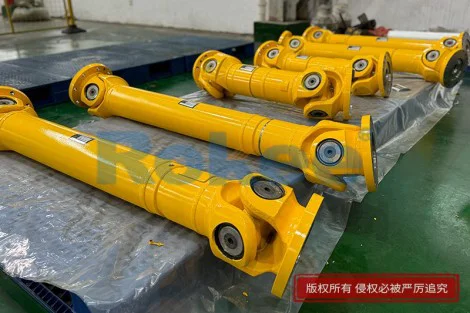
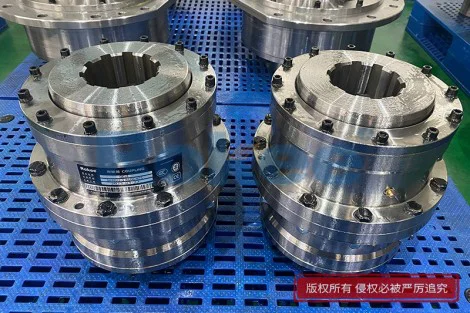
The basic structural composition of telescopic universal shaft coupling is scientifically and reasonably designed, focusing on balancing transmission accuracy, structural flexibility and mechanical strength to adapt to diverse industrial working scenarios. The whole device mainly consists of universal joint assemblies at both ends and a middle telescopic adjustment mechanism, with each component undertaking independent and coordinated functional tasks. The universal joint parts composed of precision-processed yokes and cross shaft bearings form the core angle compensation structure, enabling the coupling to adapt to a certain range of angular deviation between the driving shaft and driven shaft during operation. The middle telescopic mechanism adopts a matching spline shaft and spline sleeve structure, which can freely extend and contract along the axial direction, realizing real-time adjustment of the overall length of the coupling. All key components are processed with high-precision machining technology to ensure tight fit and smooth relative movement between parts. The integrated structural design avoids redundant accessories, simplifies the overall assembly process, and effectively reduces structural vibration and transmission resistance during power operation, laying a solid foundation for long-term stable operation of the equipment.
The core working principle of telescopic universal shaft coupling lies in the coordinated operation of angle compensation and axial telescopic adjustment, which realizes error tolerance and adaptive transmission in complex motion states. In the actual working process, when the two connected shafts produce angular deflection due to equipment operation vibration, installation errors or structural deformation, the cross shaft bearing structure of the universal joint can flexibly rotate and deflect, ensuring that torque and rotational speed can be stably transmitted without generating additional mechanical stress. When the shaft spacing changes dynamically due to equipment thermal deformation, mechanical jitter or working position adjustment, the spline matching structure of the telescopic part will slide relatively along the axial direction to automatically compensate for the changed shaft distance. This dual compensation mechanism enables the coupling to always keep a good transmission state in dynamic working environments. Different from single-function couplings that can only compensate for a single displacement error, its composite working mode eliminates transmission dead angles, avoids power loss and mechanical jamming caused by shaft position deviation, and greatly improves the fault tolerance of the transmission system.
Telescopic universal shaft coupling possesses prominent performance advantages that make it superior to many traditional transmission connection components in practical industrial applications. First of all, it has excellent comprehensive compensation capability, which can simultaneously cope with angular deviation, axial displacement and a small amount of radial offset, solving various shaft alignment problems that are difficult to adapt to rigid couplings and single-compensation flexible couplings. Secondly, it maintains high transmission efficiency while realizing flexible adjustment, with smooth torque transmission and negligible power loss during operation, which can well meet the precision power transmission requirements of mechanical equipment. In addition, the overall structure has high mechanical rigidity and load-bearing capacity, which can withstand long-term heavy-load operation and frequent start-stop impact loads without structural deformation or performance attenuation. Meanwhile, the moving parts adopt optimized friction matching design, which reduces internal friction and wear, lowers equipment operation noise, and effectively delays the aging speed of components. Its strong environmental adaptability allows it to operate stably in high-temperature, dusty and slightly vibrating working environments, with stable and reliable overall performance.
This type of coupling has extremely extensive application coverage, penetrating almost all fields involving mechanical power transmission, especially suitable for equipment with dynamic shaft position changes and complex transmission conditions. In heavy industry fields such as metallurgy and mining, it is applied to the transmission systems of rolling mills, straightening machines, mining crushers and conveying equipment, adapting to the large vibration and thermal deformation generated by long-term high-load operation of heavy machinery. In construction machinery and transportation equipment, it serves the transmission connection of cranes, excavators and road construction machinery, flexibly coping with the dynamic shaft spacing and angle changes caused by mechanical luffing and walking movement. In general mechanical manufacturing, it is used in processing machine tools, packaging equipment and automation production lines, ensuring high-precision and stable power transmission during high-speed operation. Moreover, it also plays an important role in marine auxiliary machinery, drilling equipment and rubber and plastic machinery, providing reliable transmission guarantee for various special working condition equipment.
Reasonable installation and daily maintenance are key factors to ensure the long-term stable operation and extended service life of telescopic universal shaft coupling, and standardized operation can effectively avoid common mechanical failures. During the installation process, it is necessary to ensure that the coaxiality of the connected shafts is controlled within a reasonable range to avoid excessive initial deviation that increases the operating load of the coupling. The assembly of spline parts and universal joint bearings should be kept clean to prevent dust, impurities and debris from entering the matching gap, which may cause jamming and accelerated wear. After installation, it is necessary to conduct no-load trial operation to check whether there is abnormal vibration, noise or unsmooth rotation, and adjust the installation state in time if problems are found. In daily maintenance, regular lubrication of bearing and spline moving parts is required to reduce friction loss and prevent dry wear and component rust. It is also necessary to regularly check the fastening state of connecting parts and the wear degree of key components, replace severely worn parts in time, and eliminate potential safety hazards in advance to ensure continuous and efficient operation of the transmission system.
In the field of modern mechanical transmission technology, telescopic universal shaft coupling is constantly optimized and upgraded with the progress of industrial manufacturing technology, and its comprehensive performance is continuously improved to adapt to the upgrading of industrial equipment. Traditional products are optimized in structural design, adopting more streamlined component matching to further reduce transmission inertia and improve the response speed of power transmission. In terms of material selection, high-strength and wear-resistant alloy materials are gradually applied, which significantly improves the mechanical strength, corrosion resistance and fatigue resistance of the coupling, and adapts to more harsh working environments. At the same time, the precision of component processing and assembly is continuously improved, making the angle and axial compensation more accurate, and the transmission operation more stable and smooth. In addition, the modular design concept is introduced into product research and development, realizing flexible combination of components, which facilitates later maintenance and part replacement, and reduces the comprehensive operation cost of equipment. These technological optimizations further expand the application scope and service value of the coupling.
As an indispensable basic component of mechanical transmission systems, telescopic universal shaft coupling occupies an irreplaceable core position in industrial equipment operation and mechanical system design. Its unique dual compensation function, stable transmission performance and strong working condition adaptability effectively solve many pain points in traditional mechanical transmission, such as poor adaptability to dynamic shaft position deviation, high component wear rate and low transmission stability. With the continuous development of industrial automation and intelligent manufacturing, mechanical equipment is developing towards high speed, high precision and high load, which puts forward higher requirements for the flexibility, stability and durability of transmission components. The continuous technical iteration and performance optimization of telescopic universal shaft coupling make it fully adapt to the development trend of modern machinery, providing reliable basic support for the efficient and safe operation of various industrial equipment, and also injecting continuous power for the upgrading and innovation of mechanical transmission technology.