Radial Load Drum Coupling

Radial load drum coupling is a specialized power transmission component uniquely engineered to integrate efficient torque transmission and heavy radial load bearing, standing out from conventional gear couplings in heavy-duty mechanical systems. Primarily applied in drum-driven equipment, this coupling serves as a critical connecting unit between reducer output shafts and mechanical drums, solving the dual core demands of stable power transfer and continuous radial force support during equipment operation. Its distinctive drum-shaped tooth profile and spherical matching structure eliminate the defects of uneven stress concentration and poor misalignment compensation found in traditional straight-tooth couplings. Designed to withstand persistent high radial loads generated by wire rope tension and material gravity, it maintains steady transmission performance under long-term heavy-load and intermittent impact working conditions. Widely adaptable to various heavy machinery scenarios, it balances structural compactness, operational stability and service durability, becoming an indispensable core part for ensuring the reliable operation of lifting, metallurgical and mining mechanical transmission systems.
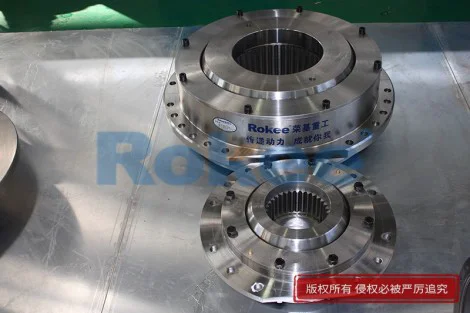
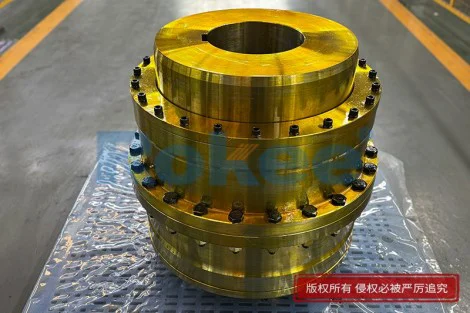
The structural design of radial load drum coupling is highly optimized for heavy-load working scenarios, consisting of core components including drum-shaped outer gear sleeve, inner tooth sleeve, bearing support structure, sealing assembly and positioning parts. Different from common transmission couplings that only focus on torque transfer, this product embeds an integrated radial bearing structure inside the overall framework, which directly undertakes the radial load generated during drum operation and replaces the traditional single-side bearing seat structure of mechanical drums. The drum-shaped tooth profile is the most pivotal structural feature, whose curved surface design enlarges the contact area of meshing tooth surfaces compared with straight teeth. This structural improvement enables gradual and uniform load transfer during shaft rotation, effectively avoiding local stress accumulation and single-tooth overpressure damage. Meanwhile, the internal spherical matching structure provides flexible compensation for minor axial deviation, angular deflection and radial displacement between connected shafts, which are inevitable in long-term mechanical operation. The compact overall layout avoids excessive space occupation while enhancing structural rigidity, and the matched sealing components can effectively block dust, moisture and abrasive particles in industrial environments, protecting internal gear meshing pairs and bearing structures from wear and corrosion.
The working principle of radial load drum coupling relies on the synergistic operation of gear meshing transmission and radial load bearing structure to realize dual mechanical functions. In actual equipment operation, the driving power transmitted from the reducer acts on the drum-shaped outer gear sleeve of the coupling, and the precise meshing between the outer drum teeth and inner tooth sleeve drives the driven shaft and mechanical drum to rotate synchronously, completing efficient torque transmission. Unlike ordinary couplings that only bear torsional force, this coupling’s built-in bearing support system independently undertakes all radial loads generated by the drum during operation. When the drum winds steel wires or bears material loads, the generated radial tension is directly transmitted to the coupling’s bearing structure instead of acting on the shaft body and gear meshing parts. This force separation mechanism completely isolates torque transmission and radial load bearing, ensuring that the gear meshing pair only bears uniform torsional load without interference from radial shear force. The flexible compensation capability of the drum-shaped tooth surface further optimizes the force state during operation, allowing the coupling to adapt to slight shaft position changes caused by equipment vibration and mechanical deformation, maintaining continuous and stable power transmission without jitter or stuck operation.
Radial load drum coupling exhibits outstanding performance advantages in load bearing and operational stability, making it superior to traditional coupling products in heavy-duty working conditions. Benefiting from the optimized drum-shaped tooth meshing mode, its effective load-bearing area is significantly increased, realizing more uniform stress distribution on each tooth surface during torque transmission. This structural advantage enables the coupling to carry larger torque under the same overall dimensional specifications, with enhanced overload resistance to cope with instantaneous impact loads generated by equipment start-stop and sudden load changes. In terms of radial load bearing, the integrated bearing structure realizes centralized bearing of high radial force, avoiding the problem of reduced transmission accuracy and shortened service life caused by long-term radial force extrusion on ordinary couplings. Additionally, the flexible misalignment compensation function effectively reduces mechanical vibration and running noise during equipment operation, weakening the friction loss between matching parts. The overall structural rigidity and wear resistance are fully improved, which can adapt to long-term continuous operation in harsh industrial environments such as high dust and variable load, effectively reducing equipment failure rates and improving the overall operational stability of mechanical transmission systems.
This type of coupling has extremely broad application value in heavy industrial mechanical equipment, mainly covering core scenarios that require simultaneous torque transmission and radial load bearing. Lifting machinery is its most typical application field, where it is applied to the drum transmission structure of various lifting equipment to bear the huge radial tension generated by steel wire rope winding and ensure stable power output during material lifting and handling. In metallurgical industry equipment, it adapts to the high-load and continuous operation state of rolling and conveying machinery, providing reliable transmission support for heavy-duty drum operation under high-temperature and dusty working environments. Mining machinery also widely adopts this coupling for drum transmission components of conveying and winding equipment, coping with complex working conditions of frequent start-stop and variable load impact. Beyond these core scenarios, it is also applicable to heavy-duty conveying equipment, port handling machinery and other industrial equipment with drum transmission structures. Its strong environmental adaptability and load-bearing performance make it a universal core component for heavy mechanical transmission, effectively solving the technical pain points of insufficient radial load capacity and poor stability of traditional couplings in heavy-load drum equipment.
The service life and maintenance performance of radial load drum coupling are far better than conventional transmission couplings, bringing significant economic and operational benefits to industrial production. The uniform stress distribution of drum-shaped tooth surfaces avoids local fatigue wear and tooth surface fracture failures that often occur in straight-tooth couplings, greatly extending the service cycle of gear meshing pairs. The independent radial bearing structure adopts wear-resistant and pressure-resistant structural design, which can maintain stable bearing performance after long-term high-load operation without frequent component failure. Equipped with high-performance sealing components, the internal precision matching structure is effectively isolated from external harsh environments, reducing the erosion of dust, impurities and humid air on internal parts and avoiding lubricant deterioration and component corrosion. In terms of daily maintenance, the integrated modular structure simplifies disassembly and assembly steps, eliminating the need for complex debugging work during inspection and replacement. The coupling supports long-term stable operation with regular simple lubrication maintenance, reducing manual maintenance frequency and equipment downtime. The reliable durability lowers the overall operating cost of mechanical equipment, avoiding production losses caused by frequent coupling failures and replacement, and improving the continuous operation efficiency of industrial production lines.
In the field of heavy mechanical transmission technology, radial load drum coupling represents an optimized design direction of integrating multi-functional mechanical performance, and its technical advantages continue to promote the upgrading of heavy-duty transmission components. Traditional coupling products often have single functions, either focusing only on torque transmission without radial load bearing capacity, or having poor misalignment compensation ability leading to easy wear and failure. The emergence of radial load drum coupling perfectly makes up for these technical deficiencies, realizing the organic combination of high-efficiency torque transmission, heavy radial load bearing and flexible misalignment compensation. With the continuous development of heavy industry towards large-scale, high-load and long-term continuous operation, the performance requirements for mechanical transmission components are increasingly stringent. This coupling’s compact structure, strong comprehensive bearing capacity and high operational stability can fully meet the iterative upgrading needs of modern heavy machinery. Its unique force separation transmission mechanism and optimized tooth surface design provide a mature technical reference for the structural innovation of special couplings for heavy-load drum equipment, and it will occupy a more important position in the field of industrial mechanical transmission with the improvement of heavy machinery integration and precision.
Reasonable installation and standardized operation are key prerequisites to ensure the full performance and long-term stable operation of radial load drum coupling. During the installation process, the coaxiality of the driving shaft and driven shaft must be strictly calibrated to avoid excessive installation deviation exceeding the coupling’s compensation range, which may cause additional stress on the meshing tooth surface and bearing structure. The installation position should ensure that the coupling can bear radial load evenly without unilateral force deviation, and the fastening parts need to be locked stably to prevent displacement and loosening during high-speed operation. In daily equipment operation, sudden overloading and frequent violent start-stop should be avoided as much as possible, although the coupling has good impact resistance; standardized operation can further reduce fatigue loss of components. Regular routine inspection is also essential, including checking the sealing state to prevent leakage of lubricant and entry of impurities, detecting the wear degree of tooth surfaces and bearing structures, and supplementing lubricant in time. Scientific installation specification and daily maintenance can maximize the coupling’s mechanical performance, maintain long-term transmission accuracy and load-bearing capacity, and effectively extend the overall service life of the equipment transmission system.