Barrel Roller Coupling

Barrel roller coupling is a high-performance mechanical transmission component specially engineered for heavy-duty industrial power transmission scenarios, serving as a critical connecting unit between driving and driven shafts in mechanical systems. Unlike traditional coupling structures that rely on rigid meshing or flexible rubber transmission, this coupling adopts a unique roller rolling transmission mechanism, which effectively balances high torque transmission capacity, misalignment compensation performance and operational stability. It is widely applied in heavy machinery, material handling equipment, metallurgical transmission systems and various industrial transmission devices that bear frequent impact loads and complex shaft displacement. The core design advantage lies in its use of hardened steel barrel rollers as the intermediate force-transmitting medium, which converts sliding friction into rolling friction during operation, significantly reducing mechanical wear and energy loss. Meanwhile, its ingenious structural layout enables it to adapt to radial, angular and axial shaft deviations generated by equipment installation errors and long-term operational deformation, ensuring continuous and stable power output of mechanical equipment under harsh working conditions.
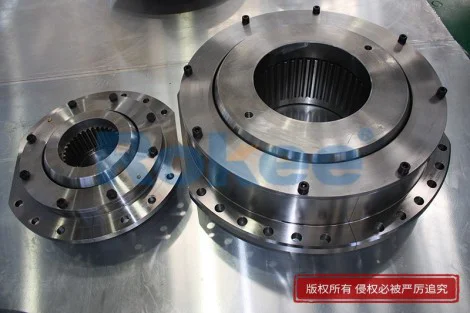
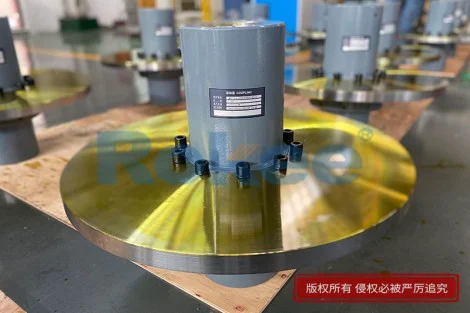
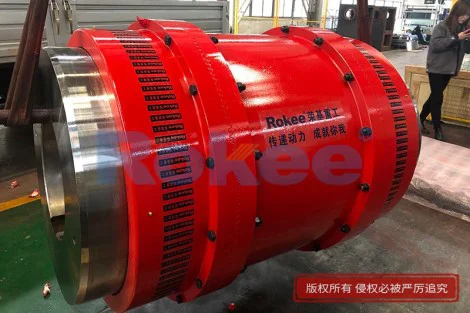
The structural composition of barrel coupling follows a rigorous and practical mechanical design logic, with every core component cooperating precisely to complete efficient and reliable torque transmission. The overall structure mainly includes a flanged outer sleeve, an inner toothed hub, multiple high-strength hardened steel barrel rollers and integrated sealing and limiting components. The inner wall of the outer sleeve is processed with uniform semicircular tooth grooves, and the outer surface of the matching inner hub is equipped with corresponding semicircular tooth structures, forming closed circular accommodating spaces after assembly. The cylindrical barrel rollers are evenly arranged in these spaces, serving as the key medium for connecting the outer sleeve and the inner hub. All core load-bearing parts are made of high-strength alloy materials and undergo professional heat treatment processes, which greatly enhance surface hardness and structural toughness. The two sides of the coupling are equipped with precision limiting and sealing structures, which can fix the axial position of the rollers to avoid displacement during high-speed operation, while effectively isolating external dust, moisture and industrial debris. This integrated structural design not only simplifies the overall assembly process but also lays a solid foundation for long-term stable operation and low failure rate of the coupling in complex industrial environments.
The working principle of barrel roller coupling is based on pure rolling friction transmission and flexible misalignment compensation, realizing efficient and stable power transmission between two rotating shafts. When the driving shaft starts to rotate, it drives the connected inner hub to rotate synchronously, and the semicircular tooth grooves on the hub push the embedded barrel rollers to roll along the tooth tracks of the outer sleeve. During the whole transmission process, the rollers maintain continuous rolling contact with the inner and outer tooth surfaces, realizing uniform transfer of torque and rotational speed. Different from gear couplings that produce sliding friction and impact meshing, the rolling contact mode of barrel rollers eliminates instantaneous stress concentration and friction loss caused by rigid meshing. When the driving shaft and driven shaft have coaxial deviation, angular deflection or axial displacement due to installation errors, equipment vibration or structural deformation, the barrel rollers can adaptively adjust their rolling track and contact angle in the tooth grooves. This flexible adaptive behavior can automatically compensate for various shaft misalignments, avoid additional bending stress and shear stress on the shaft system, and ensure that the power transmission process remains smooth and continuous without obvious jitter or torque fluctuation.
Barrel roller coupling possesses outstanding functional advantages that make it superior to many traditional transmission couplings in heavy-duty industrial scenarios. First of all, its rolling friction transmission mode greatly reduces mechanical wear and operating energy consumption. The hardened steel barrel rollers and precision-machined tooth surfaces have extremely low friction coefficients, which can effectively extend the service life of the coupling and reduce the power loss during torque transmission. Secondly, it has excellent comprehensive misalignment compensation capability, which can simultaneously adapt to radial, angular and axial displacements that are unavoidable in actual equipment operation, solving the common problems of shaft system jitter, component wear and transmission efficiency decline caused by shaft deviation. In addition, this coupling has strong impact load resistance. When the equipment starts, stops or bears sudden load changes, the rolling structure can buffer and absorb instantaneous impact force, avoid rigid impact damage to the shaft system and related transmission components. Moreover, its overall structural rigidity is high, with stable torque transmission performance, no obvious deformation or displacement under long-term high-load operation, and can maintain consistent transmission accuracy and stability for a long time in continuous industrial production.
The excellent environmental adaptability of barrel roller coupling enables it to operate stably in various harsh and complex industrial working conditions. In heavy production scenarios such as metallurgical processing, mining operation and port cargo handling, mechanical equipment often faces harsh environments including heavy dust, variable temperature, humid air and frequent alternating loads. Traditional flexible couplings are prone to aging, deformation and failure in such environments, while gear couplings are easy to wear and generate large operating noise. In contrast, the all-metal structural design of barrel roller coupling avoids the aging problem of flexible materials, and the integrated sealing structure can effectively block the invasion of external pollutants, ensuring that the internal rolling components always maintain a good operating state. It can adapt to long-term continuous operation under high-load, high-vibration and dust-intensive conditions, and can also maintain stable transmission performance in low-temperature or high-temperature working environments. In addition, the coupling has strong anti-fatigue ability, can withstand frequent start-stop cycles and alternating torque impact, and will not produce structural loosening or performance attenuation after long-term cyclic operation, which greatly reduces the risk of sudden shutdown and equipment failure in industrial production.
In terms of daily operation and maintenance, barrel roller coupling has significant practical advantages, which can effectively reduce the later operation cost and maintenance workload of mechanical equipment. Its simple and compact structural design makes the assembly and disassembly process extremely convenient, without complex debugging steps or special professional tools. During routine equipment inspection, staff can quickly check the operating state of the coupling’s internal rollers and tooth structures through simple disassembly, which greatly improves the efficiency of daily maintenance. The all-hardened metal components have ultra-high wear resistance and structural stability, with no need for frequent replacement of vulnerable parts. Under normal operating conditions, it only requires regular quantitative lubrication maintenance to keep the internal rolling state smooth, avoiding dry friction and abnormal wear. Compared with other types of couplings that need regular replacement of flexible parts and frequent precision calibration, it greatly reduces the frequency of equipment shutdown maintenance and the consumption of spare parts. At the same time, the coupling has low operating noise and small vibration during operation, which can effectively optimize the operating environment of mechanical equipment and reduce the noise pollution and vibration loss of the whole transmission system.
Barrel roller coupling has a wide range of industrial application values, covering almost all heavy-duty mechanical transmission fields that require high stability and high load resistance. It is commonly used in the transmission systems of lifting and handling equipment, serving as the core connecting component between reducers and winding drums, stably transmitting heavy lifting torque and ensuring the safety and smoothness of cargo lifting and handling operations. In metallurgical industrial equipment, it is applied to the transmission structure of rolling mills and conveying equipment, adapting to long-term high-load and continuous production operation. In mining and engineering machinery fields, it matches with various hoisting machinery and foundation engineering equipment, resisting complex impact loads and shaft displacements generated during mechanical operation. Besides, it also plays an important role in energy production, heavy manufacturing and port transportation equipment. Its reliable transmission performance and strong environmental adaptability can effectively improve the overall operating efficiency of mechanical equipment, reduce the failure rate of transmission systems, and provide stable and reliable technical support for the safe and efficient operation of various industrial mechanical systems.
With the continuous upgrading of modern industrial manufacturing technology and the increasing demand for high-precision and high-stability mechanical transmission, barrel roller coupling is constantly optimized and innovated in structural design and material technology. Modern optimized barrel roller coupling further improves the surface finish of tooth grooves and rollers through precision machining technology, making the rolling contact more uniform and smooth, and further reducing friction loss and operating noise. The application of new high-strength alloy materials enhances the structural toughness and wear resistance of the coupling, enabling it to bear larger torque loads and adapt to more extreme working conditions. At the same time, the optimized sealing and lubrication structure prolongs the lubrication cycle and further reduces maintenance costs. As industrial equipment develops towards large-scale, high-efficiency and long-cycle operation, barrel roller coupling, as a high-reliability heavy-duty transmission component, will have broader application prospects, and continue to provide stable and efficient transmission guarantees for the upgrading and development of various industrial mechanical equipment.