Flange Type Universal Joint Coupling

Flange type universal joint coupling is a pivotal flexible transmission component widely applied in modern mechanical transmission systems, integrating the structural advantages of flange connection and the motion compensation characteristics of universal joints. This mechanical device is designed to transmit rotational torque and motion stably between two misaligned shafts, effectively adapting to angular deflection, minor axial displacement and parallel offset generated during equipment operation. Different from conventional rigid couplings that lack displacement compensation capability and ordinary universal joints with unstable connection, it adopts integrated flange structures at both ends, which greatly enhances connection rigidity and overall structural stability. It can maintain efficient and continuous power transmission under complex operating conditions such as variable loads and frequent startup and shutdown. With excellent vibration buffering performance and strong load-bearing capacity, it effectively reduces mechanical operation friction and structural stress, lowers component wear and failure risks, and extends the service life of supporting mechanical equipment, making it a core transmission part for various heavy-duty and precision mechanical systems.
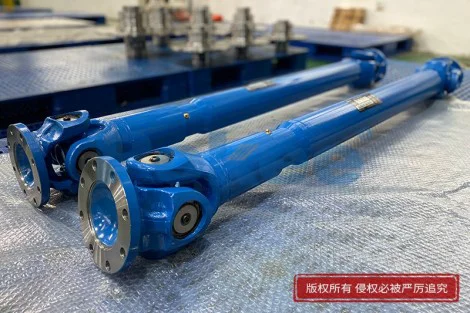
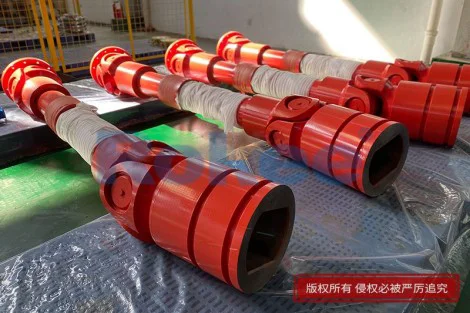
The basic structural composition of flange type universal joint coupling is sophisticated and reasonable, with each component undertaking independent and coordinated transmission functions to ensure overall stable operation. The core structure consists of two symmetric flange yokes, a central cross shaft assembly and precision bearing components. The flange yokes at both ends are the connecting bases of the coupling, featuring flat and rigid flange surfaces with reserved bolt holes for firm connection with shaft end equipment, avoiding connection looseness during high-speed rotation. The cross shaft, as the key force transmission and flexible adjustment component, connects the two flange yokes vertically, forming a movable hinge structure that supports multi-directional angular rotation. Each journal of the cross shaft is equipped with high-precision rolling bearings, which reduce sliding friction during relative motion and ensure flexible and smooth rotation of the joint. Some optimized structures are equipped with integrated sealing and dustproof components, which can isolate external dust, moisture and abrasive particles, prevent bearing abrasion and lubricant deterioration, and effectively adapt to harsh industrial operating environments while maintaining the structural integrity of the coupling for long-term stable operation.
The working principle of flange type universal joint coupling is based on the geometric motion law of cross shaft hinge transmission and flexible displacement compensation. In the operating state, the driving shaft drives the connected flange yoke to rotate synchronously, and the torque is transmitted to the cross shaft through the bearing assembly. The cross shaft converts the unidirectional rotational motion of the driving end into flexible multi-angle rotational motion, and further transmits the torque to the driven end flange yoke and the connected driven shaft. When the driving shaft and driven shaft produce angular deviation or tiny displacement due to equipment vibration, installation errors or operational deformation, the cross shaft hinge structure can automatically adjust the motion angle to compensate for shaft misalignment, avoiding rigid stress concentration caused by inconsistent shaft centerlines. Although a single universal joint structure has slight angular velocity fluctuation during operation, the double-joint matching design commonly adopted in practical applications can offset velocity differences, realize approximate constant-speed torque transmission, ensure the stability of mechanical operation, and avoid jitter, noise and power loss caused by uneven transmission.
Flange type universal joint coupling possesses prominent performance advantages that make it superior to many traditional transmission coupling products in industrial application scenarios. First of all, it has outstanding displacement compensation ability, which can simultaneously adapt to angular, axial and parallel misalignment of the connected shafts, solving the transmission failure problem caused by installation deviation and equipment operational deformation. Secondly, the flange connection structure provides extremely high connection rigidity and torsional resistance, enabling the coupling to bear large instantaneous torque and heavy continuous load without deformation or looseness. In terms of operational stability, the precision bearing matching structure reduces mechanical friction and rotational resistance, realizing low-noise and low-vibration operation. In addition, the overall structural design is compact and reasonable, with strong environmental adaptability, capable of normal operation in high-temperature, dusty and high-load working environments. It also features convenient assembly and disassembly, simple daily maintenance, no complex debugging procedures after installation, and low later operation and maintenance costs, which greatly improves the operational efficiency of mechanical systems.
This type of universal joint coupling covers a wide range of industrial application scenarios, mainly serving heavy-duty transmission equipment and mechanical systems requiring high stability and high torque transmission. In metallurgical machinery, it is applied to rolling mill transmission systems to bear continuous heavy load and frequent variable load operation, ensuring stable power output of rolling equipment. In engineering machinery, it is used in the transmission structures of large cranes, excavators and bulldozers, adapting to the vibration and displacement changes generated during equipment walking and working. In addition, it is also widely used in mining machinery, chemical transmission equipment, port handling machinery and large fan and pump transmission systems. For mechanical equipment with long-term continuous operation, complex working conditions and high requirements for transmission stability, the coupling can effectively optimize the transmission state, reduce equipment failure rate, and provide reliable power transmission guarantee for the normal operation of industrial production lines.
Material selection and manufacturing process determine the core service performance and durability of flange type universal joint coupling. High-strength alloy steel is mostly selected as the main raw material for the overall structure, which has excellent tensile strength, torsional resistance and impact resistance, and can resist structural fatigue and deformation under long-term high-load operation. The key components such as cross shaft and bearing journals undergo precision forging and heat treatment processes to improve surface hardness and structural toughness, avoiding wear and fracture failure under frequent alternating load. The flange surface is processed by precision milling and grinding to ensure flatness and assembly accuracy, so that the connection surface fits tightly and the force is uniform during operation. The bearing components adopt high-precision wear-resistant materials, with good lubricity and wear resistance, which can maintain stable rotation for a long time. Strict dimensional inspection and dynamic balance calibration are carried out after product processing to eliminate rotational imbalance, ensure no jitter during high-speed operation, and further improve the overall operational accuracy and service life of the coupling.
Reasonable installation and standardized daily maintenance are crucial to giving full play to the performance of flange type universal joint coupling and prolonging its service life. During installation, it is necessary to ensure that the coaxiality of the driving and driven shafts is within a reasonable range, avoid excessive installation deviation exceeding the compensation range of the coupling, and fasten the flange connecting bolts evenly to prevent local stress concentration caused by uneven fastening force. After installation, a no-load test run should be carried out first to check for abnormal noise, vibration and jitter, and formal load operation can be carried out after confirming stable operation. In daily maintenance, regular inspection of bolt fastening state is required to prevent looseness caused by long-term vibration. It is also necessary to check the lubrication state of internal bearings and hinge structures regularly, replenish or replace lubricants in time to avoid dry friction and component wear. Meanwhile, clean the dust and sundries on the surface and sealing parts regularly to keep the internal transmission structure clean, prevent sealing failure and component corrosion, and ensure the coupling maintains stable and efficient transmission performance for a long time.
With the continuous upgrading of modern industrial mechanical equipment towards high efficiency, high load and high precision, the technical optimization and application prospects of flange type universal joint coupling are becoming increasingly broad. At present, the industry is continuously optimizing its structural design, developing lightweight and high-strength integrated structures to reduce self-weight while improving load-bearing capacity, and further improving transmission efficiency. The optimization of sealing and lubrication systems enables the coupling to adapt to more extreme working environments such as low temperature and high humidity. In terms of application expansion, with the rapid development of new energy equipment, intelligent mechanical equipment and large-scale automated production lines, the demand for high-stability and high-compensation transmission components is increasing, which provides a broad market space for flange type universal joint coupling. In the future, with the progress of material technology and precision manufacturing technology, its comprehensive performance will be further improved, and it will play a more important role in more industrial transmission fields.