Telescopic Cardan Driveshaft

Telescopic cardan driveshaft is a core mechanical transmission component that integrates universal joint deflection compensation and telescopic axial adjustment functions, widely applied in industrial transmission, mechanical engineering and mobile equipment systems. Unlike conventional fixed-length transmission shafts with single structural performance, this specialized driveshaft can simultaneously adapt to angular deviation and axial displacement between connected power components during operation, ensuring stable and continuous torque and power transmission under dynamic working conditions. Its unique composite structural design effectively solves common mechanical problems such as transmission jamming, structural vibration and component wear caused by equipment position deviation, thermal deformation and mechanical operation displacement. With high structural flexibility, strong operational stability and excellent environmental adaptability, it has become an indispensable key part of modern flexible mechanical transmission systems, providing reliable power connection guarantees for various complex and variable mechanical operating scenarios.
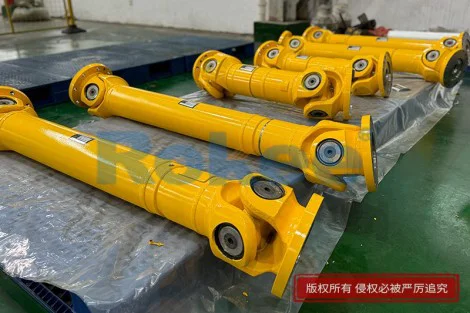
The overall structural composition of telescopic cardan driveshaft presents a modular integrated design, with multiple functional components cooperating closely to realize dual compensation and power transmission functions. The main structural parts include universal joint assemblies, telescopic spline mechanisms, shaft body pipelines and end connection structures, each undertaking independent core tasks while forming a coordinated operating system. The universal joint assembly, serving as the angular compensation core, is composed of cross shafts, bearing cups and fork-shaped yokes, which can flexibly adjust the transmission angle to adapt to non-coaxial power connection states. The telescopic spline mechanism consists of mutually matched inner and outer spline shafts with precise machining gaps, enabling free sliding and length adjustment along the axial direction. The integral shaft body adopts high-strength alloy materials with optimized forging and heat treatment processes to ensure structural rigidity and torsion resistance. The end connection structures with diverse adaptive forms can fit different mechanical connection interfaces, realizing stable assembly and reliable power input and output for the whole driveshaft.
The working principle of telescopic cardan driveshaft is based on the dual coordination of angular kinematic compensation and axial displacement adjustment, realizing uninterrupted power transmission under dynamic offset conditions. In the actual operation of mechanical equipment, the relative position of power driving end and driven end often changes due to equipment vibration, structural deformation and working stroke adjustment. The universal joint structure can generate flexible angular deflection through the rotation of cross shafts and bearings, offsetting the angle error between the two sets of transmission shafts and avoiding torque loss and transmission failure caused by rigid connection. Meanwhile, the inner and outer spline pairs of the telescopic mechanism slide relatively along the axis in real time, automatically compensating the axial distance change between equipment components. This linkage working mode enables the driveshaft to always maintain a tight and stable connection state during equipment operation, ensuring that torque can be efficiently and accurately transmitted without being affected by small-amplitude position changes of mechanical parts.
The outstanding performance advantages of telescopic cardan driveshaft make it superior to traditional fixed transmission shafts in complex working environments. First of all, it has ultra-strong adaptive capacity, which can cope with dual offset interference of angle and axis simultaneously, breaking through the application limitation of single compensation of ordinary transmission parts. Secondly, the spline sliding structure with precise matching design has low friction resistance and smooth telescopic operation, which will not produce mechanical stuck or impact vibration during length adjustment, effectively reducing equipment operation noise and vibration amplitude. In addition, the integral structure has good fatigue resistance and impact resistance, and can maintain stable transmission performance under long-term high-load operation and frequent dynamic adjustment. Its flexible structural design also reduces the assembly precision requirement of mechanical equipment, lowers the installation difficulty and later maintenance cost, and significantly improves the overall operational reliability and service life of the mechanical transmission system.
The material selection and manufacturing process of telescopic cardan driveshaft directly determine its service performance and service life, and all links follow high-precision mechanical processing standards. The main shaft body and spline parts are mostly made of high-strength alloy materials with excellent torsion resistance, wear resistance and thermal stability, which can resist structural deformation and material fatigue under high torque and high-speed operation. The universal joint bearing components adopt precision bearing materials with high smoothness and low wear characteristics, ensuring flexible rotation and long-term stable operation of the joint parts. In the processing stage, advanced precision broaching, grinding and forging processes are adopted for spline structures to ensure the matching accuracy of inner and outer shafts and eliminate transmission gaps. After processing, the whole parts will undergo strict heat treatment and surface strengthening treatment to improve surface hardness and corrosion resistance, so that the driveshaft can adapt to harsh working conditions such as high temperature, dust and humid environment.
Telescopic cardan driveshaft has a wide range of application scenarios, covering multiple fields of industrial machinery and mobile mechanical equipment. In industrial production equipment, it is applied to automated production lines, transmission machinery and processing equipment, adapting to the position deviation and stroke change of mechanical parts in continuous production. In engineering machinery and mobile equipment, it serves power transmission systems that need frequent position adjustment and angle change, and can effectively cope with the vibration and displacement generated during equipment operation. In transportation and logistics machinery, it provides stable power connection for transmission equipment with variable operating distances, ensuring the continuity and stability of material transmission. In addition, it is also widely used in agricultural machinery, environmental protection equipment and special mechanical systems, realizing efficient power transmission for various flexible connection working conditions, and its versatile performance makes it a universal transmission component in the mechanical industry.
Daily maintenance and fault prevention are crucial to maintain the long-term stable operation of telescopic cardan driveshaft, and standardized maintenance can effectively extend its service life and reduce failure rates. In the daily operation process, regular inspection of the telescopic spline matching state and universal joint flexibility is required to check for abnormal jamming, loose rotation and abnormal noise. It is necessary to regularly fill professional lubricating grease into the spline sliding parts and bearing moving parts to reduce friction and wear between mechanical structures and avoid dry friction damage caused by lack of lubrication. At the same time, keep the surface of the driveshaft clean to prevent dust, impurities and corrosive substances from adhering to the spline and joint parts, so as to avoid structural abrasion and corrosion failure. During equipment startup and operation, avoid sudden overload and violent impact, reduce the instantaneous torque impact on the driveshaft, and prevent structural fatigue damage and component deformation caused by long-term overload operation.
With the continuous upgrading of modern mechanical equipment towards high efficiency, precision and intelligence, the technical development of telescopic cardan driveshaft is also constantly optimized and innovated. The current development trend focuses on structural lightweight and high precision optimization, adopting new high-strength and light-weight materials to reduce the self-weight of the driveshaft while ensuring structural strength, so as to improve the dynamic response efficiency of mechanical transmission. The precision matching design of telescopic structures is further upgraded to reduce transmission gaps and improve the accuracy and stability of power transmission. In addition, the integration of wear-resistant, corrosion-resistant and self-lubricating new technologies effectively enhances the environmental adaptability and service cycle of the product. In the future, with the continuous progress of mechanical manufacturing technology, telescopic cardan driveshaft will realize more intelligent adaptive adjustment performance, adapt to more complex and diversified mechanical working conditions, and provide more efficient and reliable support for the upgrading and development of modern mechanical transmission systems.