Combination of Universal Shaft Coupling and PUF Sandwich Panel Production Line Transmission Scheme Optimization
In the modern manufacturing industry, the production efficiency and product quality of PUF (Polyurethane Foam) sandwich panels are directly determined by the stability and efficiency of the transmission system. As a key mechanical component in power transmission, the universal shaft coupling plays an irreplaceable role in solving the problems of shaft misalignment, angular deviation and unstable torque transmission in the production line. With the continuous improvement of industrial automation level and the increasing demand for high-precision, high-efficiency and low-energy-consumption production equipment, the traditional transmission scheme of PUF sandwich panel production line has gradually exposed some defects, such as poor adaptability to complex working conditions, high energy consumption in transmission process, easy wear of components and low synchronization of each production link. Therefore, optimizing the transmission scheme by combining universal shaft coupling with the characteristics of PUF sandwich panel production line has become an important way to improve the overall performance of the production line, reduce production costs and enhance market competitiveness.
PUF sandwich panels have been widely used in construction, cold storage, logistics and other fields due to their excellent thermal insulation, sound insulation, light weight and structural stability. The production line of PUF sandwich panels is a complex integrated system involving multiple processes, including uncoiling of facing materials, roll forming, preheating, PUF foaming, lamination, curing and cutting. Each process link needs precise and stable power transmission to ensure the consistency of product specifications and performance. The transmission system of the production line is responsible for transmitting the power of the motor to each executive component, such as uncoilers, roll forming machines, foaming machines and cutting machines, which requires the transmission components to have good torque transmission capacity, angle compensation capacity and running stability. In the traditional transmission scheme, ordinary rigid couplings or elastic couplings are often used, which have strict requirements on the coaxiality of the driving shaft and the driven shaft. However, due to the limitations of the overall layout of the production line, the installation errors of equipment and the thermal expansion and vibration during long-term operation, the shafts of each component are often misaligned, resulting in increased transmission resistance, uneven torque transmission, increased noise and vibration, accelerated wear of components, and even affect the normal operation of the production line in severe cases. These problems not only reduce the production efficiency and product quality, but also increase the maintenance cost and service life of the equipment.
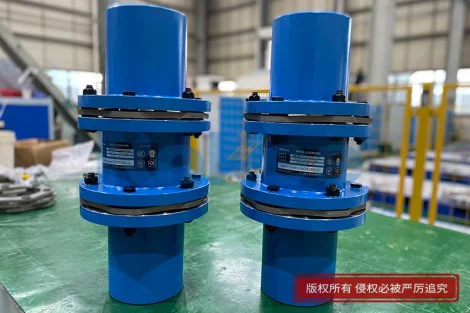
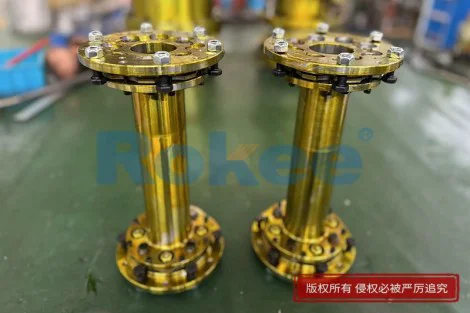
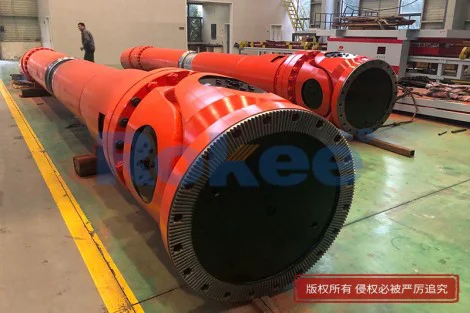
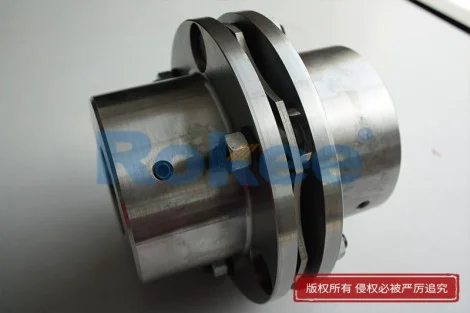
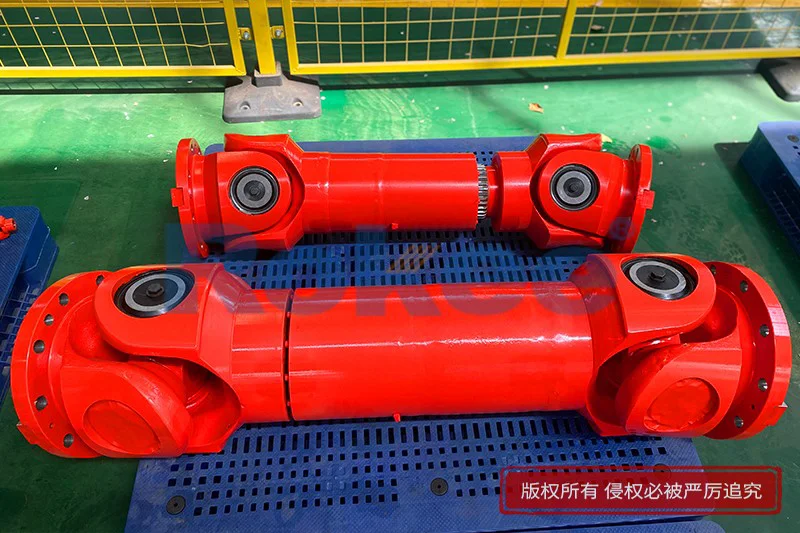
The universal shaft coupling, as a kind of flexible transmission component, has the prominent advantage of being able to realize reliable power transmission when the two connected shafts are not on the same axis and there is an angular deviation. Its working principle is based on the theory of spatial linkage mechanism. Taking the commonly used cross-axis universal shaft coupling as an example, it uses a special structure composed of cross shaft, bearings and fork head components to convert the rotational motion of the input shaft into the swing motion of the cross shaft, and then transmit the swing motion to the output shaft, so as to realize the transmission of torque. When there is an angle between the two shafts, the cross shaft will continuously adjust its angle with the rotation, ensuring the continuous transmission of power. In addition, the universal shaft coupling can also compensate for the axial displacement and radial displacement between the shafts to a certain extent, which is particularly suitable for the complex working conditions of PUF sandwich panel production lines. From the perspective of material selection, universal shaft couplings are usually made of high-quality alloy steels, which have high strength, wear resistance and fatigue life after appropriate heat treatment, and can adapt to the high-load and long-term continuous operation requirements of PUF sandwich panel production lines. Compared with ordinary couplings, the universal shaft coupling has better adaptability, higher transmission efficiency and more stable operation performance, which provides a reliable technical support for the optimization of the transmission scheme of PUF sandwich panel production lines.
The optimization of the transmission scheme of PUF sandwich panel production line based on universal shaft coupling is not a simple replacement of components, but needs to combine the structural characteristics of the production line, the working requirements of each process and the performance parameters of the universal shaft coupling to carry out a comprehensive and systematic design. First of all, it is necessary to conduct a detailed investigation and analysis of the existing transmission system, find out the key problems affecting the transmission efficiency and stability, such as the position of shaft misalignment, the range of angular deviation, the size of transmission torque and the frequency of load fluctuation. On this basis, select the appropriate type and specification of universal shaft coupling. According to the different working conditions of each process link of the production line, different types of universal shaft couplings can be selected. For example, in the roll forming and cutting links with high requirements on transmission precision and stability, double-joint universal shaft couplings can be used to eliminate the speed fluctuation caused by single universal shaft coupling, ensure the synchronization of the driving shaft and the driven shaft, and improve the transmission precision. In the uncoiling and conveying links with large load and large angular deviation, heavy-duty universal shaft couplings can be selected to meet the requirements of high torque transmission and large angle compensation. At the same time, the structural parameters of the universal shaft coupling, such as the length of the shaft, the diameter of the cross shaft and the type of bearing, need to be matched with the power parameters of the motor and the load requirements of the executive components to ensure that the universal shaft coupling can play its best performance in the transmission process.
In the process of optimizing the transmission scheme, it is also necessary to consider the coordination between the universal shaft coupling and other components of the transmission system, such as motors, reducers and bearings. The reasonable matching of these components can effectively improve the overall transmission efficiency and reduce energy consumption. For example, the selection of motors should be combined with the transmission efficiency of the universal shaft coupling and the load characteristics of the production line to avoid the phenomenon of large horse-drawn small carts, which leads to energy waste. The reducer should be selected according to the transmission ratio requirements and the torque transmission capacity of the universal shaft coupling to ensure that the power transmitted to the executive components meets the working requirements. In addition, the installation and debugging of the universal shaft coupling is also an important link affecting the transmission effect. During installation, it is necessary to accurately adjust the position and angle of the universal shaft coupling to minimize the initial misalignment between the shafts. At the same time, appropriate lubricating oil should be selected according to the working conditions to reduce the friction between the components of the universal shaft coupling, reduce wear and extend the service life. Regular maintenance and inspection of the universal shaft coupling during operation, such as checking the wear of bearings, the tightness of fasteners and the amount of lubricating oil, can timely find and solve potential problems, ensuring the long-term stable operation of the transmission system.
The optimization of the transmission scheme by combining the universal shaft coupling with the PUF sandwich panel production line can bring multiple benefits to the production line. In terms of production efficiency, the use of universal shaft coupling can effectively reduce the transmission resistance, improve the synchronization of each production link, avoid the shutdown caused by transmission failure, and thus improve the continuous operation capacity of the production line. For example, in the foaming and lamination links, the stable transmission of the universal shaft coupling can ensure the uniform distribution of PUF foam and the close bonding of the facing materials and the foam core, reduce the product defect rate, and improve the production efficiency. In terms of energy consumption, the universal shaft coupling has high transmission efficiency, which can reduce the energy loss in the power transmission process. Compared with the traditional transmission scheme, the optimized transmission scheme can reduce energy consumption by 8% - 15%, which has significant energy-saving effects. In terms of equipment maintenance, the universal shaft coupling has strong wear resistance and long service life, and the maintenance cycle is longer than that of ordinary couplings, which can reduce the maintenance frequency and maintenance cost of the equipment. At the same time, the universal shaft coupling has good adaptability to the working environment, can adapt to the high temperature, dust and other harsh working conditions in the PUF sandwich panel production line, and reduce the failure rate of the transmission system.
In practical application, the effect of the optimized transmission scheme needs to be verified through actual operation and data analysis. By installing sensors on the transmission system, the parameters such as transmission torque, speed, vibration and noise are collected in real time, and the operation status of the transmission system is monitored and analyzed. Through comparison with the traditional transmission scheme, the improvement effect of the optimized scheme in terms of transmission efficiency, stability and energy consumption is evaluated. At the same time, according to the actual operation situation, the parameters of the transmission scheme are continuously adjusted and optimized to make it more suitable for the working requirements of the PUF sandwich panel production line. For example, in a PUF sandwich panel production line, after adopting the universal shaft coupling transmission scheme, the transmission efficiency of the production line is increased by 12%, the product defect rate is reduced by 10%, the energy consumption per unit product is reduced by 11%, and the maintenance cost is reduced by 18%, which fully reflects the superiority of the optimized transmission scheme. In addition, with the development of intelligent manufacturing technology, the transmission system of PUF sandwich panel production line can be combined with intelligent monitoring and control technology to realize real-time monitoring and fault early warning of the universal shaft coupling and other transmission components, further improving the reliability and intelligence level of the transmission system.
It should be noted that the optimization of the transmission scheme of PUF sandwich panel production line based on universal shaft coupling also needs to consider some potential problems. For example, the selection of universal shaft coupling needs to be combined with the actual working conditions of the production line, and blind selection should be avoided, otherwise it may not only fail to achieve the optimization effect, but also increase the production cost. In addition, the installation and debugging of the universal shaft coupling requires professional technical personnel to operate to ensure the installation accuracy and debugging effect. At the same time, during the long-term operation of the production line, the universal shaft coupling will have certain wear and tear, which needs to be regularly maintained and replaced to avoid affecting the normal operation of the transmission system. In addition, with the continuous upgrading of PUF sandwich panel production technology and the increasing demand for product quality, the transmission scheme also needs to be continuously improved and optimized to adapt to the new production requirements.
In the context of the continuous development of industrialization and automation, the optimization of the transmission scheme of PUF sandwich panel production line is an important direction to improve the competitiveness of enterprises. The universal shaft coupling, with its unique structural advantages and excellent transmission performance, provides an effective way for the optimization of the transmission scheme. By reasonably selecting and applying the universal shaft coupling, optimizing the matching relationship between each component of the transmission system, and strengthening the installation, maintenance and management of the transmission system, the overall performance of the PUF sandwich panel production line can be significantly improved, the production efficiency and product quality can be enhanced, the production cost can be reduced, and the sustainable development of enterprises can be promoted. In the future, with the continuous progress of material science and mechanical manufacturing technology, the performance of the universal shaft coupling will be further improved, and its application in the PUF sandwich panel production line will be more extensive and in-depth. At the same time, the combination of intelligent technology and transmission system will bring more possibilities for the optimization of the transmission scheme, making the PUF sandwich panel production line develop towards a more efficient, stable, energy-saving and intelligent direction.
Another important aspect of the transmission scheme optimization is the integration of the universal shaft coupling with the control system of the production line. The modern PUF sandwich panel production line is usually equipped with an automatic control system to realize the precise control of each process link. By integrating the operation parameters of the universal shaft coupling into the control system, the real-time monitoring and adjustment of the transmission process can be realized. For example, when the torque or speed of the transmission system deviates from the set value, the control system can automatically adjust the output power of the motor or the position of the universal shaft coupling to ensure the stability of the transmission system. This integration not only improves the automation level of the production line, but also reduces the manual intervention, and further improves the reliability and stability of the transmission system. In addition, the data collected by the control system can be used for statistical analysis and fault diagnosis, which provides a basis for the further optimization of the transmission scheme and the maintenance of the equipment.
The material selection of the universal shaft coupling also has an important impact on the optimization effect of the transmission scheme. In the PUF sandwich panel production line, the transmission components are often in a working environment with high load, high temperature and more dust, so the universal shaft coupling needs to have good wear resistance, high temperature resistance and corrosion resistance. At present, with the advancement of material science, new materials such as high-strength stainless steel and special alloys have been widely used in the manufacture of universal shaft couplings, which further improve the performance of the universal shaft coupling. For example, the universal shaft coupling made of high-strength stainless steel has better corrosion resistance and wear resistance, which can adapt to the harsh working environment of the PUF sandwich panel production line and extend the service life of the component. In addition, the application of new materials also reduces the weight of the universal shaft coupling, reduces the inertia during operation, and improves the transmission efficiency and response speed of the transmission system.
In the process of optimizing the transmission scheme, it is also necessary to consider the adaptability of the production line to different product specifications. The PUF sandwich panels of different specifications have different requirements on the transmission speed, torque and precision of the production line. The universal shaft coupling has good flexibility and adjustability, which can adapt to the production requirements of different specifications of PUF sandwich panels by adjusting its structural parameters or selecting different types of universal shaft couplings. For example, when producing PUF sandwich panels with larger thickness, the load of the transmission system increases, and the heavy-duty universal shaft coupling can be selected to meet the torque transmission requirements; when producing PUF sandwich panels with higher precision, the double-joint universal shaft coupling can be used to improve the transmission precision. This adaptability not only improves the flexibility of the production line, but also reduces the cost of equipment transformation when the product specifications are changed, which is conducive to the diversification of enterprise products.
To sum up, the combination of universal shaft coupling and PUF sandwich panel production line is an effective way to optimize the transmission scheme. By selecting the appropriate type and specification of universal shaft coupling, optimizing the matching relationship between each component of the transmission system, strengthening the installation, maintenance and management of the transmission system, and integrating with the intelligent control system, the transmission efficiency and stability of the PUF sandwich panel production line can be significantly improved, the energy consumption and maintenance cost can be reduced, and the product quality and production efficiency can be enhanced. In the future, with the continuous progress of technology, the optimization of the transmission scheme will be more intelligent and refined, which will provide a stronger guarantee for the development of the PUF sandwich panel manufacturing industry. Enterprises should pay attention to the application and optimization of the transmission scheme, continuously improve the technical level of the production line, and enhance their core competitiveness in the market.