Industrial Tire Coupling

Industrial tire couplings are essential flexible mechanical components widely utilized in modern mechanical transmission systems, serving as a critical link between driving and driven shafts across diverse industrial equipment. Engineered with a distinctive rubber tire elastic core paired with precision-machined metal hubs, these couplings primarily function to transmit rotational torque while effectively addressing common operational challenges in mechanical operation, including shaft misalignment, mechanical vibration, and sudden impact loads. What distinguishes tire couplings from other flexible coupling types is their superior multi-directional displacement compensation capability and outstanding vibration damping performance, enabling them to adapt to complex and fluctuating working conditions stably. Their simple structural composition, installation convenience, and maintenance-free operational characteristics further enhance their practical value, making them a preferred transmission solution for heavy-duty, high-vibration, and frequent start-stop mechanical scenarios in general industrial manufacturing fields.
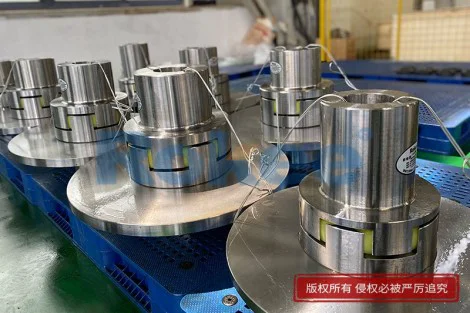
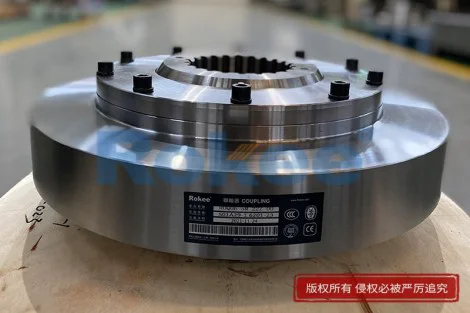
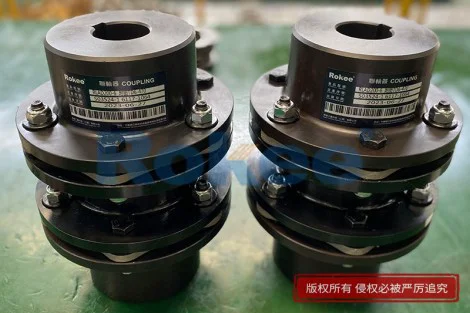
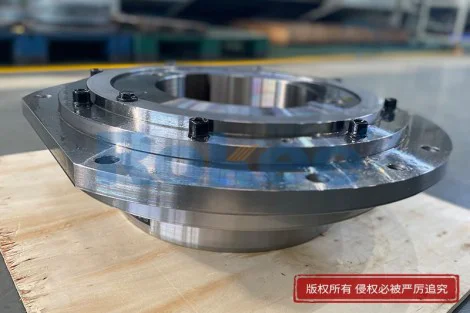
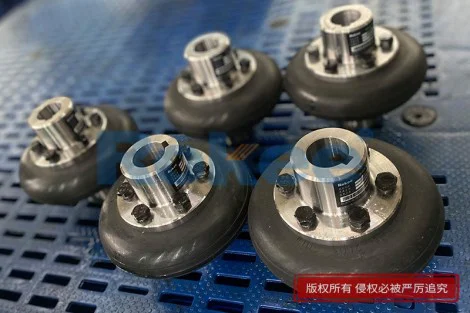
The structural design of industrial tire couplings is ingenious and streamlined, consisting of three core components: two symmetrical metal hubs and a reinforced rubber tire elastic element, with no complex internal transmission accessories. The metal hubs are manufactured through precise machining processes, featuring smooth shaft connection holes and standardized bolt holes to ensure tight and stable assembly with equipment shafts. The core rubber tire element adopts high-elasticity polymer rubber materials, embedded with multi-layer fiber reinforcement structures inside, which greatly improves the overall tensile strength and deformation resistance of the tire body while retaining excellent elastic flexibility. During assembly, the rubber tire element is firmly clamped and fixed between the two metal hubs via high-strength bolts, forming an integrated flexible transmission structure. This bolted assembly method not only ensures reliable torque transmission during equipment operation but also allows for quick disassembly and replacement of the rubber tire element when needed. Compared with integrated coupling structures, this split design effectively reduces later replacement costs and operation downtime, adapting to the frequent maintenance needs of continuous industrial production equipment.
The working principle of industrial tire couplings centers on the elastic deformation characteristics of rubber materials to realize efficient and stable mechanical torque transmission and operational buffering. In the working state, torque generated by the driving equipment is transmitted to the driving-side metal hub, and then transferred to the rubber tire element through the fixed bolt connection. The rubber tire body undergoes mild shear and compression elastic deformation under the action of torque, and further transmits the power to the driven-side metal hub, thereby driving the connected mechanical equipment to operate synchronously. When the connected shafts produce angular deflection, parallel offset or axial displacement due to equipment installation errors, mechanical wear or operational vibration, the flexible rubber tire can adaptively deform in multiple directions to compensate for these misalignments. This flexible compensation mode avoids rigid friction and extrusion between shafts and transmission components, fundamentally eliminating the additional mechanical stress caused by shaft misalignment. Meanwhile, the rubber material can effectively absorb and consume the vibration energy and impact force generated during equipment start-up, shutdown and load fluctuation, realizing smooth power transmission and stabilizing the overall operation state of the mechanical system.
Industrial tire couplings possess unparalleled performance advantages in vibration damping and shock absorption, which become their core competitive strengths in industrial transmission applications. In the actual operation of industrial equipment, frequent load changes, uneven operation of power components and external environmental interference will produce continuous mechanical vibration and instantaneous impact loads. These adverse factors not only affect the operating accuracy of equipment but also easily cause fatigue wear of bearings, gears and other precision parts, shortening the service life of the entire mechanical system. The high-elastic rubber tire element of tire couplings has excellent energy absorption and damping properties, which can quickly attenuate high-frequency vibration generated during operation and buffer instantaneous impact loads at the moment of equipment start-stop and load switching. Unlike rigid couplings that completely transmit vibration and impact, and other flexible couplings with limited damping effect, tire couplings can isolate most vibration and impact energy between driving and driven ends. This excellent damping performance effectively protects key mechanical components, reduces equipment failure rates, and greatly extends the service cycle of the entire transmission system.
Multi-dimensional misalignment compensation capability is another key functional feature of industrial tire couplings, enabling them to adapt to complex and changeable industrial installation and operation environments. In the on-site installation of mechanical equipment, it is difficult to achieve absolute coaxiality of two connecting shafts due to manual operation errors, equipment foundation settlement and structural assembly deviations. Long-term operation of equipment will also lead to gradual shaft displacement and deflection due to component wear and vibration. Most traditional couplings can only compensate for a single type of misalignment with a small compensation range, which is prone to local stress concentration and accelerated component aging when facing composite misalignment. In contrast, industrial tire couplings can simultaneously and effectively compensate for angular misalignment, parallel radial misalignment and axial displacement of shafts. The large elastic deformation space of the rubber tire body allows it to adapt to composite displacement changes in multiple directions without generating additional transmission resistance and mechanical stress. This powerful adaptive capability greatly reduces the installation accuracy requirements of equipment, lowers the difficulty of on-site debugging, and ensures long-term stable operation of equipment under slight shaft displacement conditions.
Industrial tire couplings have extremely wide application scenarios, covering most conventional and heavy-duty mechanical transmission fields in industrial production. They are widely applied in conveying equipment such as belt conveyors and screw conveyors, which often face unstable load and continuous vibration during long-distance material transportation. The damping and compensation performance of tire couplings can effectively adapt to the fluctuating operating state of conveying equipment and ensure stable material transmission. In pumping and fan equipment used in chemical, environmental protection and building materials industries, frequent start-stop operation and fluid impact will cause severe equipment vibration, and tire couplings can well buffer these adverse effects and protect the motor and pump body structure. In addition, they are also commonly used in mining machinery, metallurgical equipment, food processing machinery and general mechanical transmission devices. Whether it is continuous stable operation under normal load or intermittent operation under heavy load and impact conditions, tire couplings can maintain reliable transmission performance, showing strong environmental adaptability and working condition compatibility.
In terms of daily operation and maintenance, industrial tire couplings have obvious economic and practical advantages, meeting the efficient and low-consumption operation needs of modern industrial production. The all-rubber flexible transmission structure requires no lubrication and regular oil supplement maintenance, completely avoiding the oil leakage pollution and lubricant replacement costs existing in gear couplings and chain couplings. The overall structure has no easily worn rigid friction parts, and the fiber-reinforced rubber tire body has strong wear resistance and aging resistance, ensuring long-term stable operation under normal working conditions. Daily maintenance work only requires regular visual inspection of the rubber tire surface to check for obvious cracks, aging deformation or bolt loosening, with extremely low maintenance difficulty and time cost. When the rubber tire element reaches the service life and needs to be replaced, the split structural design allows operators to complete disassembly and replacement quickly without disassembling the entire equipment transmission system, greatly reducing equipment shutdown time and improving production efficiency. This low-maintenance and easy-to-replace feature makes tire couplings very suitable for large-scale continuous production lines that pursue high operational efficiency.
With the continuous upgrading of industrial mechanical equipment towards high efficiency, high stability and low energy consumption, the application value and development potential of industrial tire couplings are constantly highlighted. Modern industrial production puts forward higher requirements for the stability, noise reduction and service life of mechanical transmission systems, and the excellent vibration damping, misalignment compensation and impact resistance of tire couplings can perfectly match these development trends. With the continuous innovation of rubber material modification technology, the high-temperature resistance, oil resistance and aging resistance of tire coupling rubber elements are constantly improved, enabling them to adapt to more harsh working environments such as high temperature, humidity and corrosive gas. In the future industrial transmission field, tire couplings will further replace traditional rigid and single-function flexible couplings, becoming one of the mainstream basic components of mechanical transmission systems, and providing reliable basic support for the stable and efficient operation of various industrial mechanical equipment.