National Standard Couplings

Barrel Couplings
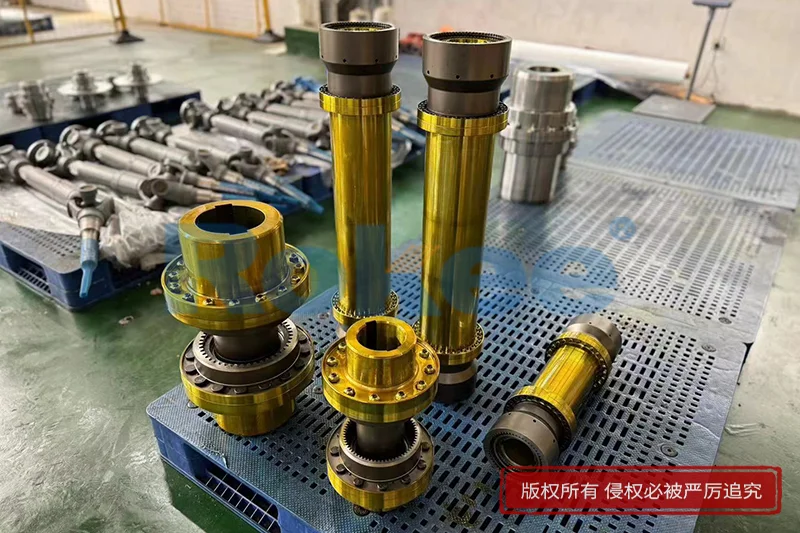
Drum coupling is a key component in industrial power transmission systems, designed to connect the reducer’s power input shaft with the drum, enabling stable torque transmission while limiting the drum’s axial movement. It features a rigid-flexible structure, mainly composed of an inner gear ring and a flange half-coupling with outer teeth, where the outer teeth are processed into a spherical drum shape, a design that distinguishes it from traditional straight-tooth couplings. This unique drum-shaped tooth structure allows it to compensate for radial, axial, and angular displacements between two shafts, effectively offsetting installation errors, beam bending, and bearing wear that may occur during operation. Compared with straight-tooth couplings, it has a 15-20% higher load-bearing capacity and can withstand larger radial loads, making it suitable for harsh industrial environments. Barrel Coupling is widely used in cranes, conveying systems, metallurgy, mining, and other fields, especially in drum drives of various heavy machinery. Its compact structure, small turning radius, and high transmission efficiency (up to 99.7%) ensure long-term stable operation, while the trumpet-shaped tooth end of the outer gear sleeve facilitates easy installation and disassembly. Proper lubrication and sealing can further reduce tooth wear and extend its service life, making it an essential part for ensuring the efficiency and reliability of industrial transmission systems.

Tyre Couplings
A tire coupling is a type of flexible coupling widely used in industrial power transmission systems, designed to connect two rotating shafts while accommodating misalignments and dampening vibrations. It consists of a tire-shaped elastomeric element bonded to metal hubs through vulcanization, which are then connected to the driving and driven shafts via bolts. This unique structure enables it to transmit torque efficiently while absorbing shocks and compensating for axial, radial, and angular displacements between shafts. The elastomeric tire element, typically made of high-quality rubber or polyurethane blends, provides excellent damping performance, reducing the impact of sudden load changes and operational vibrations on connected machinery. This not only protects the shafts and bearings from excessive wear but also enhances the overall stability and lifespan of the entire transmission system. Tyre couplings are easy to install and maintain, requiring no lubrication, which simplifies operational procedures and reduces maintenance costs. They are suitable for a wide range of harsh industrial environments, including mining, metallurgy, construction, and chemical industries, where equipment often operates under dusty, wet, or high-vibration conditions. Their ability to handle frequent starts, stops, and reverse rotations makes them a reliable choice for various mechanical equipment, ensuring smooth and continuous operation even in demanding working scenarios.